Introduction
The importance of establishing operational boundaries
Introducing the concept of "scope"
Scope 1: Direct greenhouse gas emissions
Scope 2: Indirect greenhouse gas emissions from electricity
Scope 3: Other indirect greenhouse gas emissions
Inventorying and reporting on emission scopes
Scope 1: Direct greenhouse gas emissions
Scope 2: Indirect greenhouse gas emissions from electricity
Scope 3: Other indirect greenhouse gas emissions
Conclusion
Distinguishing Direct and Indirect Emissions
Introduction
To manage greenhouse gases effectively, businesses need to establish operational boundaries comprehensively, including both direct and indirect emissions. This helps businesses not only better manage the greenhouse gas risks and opportunities across the value chain, but also establishes a foundation for transparent and accurate greenhouse gas reporting. This article will help you better understand the difference between direct and indirect emissions, so you can build an effective greenhouse gas inventory and reporting strategy.
The importance of establishing operational boundaries
After a business has determined its scope of ownership or control, the company will need to establish its operational boundaries, including:
- Identifying the emissions associated with the business's activities
- Classifying direct and indirect emission sources
- Selecting the inventory scope
- Reporting indirect emissions
To manage greenhouse gases effectively, establishing comprehensive operational boundaries for both direct and indirect emissions will help a company better manage the greenhouse gas risks and opportunities that exist throughout its value chain.
Direct greenhouse gas emissions are emissions from sources that are owned or controlled by the company.
Indirect greenhouse gas emissions are emissions that are a consequence of the company's activities but occur at sources owned or controlled by another company. What is classified as direct and indirect emissions depends on the consolidation approach (equity share or control) chosen to establish the organizational boundaries.
The diagram below shows the relationship between a company's organizational boundaries and operational boundaries.
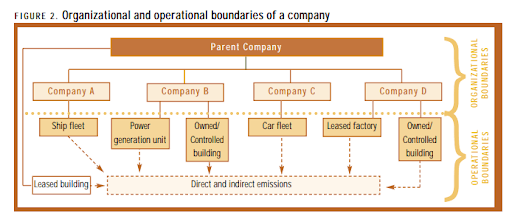
Figure 1: Diagram of a company's organizational boundaries and operational boundaries
Introducing the concept of "scope"
To help delineate direct and indirect emission sources, enhance transparency, and provide utility for different types of organizations as well as different types of climate policies and business goals, three "scopes" (Scope 1, Scope 2, and Scope 3) are defined for greenhouse gas inventory and reporting purposes.
Scope 1 and 2 are defined in this article to ensure that two or more companies will not account for the same emissions within the same scope. This helps eliminate the possibility of double counting. At a minimum, companies must classify, inventory, and report Scope 1 and 2.
Scope 1: Direct greenhouse gas emissions
Direct greenhouse gas emissions occur from sources owned or controlled by the company, for example: emissions from combustion in boilers, furnaces, and vehicles owned or controlled by the company; emissions from chemical production in process equipment owned or controlled by the company.
Direct CO2 emissions from biomass combustion are not included in Scope 1 but must be reported separately.
Greenhouse gas emissions not covered by the Kyoto Protocol, such as CFCs, NOx, etc., are not included in Scope 1 but may be reported separately.
Scope 2: Indirect greenhouse gas emissions from electricity
Scope 2 includes greenhouse gas emissions from the generation of purchased electricity consumed by the company. Purchased electricity is all electricity that the company uses but does not generate on-site itself. The greenhouse gas emissions associated with the electricity your company uses are actually released at the supplier's power plant, not at your company's office or factory. However, under greenhouse gas reporting regulations, your company is still responsible for these emissions (Scope 2 emissions) because your company is the consumer of that electricity, and therefore indirectly causes these emissions.
Scope 3: Other indirect greenhouse gas emissions
Scope 3 is an optional reporting category that accounts for all other indirect emissions. Scope 3 emissions are a consequence of the company's activities, but occur from sources not owned or controlled by the company. Some examples of Scope 3 activities are the extraction and production of purchased materials; transportation of purchased fuels; and the use of sold products and services.
Operational boundaries determine which activities belong to direct emissions and which belong to indirect emissions within the organizational boundaries the business has established. The operational boundaries (Scope 1, Scope 2, Scope 3) are decided at the company level after the organizational boundaries have been established.
Once the operational boundaries have been selected, they will be applied consistently to clearly identify and classify direct and indirect emissions at each level of activity (see example below). The established organizational boundaries and operational boundaries together form a company's inventory boundary.
Example of Organizational Boundaries & Operational Boundaries
Company X is a parent company with full ownership and financial control over operations A and B, but it holds only a 30% non-operating interest with no financial control over operation C.
Establishing Organizational Boundaries: Company X will decide whether to account for greenhouse gas emissions based on equity share or financial control. If the choice is equity share, Company X will include operations A and B, as well as 30% of the emissions from operation C. If the chosen approach is financial control, Company X will only count the emissions from operations A and B as relevant and to be consolidated. Once this decision is made, the organizational boundaries have been determined.
Establishing Operational Boundaries: After the organizational boundaries are established, Company X then needs to decide, based on its business objectives, whether to account for only Scope 1 and Scope 2, or to include the relevant Scope 3 categories for its operations.
For operations A, B, and C (if the equity share approach is chosen), greenhouse gas emissions will be accounted for within the scopes Company X has selected, meaning managers apply the company's policy in establishing its operational boundaries.
Inventorying and reporting on emission scopes
Companies inventory and report Scope 1 and 2 emissions separately. Companies may further subdivide emissions data within the scopes to increase transparency or to facilitate comparison over time. For example, they may subdivide the data by business unit/facility, country, source type (stationary combustion, process, fugitive, etc.), and activity type (electricity generation, electricity consumption, generation or purchase of electricity for sale to end users, etc.).
These three scopes together provide a comprehensive inventory framework for managing and reducing direct and indirect emissions. Figure 3 provides an overview of the relationship between the scopes and the activities that generate direct and indirect emissions along the value chain of a company.
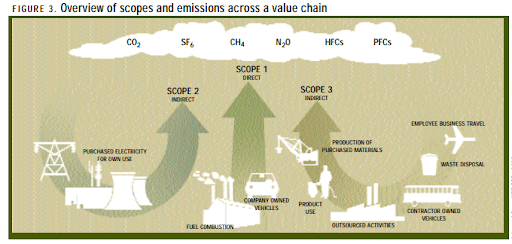
Figure 2: Overview of scopes and emissions across the value chain
Companies can improve operational efficiency throughout their entire value chain, thereby gaining more benefits. Even in the absence of regulations or incentive policies, measuring and tracking greenhouse gas emissions across the value chain also helps businesses identify opportunities to increase efficiency and save costs.
For example, using fly ash as a clinker substitute (clinker is an indispensable raw material component for producing cement - the binding agent used in construction) in cement production helps reduce downstream emissions from the treatment of waste fly ash, and upstream emissions from clinker production). Even when such "win-win" options are not available, reducing indirect emissions can still be more cost-effective than reducing Scope 1 emissions.
Therefore, inventorying indirect emissions can help identify where to allocate limited resources in a way that optimizes greenhouse gas emission reductions and return on investment.
Scope 1: Direct greenhouse gas emissions
Companies report greenhouse gas emissions from sources that the business owns or controls as Scope 1. Direct greenhouse gas emissions are primarily the result of the following types of activities carried out by the company:
- Generation of electricity, heat, or steam. These emissions result from the combustion of fuels in stationary sources, such as boilers, furnaces, and turbines.
- Physical or chemical processing. Most of these emissions result from the manufacturing or processing of chemicals and materials, such as the production of cement, aluminum, adipic acid, ammonia, and waste treatment.
- Transportation of materials, products, waste, and employees. These emissions result from the combustion of fuels in mobile combustion sources owned/controlled by the company (e.g., trucks, trains, ships, airplanes, buses, and cars).
- Fugitive emissions. These emissions result from intentional or unintentional releases, such as equipment leaks from joints, seals, packing, and gaskets; methane emissions from coal mines and venting; hydrofluorocarbon (HFC) emissions during the use of refrigeration and air conditioning equipment; and methane leaks from gas transport.
Selling electricity generated by the company itself
Emissions associated with the sale of self-generated electricity to another company are not deducted/offset from Scope 1. This treatment of sold electricity should be consistent with how other sold greenhouse-gas-intensive products are inventoried, for example: emissions from the production of clinker sold by a cement company or the production of scrap steel by an iron and steel company are not deducted from their Scope 1 emissions. Emissions associated with the sale/transfer of self-generated electricity may be reported in the optional information section.
Scope 2: Indirect greenhouse gas emissions from electricity
Companies report emissions from the generation of purchased electricity consumed in equipment or operations owned or controlled by the business as Scope 2.
Scope 2 emissions are a special type of indirect emissions. For many companies, purchased electricity is one of the largest sources of greenhouse gas emissions and the most important opportunity to reduce these emissions. Inventorying Scope 2 emissions allows companies to assess the risks and opportunities associated with changing electricity costs and greenhouse gas emission costs. Another important reason for companies to track these emissions is that this information may be required for certain greenhouse gas programs.
Companies can reduce electricity use by investing in energy-efficient and energy-conservation technologies. In addition, emerging green energy markets offer opportunities for some companies to switch to lower-emission electricity sources.
Companies can also install an efficient on-site cogeneration plant (cogeneration technology, also known as Cogeneration, is a system that simultaneously produces two useful forms of energy - Heat and Electricity), especially if it replaces the purchase of higher-emission-intensity electricity from the grid or an electricity supplier. Reporting Scope 2 emissions allows for a transparent inventory of greenhouse gas emissions and of emission reduction activities and opportunities.
Indirect emissions associated with electricity transmission and distribution
Utility companies often purchase electricity from independent power producers or from the grid and resell it to end consumers through the transmission and distribution (T&D) system. A portion of the electricity that the utility company purchases is lost (T&D losses) during transmission and distribution to end consumers (Figure 3).
Consistent with the definition of Scope 2, emissions from the generation of purchased electricity that is lost during transmission and distribution are reported under Scope 2 by the company that owns or controls the T&D operation. End consumers of the purchased electricity do not report the indirect emissions associated with T&D losses under Scope 2 because they do not own or control the T&D operation where the electricity is lost (T&D losses).
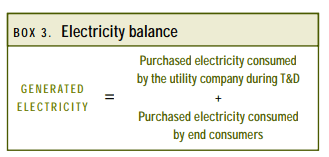
Figure 3: Electricity balance
This approach ensures there is no double counting in Scope 2 because only the T&D utility company will inventory the indirect emissions associated with T&D losses under Scope 2.
Another advantage of this approach is that it simplifies the reporting of Scope 2 emissions by allowing the use of commonly available emission factors that in most cases do not include T&D losses.
However, end consumers may report the indirect emissions associated with their T&D losses under Scope 3 in the category "generation of electricity consumed in a T&D system."
Other types of indirect emissions associated with electricity
Indirect emissions from the upstream activities of the company's electricity supplier (e.g., exploration, drilling, flaring, transport) are reported under Scope 3.
Emissions from the generation of purchased electricity for resale to end consumers are reported under Scope 3 in the category "generation of purchased electricity that is then resold to end consumers."
Emissions from the generation of purchased electricity for resale to parties other than end consumers (e.g., electricity traders) may be reported separately from Scope 3 in the "optional information" section.
The following two examples illustrate how to inventory greenhouse gas emissions from the generation, sale, and purchase of electricity.
Example 01:
- Company A (Independent Power Producer): Generates 100 MWh of electricity and emits 20 tonnes of emissions per year. Company A reports the direct emissions from this electricity generation under Scope 1.
- Company B (Electricity Trader): Purchases 100 MWh of electricity from Company A and resells all of it to Company C (a utility company). Company B reports the emissions from electricity purchased and sold to a party other than an end consumer (Company C) as optional information, separate from Scope 3.
- Company C (Utility Company): Purchases 100 MWh of electricity from Company B. Company C consumes 5 MWh of electricity in its transmission and distribution (T&D) system and sells the remaining 95 MWh to Company D.
- Company C reports the indirect emissions from the generation of the portion of purchased electricity sold to end consumers (95 MWh to Company D) under Scope 3.
- Company C reports the indirect emissions from the generation of the portion of purchased electricity that the company consumes in its T&D system (5 MWh) under Scope 2.
- Company D (End Consumer): Purchases 95 MWh of electricity from Company C and consumes it in its operations. Company D reports the indirect emissions associated with the consumption of purchased electricity under Scope 2 and may optionally report the emissions associated with upstream T&D losses under Scope 3.
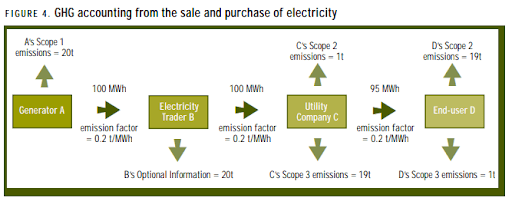
Figure 4: Example of greenhouse gas inventory from the purchase and sale of electricity
Example 02:
Company D (which has now installed a cogeneration unit): Reports all direct emissions from the cogeneration unit under Scope 1. Sells surplus electricity to Company E. Company D reports the indirect emissions from the generation of electricity for export to Company E as optional information, separate from Scope 3.
Company E (a neighboring company): Purchases electricity from Company D's cogeneration unit. Company E reports the indirect emissions associated with the consumption of this purchased electricity under Scope 2.
Scope 3: Other indirect greenhouse gas emissions
Scope 3 is optional, but it offers an opportunity for transformation in greenhouse gas management. Companies may want to focus on inventorying and reporting activities that are relevant to their business and objectives, and for which they have reliable information.
Because companies have the discretion to choose which categories to report, Scope 3 may not be suitable for comparison between companies. This section provides an indicative list of Scope 3 categories and includes case studies of some categories.
Some of the activities below would be included in Scope 1 if the associated emission sources are owned or controlled by the company (e.g., if the transportation of products is carried out by vehicles owned or controlled by the company). To determine whether an activity belongs to Scope 1 or Scope 3, the company should refer to the chosen consolidation approach (equity share or control) used when establishing its organizational boundaries.
- Extraction and production of purchased materials and fuels.
- Transportation-related activities
- Transportation of purchased materials or goods
- Transportation of purchased fuels
- Employee business travel
- Employee commuting to and from work
- Transportation of sold products
- Transportation of waste
- Electricity-related activities not included in Scope 2
- Extraction, production, and transportation of fuels consumed in the generation of electricity (whether purchased electricity or electricity self-generated by the reporting company)
- Purchase of electricity for sale to end consumers (reported by the utility company)
- Generation of electricity that is lost in a T&D system (reported by the end consumer)
- Leased assets, franchises, and outsourced activities — emissions from such contractual arrangements are classified as Scope 3 only if the chosen consolidation approach (equity share or control) does not apply to these activities. The company's accountant should be consulted for clarification on the classification of leased assets.
- Use of sold products and services
- Waste treatment:
- Disposal of waste generated during operations
- Disposal of waste generated during the production of purchased materials and fuels
- Treatment of sold products at the end of their life cycle
Accounting for Scope 3 emissions
Inventorying Scope 3 emissions does not necessarily require a full and detailed greenhouse gas life-cycle analysis for all products and activities. Typically, focusing on one or two major greenhouse-gas-generating activities is more valuable. Although it is difficult to provide general guidance on which Scope 3 emissions should be included in an inventory, some general steps can be outlined as follows:
- Describe the value chain.
- Determine which Scope 3 categories are relevant.
- Identify partners along the value chain.
- Quantify Scope 3 emissions
Conclusion
To manage greenhouse gases effectively and innovatively, companies need to establish operational boundaries comprehensively, including both direct and indirect emissions. Inventorying indirect emissions plays an important role in identifying opportunities to reduce greenhouse gases and optimize resource allocation.
Instead of focusing only on direct emission sources from their own operations, considering indirect emission sources in the value chain helps businesses gain a more comprehensive view of their environmental impact. This not only supports the development of more effective emission reduction strategies but can also bring economic benefits to the business. For example, seeking solutions to reduce Scope 3 emissions (indirect emissions) can drive collaboration with suppliers to improve production processes or find lower-emission alternative materials.
These efforts not only contribute to protecting the environment but can also help businesses optimize costs and improve operational efficiency. Establishing operational boundaries comprehensively and fully inventorying both direct and indirect emissions is crucial for businesses to manage greenhouse gases in an innovative, effective, and sustainable manner.