1. How the list is distributed
2. Checking the list: a technical hurdle to know about upfront
3. If you are on the list: what to submit, to whom, and by when
4. Three things to do right now
5. Points we have not verified
6. Conclusion
References
Decision 42/2026/QD-TTg: 2,441 Facilities Must Conduct a GHG Inventory
On 10 August 2026, the Prime Minister issued Decision No. 42/2026/QD-TTg on the List of sectors and greenhouse gas-emitting facilities required to conduct a greenhouse gas (GHG) inventory (updated). The Decision takes effect from 25 September 2026 and replaces Decision No. 13/2024/QD-TTg dated 13 August 2024.
The new list includes 2,441 facilities.
For a manufacturer, the questions worth asking right now are very specific: is our facility on the list, and if so, what must we submit, to whom, and by when? This article answers those three questions and is also clear about the points we have not yet been able to verify ourselves.
Is your company required to conduct a GHG inventory?
Free check in about 20 seconds based on your industry and energy consumption — no sign-up required.
Check now →1. How the list is distributed
The 2,441 facilities are distributed by managing ministry as follows:
| Managing ministry | Number of facilities | Share |
|---|---|---|
| Industry and Trade | 1,916 | 78.5% |
| Construction | 411 | 16.8% |
| Agriculture and Environment | 61 | 2.5% |
| Transport | 53 | 2.2% |
| Total | 2,441 | 100% |
Two different breakdowns appear in the same document and should not be confused. The four ministries above reflect the breakdown by the authority managing the facility list. In parallel, the Decision also sets out a list of sectors subject to inventory according to the classification of the Framework Convention, comprising six sectors: energy, transport, construction, industrial processes, agriculture and forestry, and waste. The "six sectors" figure reported in the press refers to this second breakdown and does not contradict the table above.
The most notable point is that nearly 79% of facilities fall under the Ministry of Industry and Trade. This is first and foremost a regulation about factories. If your company has production lines, boilers, kilns or high industrial electricity consumption, the likelihood of being on the list is higher than you might think.
A note on the figures in circulation. The earlier draft proposed 2,705 facilities, corresponding to roughly 539 facilities added to the previous list. The official figure issued is 2,441. If the document you are reading says 2,705, it is the draft, not the version in force.
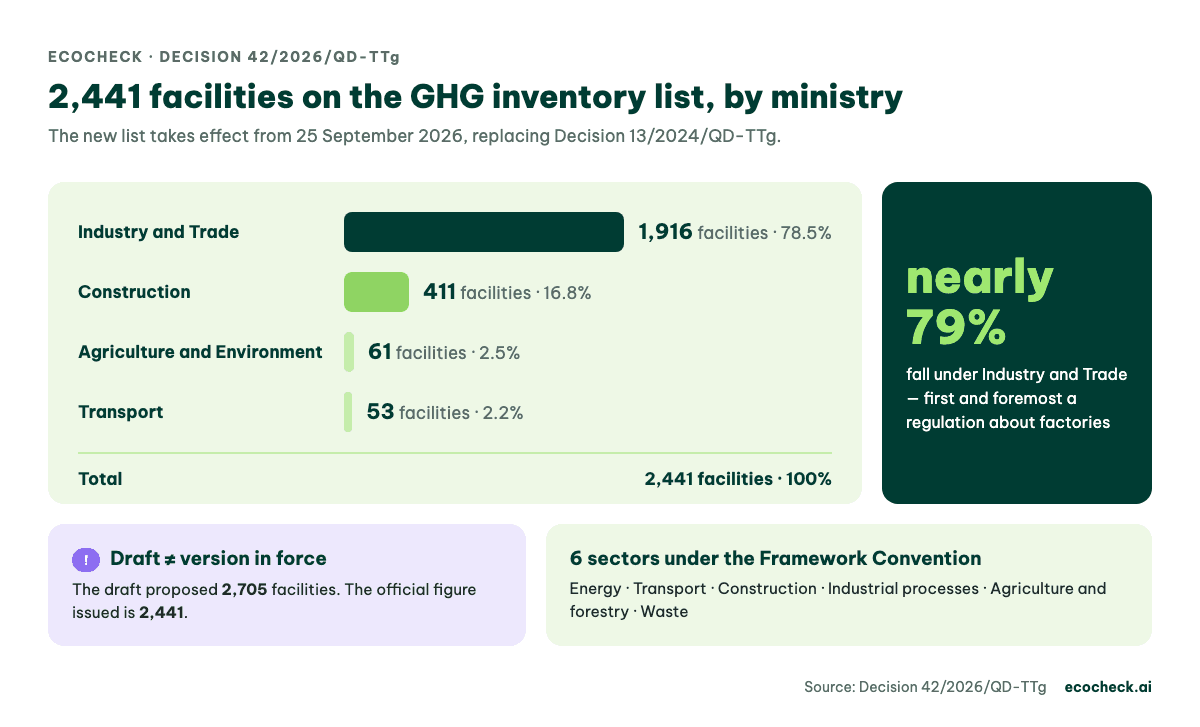
Figure 1: Chart of the 2,441 facilities required to conduct a GHG inventory by managing ministry: Industry and Trade 1,916 (78.5%), Construction 411, Agriculture and Environment 61, Transport 53
2. Checking the list: a technical hurdle to know about upfront
At the time we checked, the appendix listing the facilities attached to the Decision was published as a scanned document without a text layer. This means you cannot open the file and use Ctrl+F to search for a company name. You have to go through it page by page by eye, or run OCR and cross-check the results yourself.
Practical consequences:
- Single-facility companies can check for themselves, but it takes time and there is still a risk of missing an entry when the legal entity name in the document differs from the trade name in use.
- Companies with multiple legal entities and multiple sites will find it very hard to check manually in a reliable way.
- OCR on scanned Vietnamese text with diacritics often gets proper names and place names wrong, so the results must be reviewed rather than used directly.
Two lookup principles we recommend:
Search by the full legal entity name as shown on the enterprise registration certificate, not by brand name.
Search by individual production site, because the list is compiled by facility, not by company. A company with three plants may well have only one plant on the list.
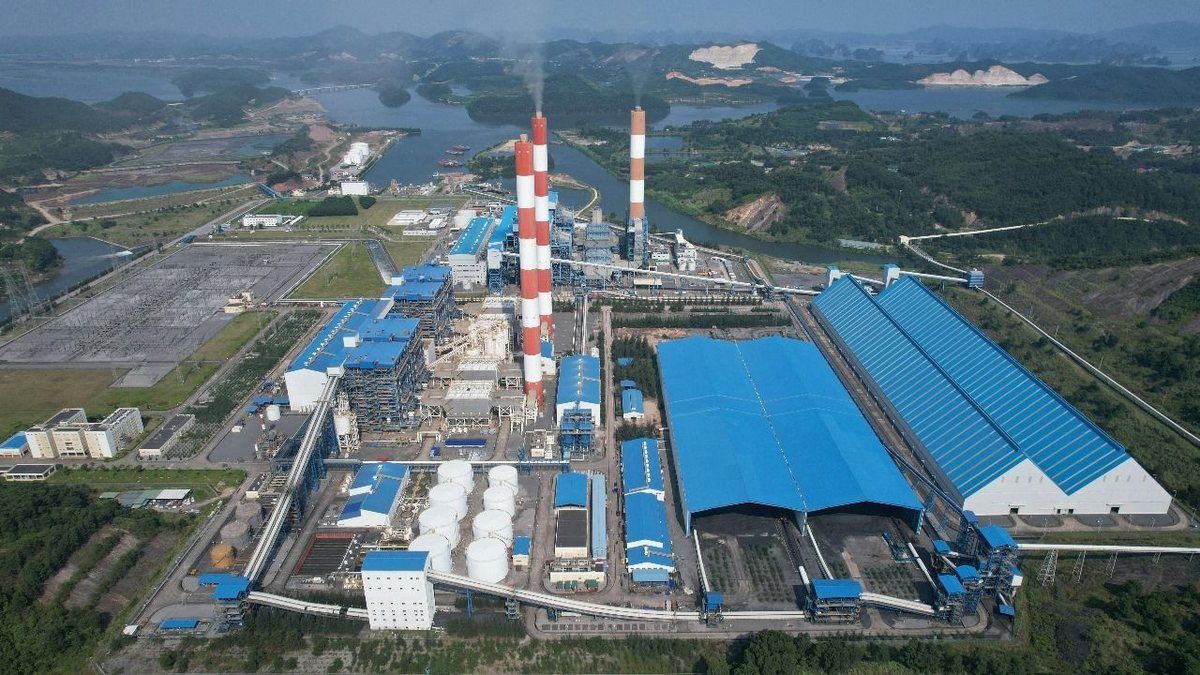
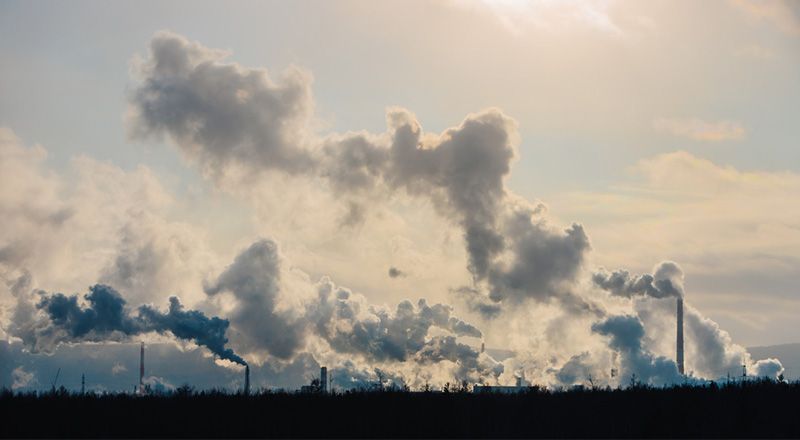
Aerial view of a large industrial plant required to conduct a GHG inventory
3. If you are on the list: what to submit, to whom, and by when
Decision 42 determines who must conduct an inventory. What must be done is set out in Decree 06/2022/ND-CP, as amended and supplemented by Decree 119/2025/ND-CP and Decree 83/2026/ND-CP. Companies should read the consolidated version rather than the original Decree 06 on its own.
Under Article 11 of Decree 06/2022/ND-CP (as amended):
- Listed facilities conduct a facility-level GHG inventory and prepare a report every two years, applicable from 2024 onwards.
- Reports are submitted to the provincial People's Committee, with a deadline before 31 March, starting from 2025.
- Each report includes the inventory results for the two years immediately preceding the reporting year.
These three points lead to a consequence that many companies have not noticed: the next submission is due before 31 March 2027, and that report must contain data for both 2025 and 2026.
Note on the 110 facilities with emission allowances (thermal power, steel, cement): they do not file the inventory report with the provincial People's Committee by 31 March. Instead they send a verified inventory report to the Ministry of Agriculture and Environment before 1 December each year, starting in 2027 (Article 11, Decree 06/2022/ND-CP as amended by Decree 119/2025/ND-CP). The annual mitigation report is still due by 31 March.
In other words, the data needed for the next reporting cycle is not data to be collected in the future. Most of it has already been generated. 2025 is over, and 2026 is nearing the end of its third quarter. If electricity bills, fuel consumption logs and refrigerant charging records for those two years have not been stored systematically, recovering them will be much harder and more expensive than recording them properly from the start.
For facilities newly added to the list under Decision 42, companies should confirm with the line ministry and the relevant provincial department exactly how the first submission cycle applies, as this depends on when the facility was added to the list.
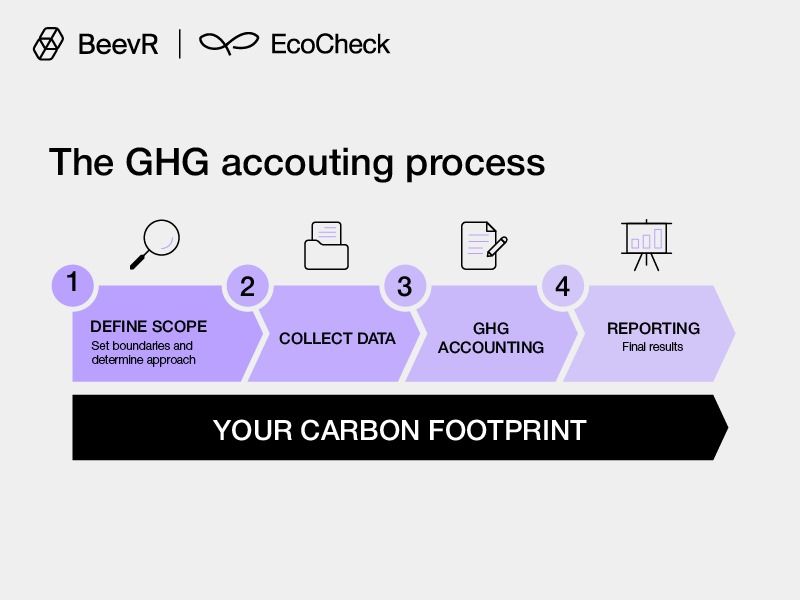
Technically, facility-level inventories are usually carried out under ISO 14064-1 or the GHG Protocol Corporate Standard, covering three scopes:
- Scope 1, direct emissions from sources owned or controlled by the facility: boilers, kilns, backup generators, in-house vehicle fleets, refrigerant leakage.
- Scope 2, indirect emissions from purchased energy, mainly grid electricity.
- Scope 3, other indirect emissions in the value chain: purchased raw materials, outsourced transport, waste treatment, business travel.
For most manufacturing facilities in Vietnam, Scope 2 accounts for a large share and is also the easiest to collect, since the data is on electricity bills. Scope 1 is harder because it requires fuel consumption data by equipment. Scope 3 is the most labour-intensive and also the part most often left unfinished.
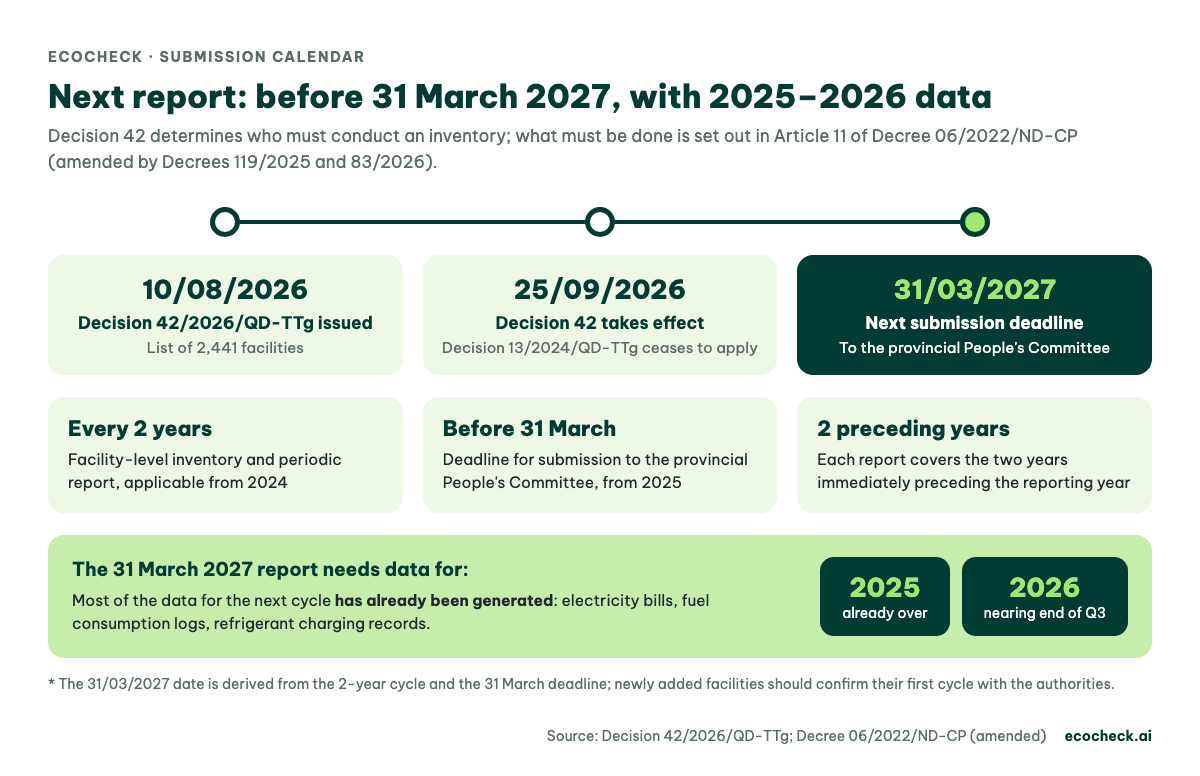
Figure 2: Timeline for Decision 42/2026: issued 10 August 2026, effective 25 September 2026, next GHG inventory report due before 31 March 2027 covering 2025 and 2026 data
4. Three things to do right now
First, determine the legal status of each facility, not of the company. Record the lookup results together with the date of the search and the page number in the document, so you have evidence if you need to provide clarification later.
Second, inventory your data sources before inventorying emissions, and go back to 2025. Before discussing emission factors, answer these questions: where are the electricity bills from January 2025 to date, who holds them, and in what format? Are DO oil, coal and LPG consumption logs recorded by equipment or only as totals? Are records of air-conditioning gas and refrigerant top-ups kept? In our implementation experience, most of the time in an inventory cycle is spent tracking down this data, not on the calculations.
Third, appoint a named person in charge. A GHG inventory cuts across engineering, procurement, administration and finance. Without someone clearly assigned, the work will stall at the boundaries between departments. This is a far more common cause of missed deadlines than technical difficulties.
5. Points we have not verified
A responsible article on legal compliance should be clear about its own limitations.
- The emission thresholds used as the basis for including facilities in the list. We have not yet completed a cross-check against the latest consolidated version of Decree 06/2022/ND-CP, so we do not cite specific figures. Note that a company's obligation arises from being named in the list, not from the company's own calculation showing it exceeds a threshold. Many threshold figures circulating online are taken from older documents.
- The first submission cycle for newly added facilities. The 31 March 2027 deadline is derived from the two-year cycle and the 31 March deadline set out in Article 11 of the amended Decree 06/2022/ND-CP. How this applies to each newly listed facility should be confirmed with the authorities.
- The status of the appendix file. Our observation that it is a scanned document without a text layer reflects the situation at the time of writing. The issuing authority may republish it in a different format.
6. Conclusion
Decision 42 does not create any new technical obligations. The inventory framework has existed since Decree 06/2022/ND-CP. What Decision 42 does is move 2,441 facilities from the voluntary category to the mandatory category, and attach specific names to that obligation.
The gap between companies that finish in a few weeks and those that take several months has almost nothing to do with knowledge of greenhouse gases. It comes down to whether energy consumption data for the past two years has been properly stored.
References
- Decision No. 42/2026/QD-TTg dated 10 August 2026 of the Prime Minister, Government Electronic Information Portal
- Decree No. 06/2022/ND-CP, as amended and supplemented by Decree No. 119/2025/ND-CP and Decree No. 83/2026/ND-CP
- Decision No. 13/2024/QD-TTg dated 13 August 2024 (no longer in force from 25 September 2026)
EcoCheck is a GHG inventory and emissions data management platform aligned with ISO 14064-1, developed by BeevR. Companies that need to check the list or review their data readiness for the next reporting cycle can contact us.




![Top 5 Công Cụ Tính Toán Phát Thải Khí Nhà Kính [Cập Nhật 2026]](https://cms.ecocheck.ai/uploads/Eco_Check_Top_5_cong_cu_va_phan_mem_ho_tro_kiem_ke_khi_nha_kinh_d9d03bf693.png)
![Phương pháp Kiểm kê Khí nhà kính: GHG Protocol & ISO 14064 [2026]](https://cms.ecocheck.ai/uploads/Cac_phuong_phap_va_tieu_chuan_kiem_ke_khi_nha_kinh_pho_bien_e645f7df80.png)