Common Greenhouse Gas Inventory Methods
Emission Factor-Based Method
Direct Measurement Method
Life Cycle Modeling
Combined Method
Bottom-up Method
Top-down Method
Greenhouse Gas Inventory Standards Businesses Should Know
GHG Protocol
ISO 14064
Comparison Between the GHG Protocol and ISO 14064
National Standards (Vietnam):
Choosing the Right Greenhouse Gas Inventory Method and Standard for Your Business
Common Greenhouse Gas Inventory Methods and Standards
As climate change becomes increasingly severe, the greenhouse gas (GHG) inventory has become a mandatory requirement for businesses and organizations worldwide. To carry out an inventory accurately and effectively, international methods and standards have been developed and widely applied. Below are some of the most common methods and standards in use today.
Common Greenhouse Gas Inventory Methods
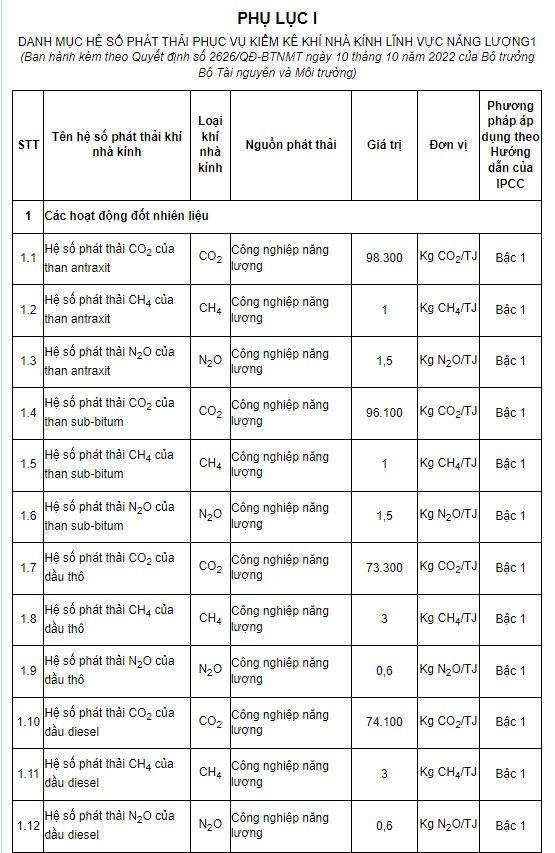
Emission Factor-Based Method
- How it works:
- Uses average emission factors (for example, the amount of CO2 emitted per unit of fuel consumed) to estimate greenhouse gas emissions from specific activities.
- Emission factors are usually provided by government agencies or international organizations.
- Advantages:
- Simple, easy to implement, and inexpensive.
- Suitable for organizations with limited resources or those just beginning to conduct greenhouse gas inventories.
- Disadvantages:
- Accuracy depends on the quality and relevance of the emission factors.
- Cannot reflect differences in performance between different organizations or technologies.
Direct Measurement Method
- How it works:
- Uses measurement devices to directly measure greenhouse gas emissions from specific sources (for example, chimneys, ventilation systems).
- Advantages:
- Provides accurate and reliable data.
- Suitable for large and easily accessible emission sources.
- Disadvantages:
- Costly and technically complex.
- Not feasible for all emission sources.

Life Cycle Modeling
- How it works:
- Assesses greenhouse gas emissions throughout the entire life cycle of a product, from raw material extraction to final disposal.
- Uses specialized software tools for calculation and simulation.
- Advantages:
- Provides a comprehensive view of a product's greenhouse gas impact.
- Supports decision-making on product design and material selection.
- Disadvantages:
- Complex and time-consuming.
- Requires detailed data across the entire supply chain.
Combined Method
- How it works:
- Combines multiple methods to leverage the advantages and overcome the disadvantages of each.
- For example: using the emission factor-based method for small activities and the direct measurement method for large emission sources.
Bottom-up Method
This method focuses on collecting specific data from each individual process or piece of equipment. It provides detailed and accurate data for each specific emission source. However, this method is usually time-consuming and requires significant resources.
Top-down Method
The top-down method uses aggregate data, such as energy bills or input figures, to estimate a business's total emissions. Although fast, this method is usually less accurate than the bottom-up method.
Greenhouse Gas Inventory Standards Businesses Should Know
GHG Protocol
The GHG Protocol (Greenhouse Gas Protocol) is one of the most widely used standards in the world for greenhouse gas inventories. Developed by the World Resources Institute (WRI) and the World Business Council for Sustainable Development (WBCSD), the GHG Protocol provides detailed guidance for businesses and organizations in measuring and managing their GHG emissions.
Scope of application:
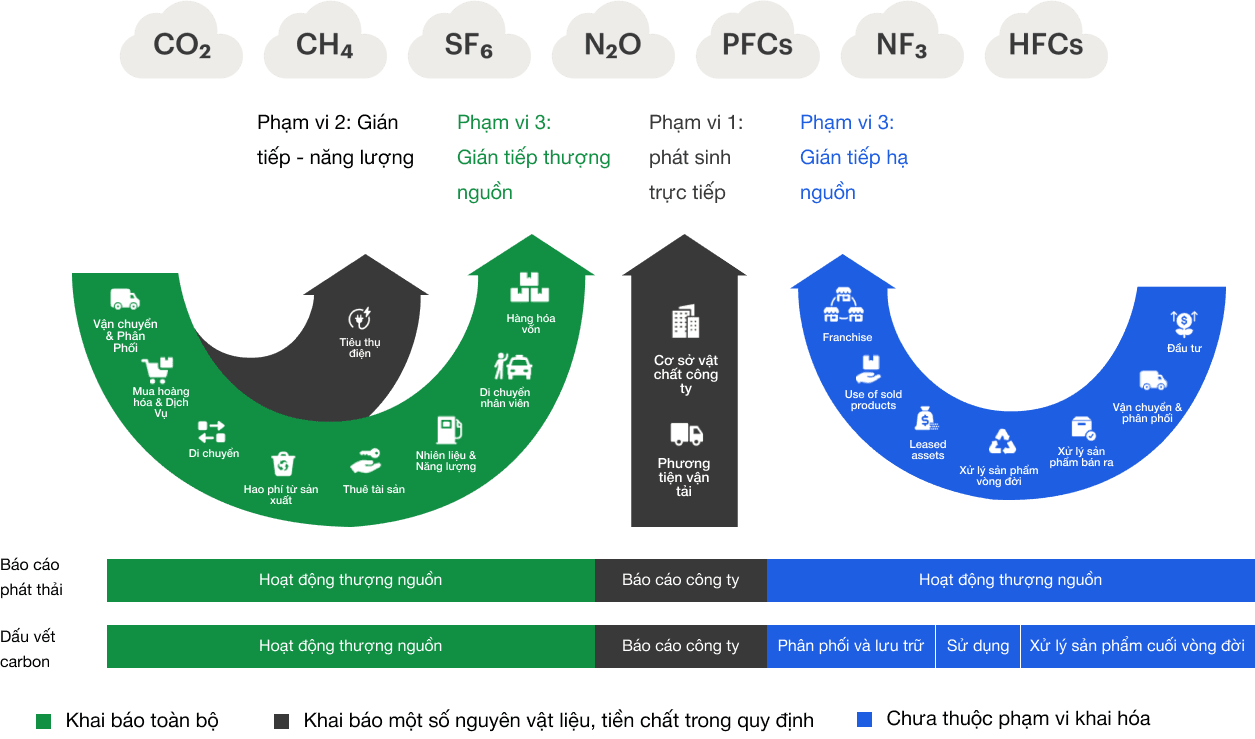
The GHG Protocol is divided into three scopes (Scope 1, Scope 2, and Scope 3) to classify emission sources:
- Scope 1: Direct emissions from sources owned or controlled by the business (for example, factories, vehicles).
- Scope 2: Indirect emissions from the consumption of energy purchased from outside sources (for example, electricity, heat).
- Scope 3: Indirect emissions from activities not under the direct control of the business but related to the supply chain (for example, transportation, waste treatment).
Advantages of the GHG Protocol:
- Comprehensiveness: The GHG Protocol covers all emission sources, from a business's direct to indirect activities, including the supply chain.
- Flexibility: This method can be applied to organizations across many different industries and can be adjusted to suit businesses of various sizes.
- Transparency: The GHG Protocol encourages transparency and standardization in emissions reporting, making it easy for stakeholders to compare and evaluate.
ISO 14064
ISO 14064 is a set of international standards developed by the International Organization for Standardization (ISO) to provide principles and requirements for greenhouse gas inventory and reporting. This set of standards is divided into three parts:
- ISO 14064-1:
Focuses on the quantification and reporting of greenhouse gas emissions at the organizational level. This is the most widely used part, helping organizations determine their GHG emissions and implement reduction measures.
- ISO 14064-2:
Guides the quantification, monitoring, and reporting of greenhouse gas emission reductions in specific projects, such as renewable energy projects or energy efficiency improvements.
- ISO 14064-3:
Addresses the process of verifying and validating GHG emissions, ensuring the accuracy and transparency of the report.
>>> See more: A Guide for Businesses to Conduct Greenhouse Gas Inventory According to ISO 14064-1
Comparison Between the GHG Protocol and ISO 14064
Both the GHG Protocol and ISO 14064 are leading standards in the field of greenhouse gas inventory. Although they share the same objective, these two sets of guidelines have some key differences:
Scope: The GHG Protocol is more detailed in Scope 3, covering all indirect emissions across the value chain, whereas ISO 14064 breaks them down into more distinct categories.
Application: The GHG Protocol provides industry-specific reporting frameworks, useful for organizations that want to compare their emissions performance with others in the same industry. ISO 14064 focuses on the requirements and technical specifications for quantifying, monitoring, reporting, and verifying greenhouse gases, with more room for interpretation and adjustment.
Recognition: ISO 14064 is more widely recognized by many organizations and government regulatory bodies, such as the UNFCCC, CDM, and VCS.
National Standards (Vietnam):
- TCVN ISO 14064-1:2018: This is the national standard equivalent to ISO 14064-1, applicable to organizations in Vietnam.
- TCVN ISO 14064-2:2018: This is the national standard equivalent to ISO 14064-2, applicable to greenhouse gas emission reduction projects in Vietnam.
Advantages of ISO 14064:
- Standardization: ISO 14064 brings standardization to GHG inventory and reporting, helping organizations comply with international requirements and minimize legal risks.
- Reliability: Complying with ISO 14064 helps businesses build trust with stakeholders thanks to a rigorous validation and verification process.
- Easy integration: ISO 14064 can be easily integrated with other environmental management systems, such as ISO 14001, helping businesses comprehensively manage their environmental impacts.
IPCC Guidelines:
The IPCC Guidelines are a comprehensive and authoritative set of documents on greenhouse gas inventory methodology, developed by the Intergovernmental Panel on Climate Change (IPCC).
Advantages of the IPCC Guidelines:
- Solid scientific basis: The IPCC Guidelines were developed by the world's leading experts on climate change and are considered the most reliable scientific source of information on greenhouse gas inventories.
- Comprehensiveness: The guidelines include detailed methodologies for inventorying all types of greenhouse gases and the main emission sectors, from energy and industry to agriculture and forestry.
- Flexibility: The guidelines provide different approaches to suit countries with varying levels of development and capacity.
- Internationally recognized: The IPCC Guidelines are widely used by countries around the world to build their national greenhouse gas inventories, serving reporting under the United Nations Framework Convention on Climate Change (UNFCCC).
- Regularly updated: The IPCC regularly updates the Guidelines to reflect the latest scientific advances on climate change and greenhouse gas inventories.
Choosing the Right Greenhouse Gas Inventory Method and Standard for Your Business
Choosing the right greenhouse gas inventory method and standard is a complex process influenced by many important factors, including:
- Inventory scope: Depending on whether the inventory is at the national, facility, or specific project level.
- Inventory purpose: Clearly determine whether the purpose is legal compliance, sustainability reporting, or internal assessment.
- Industry and organization size: Different industries and organizations have distinct inventory requirements based on the nature and scale of their operations.
- Resources and capabilities: Consider the available resources and the organization's capacity to choose the most suitable method and standard.
In Vietnam:
- For greenhouse gas inventory at the national level, applying the IPCC method and Circular 17/2022/TT-BTNMT is mandatory.
- For greenhouse gas inventory at the facility level, organizations may choose between the IPCC method, Circular 17/2022/TT-BTNMT, or international standards such as ISO 14064.
Recommendations:
- Research thoroughly: Evaluate greenhouse gas inventory methods and standards to choose the one most suitable for your organization.
- Consult experts: Seek advice from experts or experienced units for support during the inventory process.
- Ensure transparency and accuracy: Conduct the inventory clearly and accurately to ensure the reliability and quality of the results.
A greenhouse gas inventory is not only a legal requirement but also an opportunity for businesses to improve operational performance, save costs, and build reputation. Methods and standards such as the GHG Protocol and ISO 14064 provide businesses with the tools and guidance needed to conduct greenhouse gas inventories effectively and transparently. By choosing the right method, businesses can not only meet international requirements but also contribute positively to the fight against climate change.
CONTACT INFORMATION:
BeevR Technology Co., Ltd.
Address:
Hanoi Office: 125 Hoang Ngan, Trung Kinh, Cau Giay, Hanoi
Hotline: 037.6869.366
Email: [email protected]
Website: https://ecocheck.ai/