What are the GHG Protocol and ISO 14064 standards?
What are Scope 1, 2, 3 greenhouse gas emissions?
How the emission scopes are classified in the two standards, GHG Protocol and ISO 14064
Tools and methods for measuring emissions
Methods for reducing emissions by Scope 1, 2, 3
Greenhouse gas inventory with EcoCheck
Scope 1, 2, 3 GHG Emissions under GHG Protocol and ISO 14064
Under the international GHG Protocol and ISO 14064 standards, greenhouse gas emission sources are all divided into two categories, direct emissions and indirect emissions, yet each standard classifies them differently.
What are the GHG Protocol and ISO 14064 standards?
The GHG Protocol (Greenhouse Gas Protocol) is one of the most widely used standards in the world for greenhouse gas inventories. Developed by the World Resources Institute (WRI) and the World Business Council for Sustainable Development (WBCSD), the GHG Protocol provides detailed guidance for businesses and organizations in measuring and managing their GHG emissions.
ISO 14064 is a set of international standards developed by the International Organization for Standardization (ISO) to provide principles and requirements for greenhouse gas inventory and reporting. This set of standards is divided into three parts:
- ISO 14064-1:
Focuses on quantifying and reporting greenhouse gas emissions at the organizational level. This is the most commonly used part, helping organizations determine their GHG emissions and implement mitigation measures.
- ISO 14064-2:
Provides guidance on quantifying, monitoring and reporting greenhouse gas emission reductions in specific projects, such as renewable energy or energy efficiency improvement projects.
- ISO 14064-3:
Addresses the process of verifying and validating greenhouse gas emissions, ensuring the accuracy and transparency of the report.
See also: Distinguishing the GHG Protocol from ISO 14064
What are Scope 1, 2, 3 greenhouse gas emissions?
Greenhouse gas (GHG) emissions are classified into three main scopes according to international standards:
Scope 1: Includes direct emissions from sources owned or controlled by the organization, such as on-site fuel combustion, refrigerant leaks from cooling equipment and industrial production processes.
Scope 2: Includes indirect emissions from the generation of purchased electricity, heat or steam used by the organization.
Scope 3: Includes all other indirect emissions not covered by Scope 1 and 2, occurring in the organization's value chain, including both upstream activities (such as purchasing raw materials and transporting input goods) and downstream activities (such as the use of sold products and waste treatment).
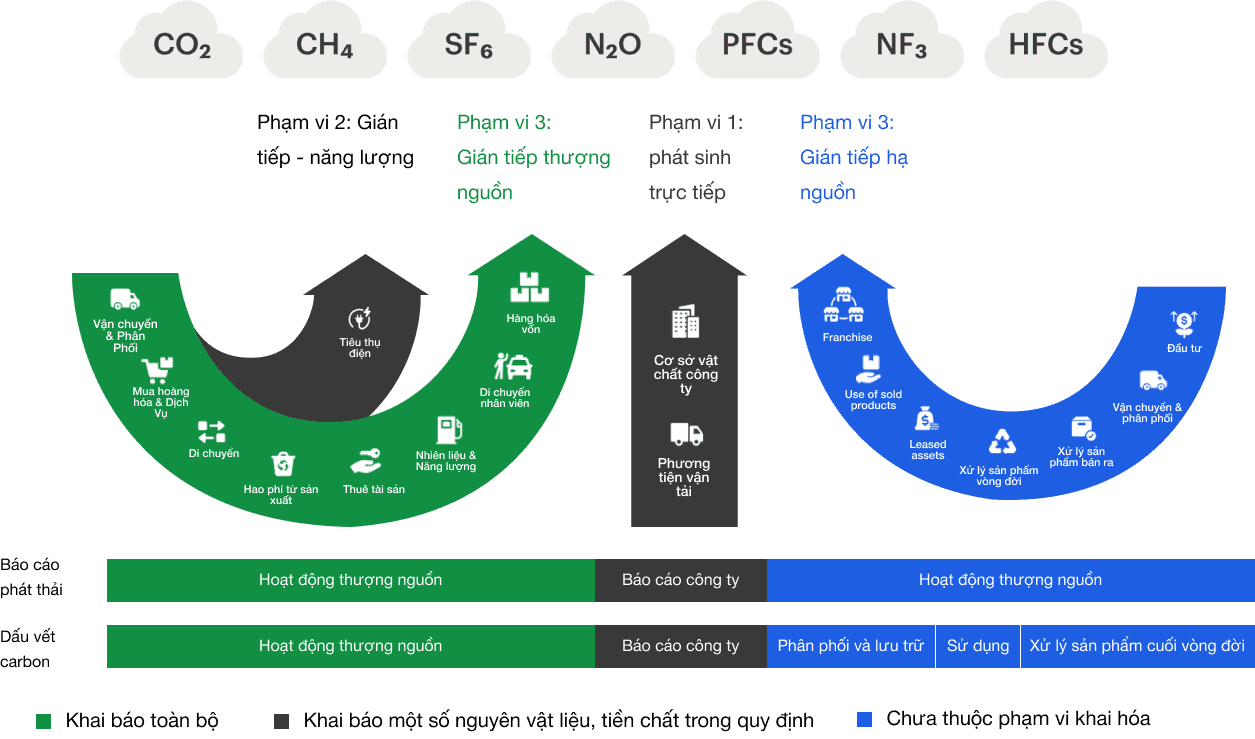
Scope 1, 2 and 3 greenhouse gas emissions under the GHG Protocol and ISO 14064
How the emission scopes are classified in the two standards, GHG Protocol and ISO 14064
Under the GHG Protocol, greenhouse gas emissions are divided into 3 scopes (as above).
Under the ISO 14064-1 standard, greenhouse gas emissions are classified as follows:
Scope 1: Similar to the GHG Protocol, includes direct emissions from sources owned or controlled by the organization.
Scope 2: Similar to the GHG Protocol, includes indirect emissions from the generation of purchased electricity, heat or steam.
Scope 3: Unlike the GHG Protocol, ISO 14064-1 divides Scope 3 into several different categories:
- Category 3: Indirect emissions from transportation.
- Category 4: Indirect emissions from products used by the organization.
- Category 5: Other indirect emissions (similar to the GHG Protocol's definition of Scope 3)
- Category 6: Other indirect emissions related to the organization's activities but occurring outside the organizational boundary.
Tools and methods for measuring emissions
- To directly measure Scope 1 emissions, businesses or organizations typically need to use sensors and instruments that directly measure the amount of greenhouse gas radiation from factories, plants and moving vehicles. The collected data is then analyzed and used to evaluate the effectiveness of emission reduction strategies.
- For Scope 2 emissions, data is provided from energy certificates and energy consumption bills. These certificates usually already include details about the composition of the energy supply, helping businesses easily assess the impact of each energy source used.
- For Scope 3 emissions, the measurement method is more complex than for the two scopes above. Commonly used tools include:
- Surveying and analyzing questionnaire responses from stakeholders in the supply chain, such as suppliers and logistics partners, to determine indirect emissions.
- Analyzing the product's life cycle from the raw material procurement stage through use to the product's final disposal stage.

Waste emitted from manufacturing plants
Methods for reducing emissions by Scope 1, 2, 3
Reducing Scope 1 greenhouse gas emissions:
- Use energy more efficiently and optimize production processes.
- Switch to renewable energy sources, such as solar or wind power.
- Maintain and upgrade equipment to minimize emissions.
Reducing Scope 2 greenhouse gas emissions:
- Choose cleaner energy suppliers and reduce energy consumption through conservation measures.
- Improve energy management systems and invest in energy-saving technologies.
Reducing Scope 3 greenhouse gas emissions:
- Strengthen supply chain management and collaborate with suppliers to reduce emissions.
- Promote recycling and efficient waste treatment.
- Encourage the use of sustainable products and services.
Greenhouse gas inventory with EcoCheck
EcoCheck provides consulting services and supports businesses in conducting greenhouse gas inventories according to international standards. With a team of experienced experts certified in ISO 14064-1, EcoCheck is committed to bringing you the most effective and accurate solutions. Register for a greenhouse gas inventory today to protect the environment and comply with legal regulations!
Analyzing and managing greenhouse gas emissions across Scopes 1, 2, and 3 not only helps organizations better understand their emission sources but also supports the development of effective mitigation strategies. Applying the GHG Protocol and ISO 14064 standards helps ensure accuracy and transparency in greenhouse gas management, thereby promoting sustainability and reducing environmental impact.
Contact EcoCheck for consultation and to conduct a greenhouse gas inventory for your business today!
CONTACT INFORMATION:
BeevR Technology Company Limited
Address:
Hanoi Office: 125 Hoang Ngan, Trung Kinh, Cau Giay, Hanoi
Hotline: 037.6869.366
Email: [email protected]
Website: https://ecocheck.ai/