What is the GHG Protocol standard?
What is ISO 14064?
Detailed Comparison of the GHG Protocol and ISO 14064
Conclusion
Comparing Two GHG Inventory Standards: GHG Protocol and ISO 14064
The two most widely used standards for measuring and reporting greenhouse gas emissions today are the GHG Protocol and ISO 14064. Both standards provide useful frameworks for calculating and inventorying greenhouse gases, so which standard should a business choose to apply? Let's work with EcoCheck to clarify the differences between these two standards in the article below.
What is the GHG Protocol standard?
The GHG Protocol is a set of international standards developed by the World Business Council for Sustainable Development (WBCSD) and the World Resources Institute (WRI). First published in 2001, the GHG Protocol provides detailed guidance for measuring and reporting greenhouse gas emissions, helping businesses, organizations, and governments calculate and manage their emissions. This set of standards consists of three main parts:
- Part 1: Basic Guidance – Covers the fundamental principles and methods for conducting a greenhouse gas inventory.
- Part 2: Sector Guidance – Classifies emission sources and provides guidance for different industries.
- Part 3: Calculation Guidance – Provides methods for calculating emissions and supporting tools.
What is ISO 14064?
ISO 14064 is a series of international standards developed by the International Organization for Standardization (ISO), with the aim of helping organizations manage and reduce greenhouse gas emissions. ISO 14064 consists of three parts:
- Part 1: Requirements for the quantification and measurement of greenhouse gas emissions (guidance at the organizational level)
- Part 2: Requirements for the validation and verification of greenhouse gas emission claims (guidance at the project level)
- Part 3: Guidance for the validation and verification of emission reduction projects
See also: Greenhouse gas emissions Scope 1, 2, 3 under the GHG Protocol and ISO 14060 standards
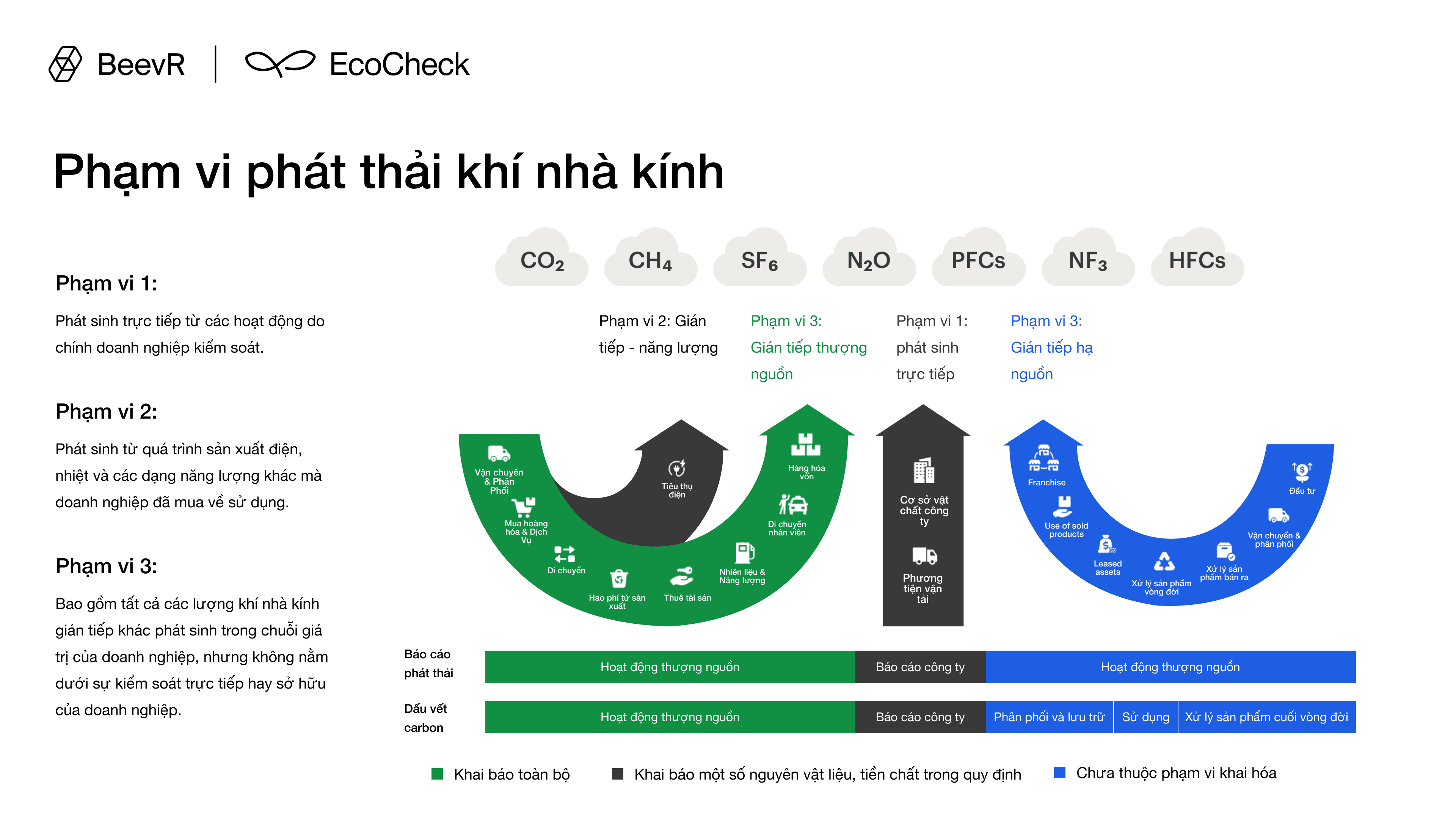
The 3 scopes of greenhouse gas emissions
Detailed Comparison of the GHG Protocol and ISO 14064
Similarities:
- The similarity between the GHG Protocol and ISO 14064 methods is that both are based on the fundamental principles of relevance, completeness, consistency, transparency, and accuracy.
- Both use the Global Warming Potential (GWP) factor to convert different greenhouse gases into CO2-equivalent units.
- Both allow flexibility and adaptation to the specific context and objectives of each organization or project, while encouraging continuous improvement and stakeholder engagement.
Differences:
| GHG Protocol | ISO 14064 | |
| Classification of emission sources at the organizational level | The GHG Protocol divides greenhouse gas emissions into three scopes: Scope 1 (direct emissions from owned or controlled sources), similar to Category 1 of ISO 14064. Scope 2 (indirect emissions from the generation of purchased electricity, heat, and steam used by the organization), similar to Category 2 of ISO 14064. Scope 3 (all other indirect emissions occurring in the value chain). Scope 3 of the GHG Protocol covers Categories 3, 4, 5, and 6 of ISO 14064. | At the organizational level, the ISO 14064-1 standard classifies greenhouse gas emissions into six categories: Category 1 - Direct GHG emissions and removals Category 2 – Indirect GHG emissions from imported energy Category 3 – Indirect GHG emissions from transportation Category 4 – Indirect GHG emissions from products used by the organization Category 5 – Indirect GHG emissions associated with the use of the organization's products Category 6 – Indirect GHG emissions from other sources. |
| Scope and application | The GHG Protocol is relatively more comprehensive and detailed, covering more sectors and activities, while also providing additional guidance and tools for calculating and managing GHGs. | ISO 14064 is more general and concise, focusing on the requirements and technical specifications for quantifying, monitoring, reporting, and verifying GHGs, while leaving more room for interpretation and adaptation. |
| Focus | The GHG Protocol focuses on identifying and calculating greenhouse gas emissions, providing detailed guidance on how to classify and measure different emission sources. | ISO 14064 emphasizes maintaining consistency, comparability, completeness, transparency, and accuracy in quantifying, monitoring, and reporting greenhouse gas emissions. It also requires organizations to identify and document their greenhouse gas reduction efforts, an aspect less emphasized by the GHG Protocol. |
| Acceptance | The GHG Protocol is more widely used and referenced by voluntary and mandatory reporting programs, initiatives, and platforms, such as the Carbon Disclosure Project (CDP), the Global Reporting Initiative (GRI), and the Science Based Targets initiative (SBTi). | ISO 14064 is more widely recognized and accepted by organizations and government regulatory bodies, such as the United Nations Framework Convention on Climate Change (UNFCCC), the Clean Development Mechanism (CDM), and the Verified Carbon Standard (VCS). |
Conclusion
Both the GHG Protocol and ISO 14064 provide useful tools for managing and reducing greenhouse gas emissions, but they serve different objectives. The GHG Protocol stands out for its flexibility and broad applicability, while ISO 14064 is better suited to organizations that require formal certification and verification.
Choosing which standard is right for your organization will depend on your specific needs for reporting, certification, and greenhouse gas emissions management.