What are the key CBAM 2027 dates?
How does the 50-tonne exemption threshold work?
How is the CBAM certificate price calculated in 2027?
Who bears the CBAM cost: the EU importer or the Vietnamese exporter?
What data must steel, aluminium, fertiliser and cement exporters provide?
Should you use actual data or default values?
What should exporters do between now and 30 September 2027?
How does CBAM relate to Vietnam’s domestic greenhouse gas inventory?
Frequently asked questions
When can CBAM certificates be purchased?
When is the first CBAM declaration due?
Do imports under 50 tonnes require CBAM compliance?
What is the CBAM certificate price for 2026?
Do Vietnamese exporters have to pay CBAM charges?
CBAM 2027: What Vietnamese Exporters Need to Do
2027 is the year CBAM starts costing real money: CBAM certificates go on sale from 1 February 2027, and by 30 September 2027 EU importers must submit their first CBAM declaration for goods imported in 2026 and surrender the number of certificates corresponding to the embedded emissions. The payer is the EU importer that imports more than 50 tonnes of CBAM goods per year (the threshold under Regulation (EU) 2025/2083), but Vietnamese exporters of steel, aluminium, cement and fertilisers must supply verified emissions data; otherwise the importer uses default values plus an escalating mark-up and will push the cost back onto the supplier.
The concept and overall roadmap of CBAM are covered in our article What is CBAM. This article is an action guide for the 2027 deadline: key dates, how the price is calculated, the data you need to prepare and what to do each quarter.
What are the key CBAM 2027 dates?
The milestones below are taken from the official website of the European Commission (Directorate-General for Taxation and Customs Union) and the CBAM Q&A updated on 27 May 2026:
| Date | Event | What it means for Vietnamese exporters |
|---|---|---|
| 1 January 2026 | CBAM enters its definitive period; only authorised CBAM declarants may import CBAM goods above the threshold | Exports in 2026 form the first chargeable period |
| Around September 2026 | National accreditation bodies expected to grant the first accreditations to CBAM verifiers | Start contacting verifiers |
| 4 January 2027 | Certificate price for Q4 2026 published | All four quarterly prices for 2026 available |
| 1 February 2027 | The common central platform starts selling CBAM certificates | Importers start buying certificates for 2026 goods |
| Early 2027 | Period recommended by the European Commission for verifying 2026 data | You must have a verification report to send to customers |
| Every quarter from 2027 | Importers must hold certificates covering at least 50% of the embedded emissions of goods imported since the start of the year | Customers need data early, not at year-end |
| 30 September 2027 | Deadline for the 2026 CBAM declaration and certificate surrender | Final deadline for your actual data to be used |
| From 2028 | Producers can share precursor emissions via the CBAM Registry | Easier data exchange across multi-tier supply chains |
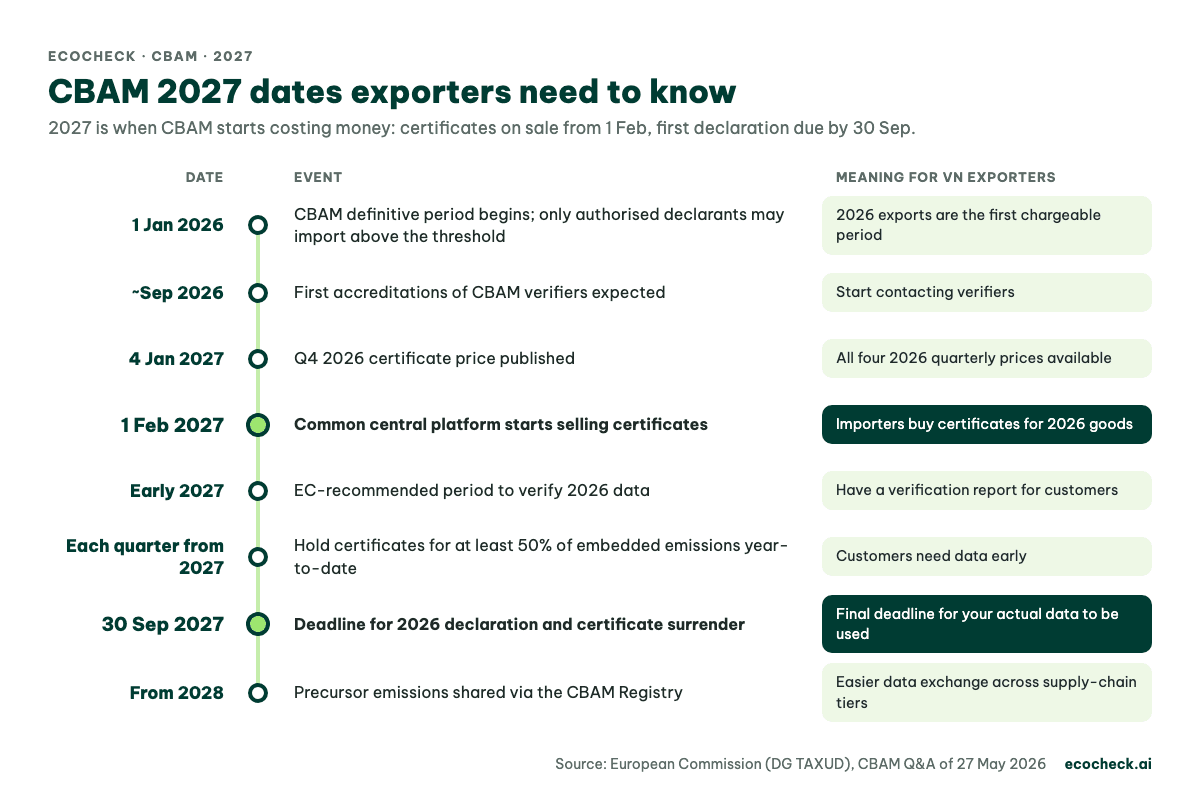
Figure 1: CBAM timeline 2026–2028: definitive period from 1 January 2026, certificate sales from 1 February 2027, declaration and surrender deadline 30 September 2027
How does the 50-tonne exemption threshold work?
Regulation (EU) 2025/2083 of 8 October 2025 amends Regulation (EU) 2023/956 and introduces a mass-based exemption threshold: importers bringing in less than 50 tonnes of CBAM goods per calendar year are exempt from CBAM obligations. Three points to get right:
- The threshold applies to the importer, not the exporter. If you sell to a large importer, even small shipments are subject to CBAM.
- Net mass is aggregated across all CBAM goods codes on customs declarations during the year.
- It does not apply to electricity and hydrogen: importers of these two goods must always be authorised CBAM declarants.
According to the European Commission, this threshold removes most small importers while still keeping over 99% of emissions in scope. In other words, virtually every significant shipment of steel, aluminium, cement or fertiliser remains subject to CBAM.
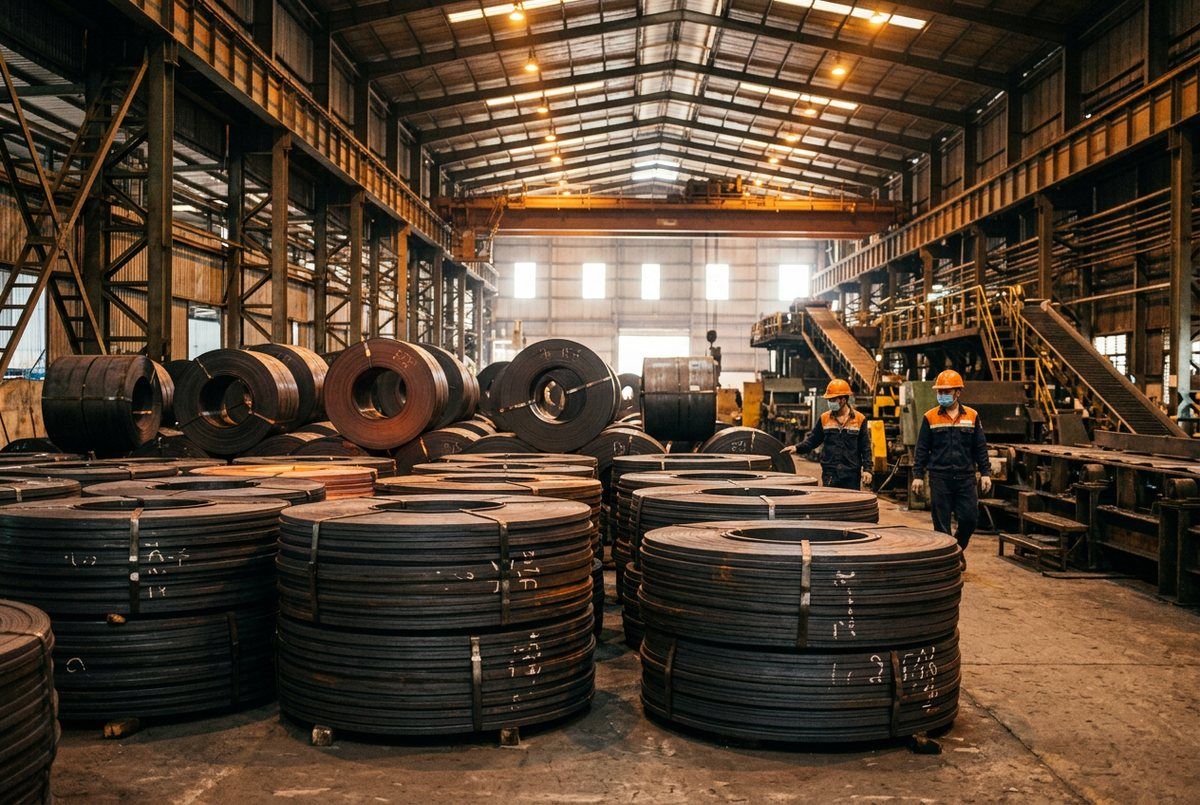
Hot-rolled steel coils waiting for export at a steel mill
How is the CBAM certificate price calculated in 2027?
The certificate price equals the weighted average auction price of EU Emissions Trading System (EU ETS) allowances. Goods imported in 2026 are priced by quarter of import; from 2027 the price is published weekly.
| Import quarter | Publication date | Certificate price (EUR/tCO₂e) |
|---|---|---|
| Q1 2026 | 7 April 2026 | 75.36 |
| Q2 2026 | 6 July 2026 | 75.28 |
| Q3 2026 | 5 October 2026 | 82.32 |
| Q4 2026 | 4 January 2027 | Not yet published |
The number of certificates to surrender is not equal to total embedded emissions. Two amounts are deducted: an adjustment reflecting the free allocation received by EU producers (calculated using CBAM benchmarks and phased down as the EU ETS cuts free allocation from 2026 to 2034, so the CBAM obligation grows each year), and the carbon price actually paid in the country of production. Rules for deducting third-country carbon prices will be set out in an implementing act in 2026. As a result, the CBAM cost per tonne of goods depends mainly on the plant’s actual embedded emissions.
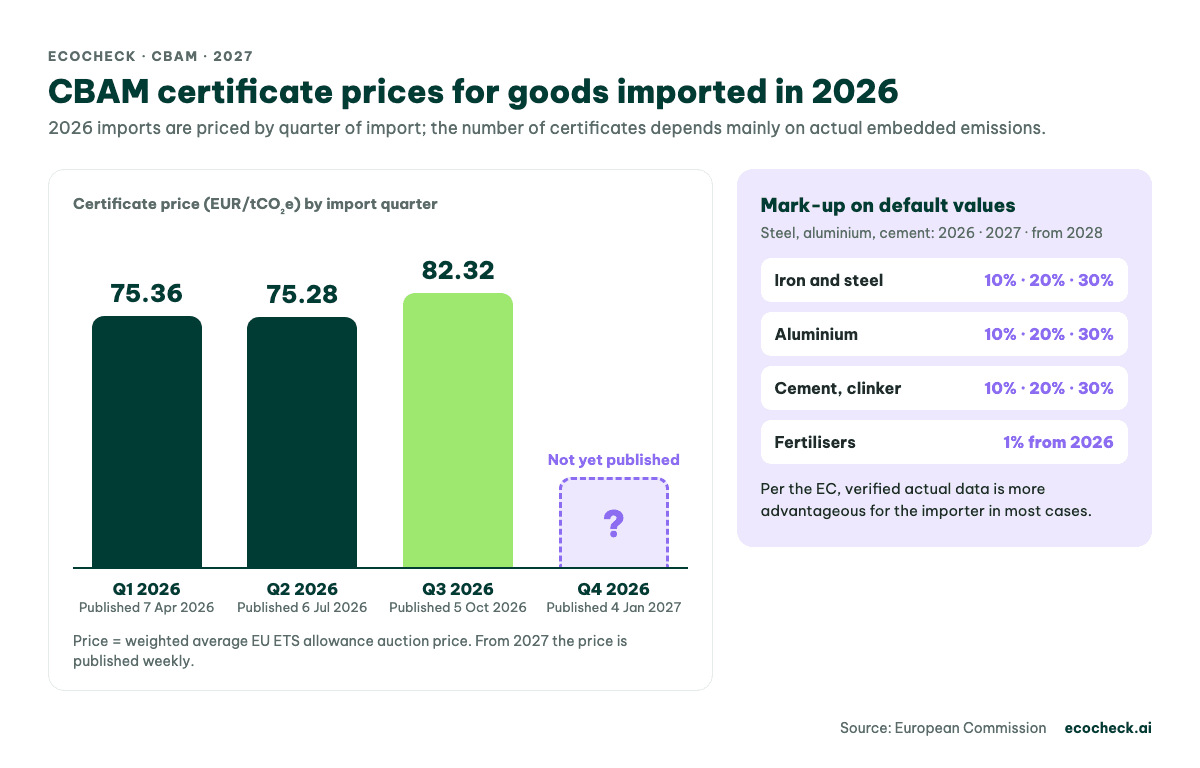
Figure 2: CBAM certificate price by 2026 import quarter: EUR 75.36, 75.28 and 82.32 per tCO₂e; Q4 published 4 January 2027; plus default-value mark-ups by sector
Who bears the CBAM cost: the EU importer or the Vietnamese exporter?
Legally, the obligation to buy and surrender certificates lies with the authorised CBAM declarant in the EU (the importer or an indirect customs representative). The declarant is also liable for incorrect declarations and may be penalised by the national competent authority. Vietnamese exporters do not pay the EU.
In practice, the pressure shifts to exporters in three ways:
- Price negotiations: importers factor CBAM costs into supplier comparisons; plants with high emissions or no data become less competitive.
- Contract clauses: requirements to provide verified data on time and indemnity commitments if the data is wrong.
- Supplier selection: preference for plants whose actual data is lower than the default values.
What data must steel, aluminium, fertiliser and cement exporters provide?
The core data is specific embedded emissions per tonne of product (tCO₂e/tonne) for each goods code, calculated using the methodology of Implementing Regulation (EU) 2025/2547 and confirmed by an accredited verifier. The emission scope differs by sector:
| Sector | Emissions to declare | Mark-up on default values | Plant data required |
|---|---|---|---|
| Iron and steel | Direct | 10% (2026), 20% (2027), 30% (from 2028) | Production route (blast furnace, electric arc furnace), fuels, coke, electrodes, precursors (billets, pig iron) and their origin |
| Aluminium | Direct | 10% (2026), 20% (2027), 30% (from 2028) | Primary or secondary aluminium, smelting fuels, PFC emissions if electrolysis is used, precursors |
| Cement, clinker | Direct and indirect | 10% (2026), 20% (2027), 30% (from 2028) | Process emissions from clinker calcination, kiln fuels, electricity consumption, clinker ratio |
| Fertilisers | Direct and indirect | 1% from 2026 | Ammonia, nitric acid (N₂O), gas or coal feedstock, electricity consumption |
This must be accompanied by installation information, the reporting period (by default the calendar year, and no period before 2026 may be used), the verification report and the communication template provided by the European Commission. Plants can also register themselves in the CBAM Registry so importers can use their actual data more easily.
Should you use actual data or default values?
Default values are published by the EU per country and year, with the mark-ups above added so that emissions are not underestimated. According to the European Commission, in most cases using verified actual data is more advantageous for the importer. Default values only make sense when a plant knows its actual emissions are higher than the default, or when its EU volumes are too small to justify the cost of verification.
Requirements for using actual data: a 2026 emissions monitoring system following the CBAM methodology, calculation spreadsheets traceable to source documents, and an on-site visit by the verifier (mandatory the first time).
What should exporters do between now and 30 September 2027?
- Q4 2026 – Map your products: list your CBAM goods codes, EU customers and 2026 export volumes; ask customers whether they exceed the 50-tonne threshold and when they need data.
- Q4 2026 – Complete 2026 monitoring: separate fuels, electricity and raw materials by the production lines making goods for the EU; trace data back to January 2026.
- Q4 2026 – Contact a verifier: choose one that is or will soon be accredited for the right goods category and book the on-site visit.
- Q1 2027 – Calculate embedded emissions and verify: finish the 2026 calculation, have it verified, and send the communication template and verification report to customers.
- Q1 2027 – Align with the domestic inventory: if the facility is on the list in Decision 42/2026/QD-TTg, use the same dataset for the inventory report submitted to the Provincial People’s Committee by 31 March 2027.
- Q2–Q3 2027 – Support customers’ declarations: explain your data before the 30 September 2027 deadline; agree contract terms for 2027, when customers must hold certificates quarterly.
- Ongoing – Reduce emissions: every tonne of CO₂ you cut is CBAM cost your customer does not have to pay; see greenhouse gas emission reduction solutions.
How does CBAM relate to Vietnam’s domestic greenhouse gas inventory?
The facility-level inventory under Decree 06/2022/ND-CP (amended by Decree 119/2025/ND-CP) calculates total emissions for the whole plant; CBAM requires emissions per product. Both datasets draw on the same activity data, so designing the inventory to be split by production line avoids doing the work twice. Steel and cement are also among the 110 facilities in the emission allowance pilot under Decision 263/QD-TTg; carbon costs paid domestically may be considered for deduction once the EU issues detailed rules. Check your domestic obligations with the greenhouse gas inventory lookup tool.
Next step: EcoCheck helps calculate embedded emissions, prepare data for verification and generate reports for importers through its CBAM reporting service, combined with its greenhouse gas inventory service so you work from a single dataset.
Frequently asked questions
When can CBAM certificates be purchased?
From 1 February 2027, on the EU’s common central platform. Only authorised CBAM declarants can buy them, including certificates for goods imported in 2026.
When is the first CBAM declaration due?
By 30 September 2027 for goods imported in 2026. By the same deadline, importers must surrender the number of certificates corresponding to the declared embedded emissions.
Do imports under 50 tonnes require CBAM compliance?
No, if the total mass of CBAM goods imported in the calendar year is under 50 tonnes, except for electricity and hydrogen. The threshold applies to the importer under Regulation (EU) 2025/2083.
What is the CBAM certificate price for 2026?
According to the European Commission: EUR 75.36/tCO₂e (Q1), 75.28 (Q2), 82.32 (Q3); the Q4 price will be published on 4 January 2027. From 2027 the price is published weekly.
Do Vietnamese exporters have to pay CBAM charges?
Not directly. The EU importer pays, but will demand verified emissions data and factor CBAM costs into price negotiations with suppliers.




![Top 5 Công Cụ Tính Toán Phát Thải Khí Nhà Kính [Cập Nhật 2026]](https://cms.ecocheck.ai/uploads/Eco_Check_Top_5_cong_cu_va_phan_mem_ho_tro_kiem_ke_khi_nha_kinh_d9d03bf693.png)
![Phương pháp Kiểm kê Khí nhà kính: GHG Protocol & ISO 14064 [2026]](https://cms.ecocheck.ai/uploads/Cac_phuong_phap_va_tieu_chuan_kiem_ke_khi_nha_kinh_pho_bien_e645f7df80.png)