Why are transport and construction both managed by the Ministry of Construction in the 2026 list?
Which companies must conduct a GHG inventory in 2026?
Construction field: which facilities must report and what data is needed?
Transport field: which facilities must report and what data is needed?
What steps does EcoCheck's GHG inventory service include?
What is the 2026–2027 GHG inventory timeline?
How much does a GHG inventory service cost?
Should you do the inventory in-house or hire a service provider?
Frequently asked questions
Which transport companies must conduct a GHG inventory in 2026?
Which building materials plants must conduct a GHG inventory?
When is the next GHG inventory report deadline?
Which guidance documents govern inventories in the construction and transport sectors?
How much does a GHG inventory cost per facility?
Do we need an inventory if we are not on the list?
Start your 2026 GHG inventory with EcoCheck
GHG Inventory Services for Transport & Construction in Vietnam 2026
Quick answer: Under Decision 42/2026/QD-TTg (effective 25 September 2026), 464 facilities in the construction sector must carry out a greenhouse gas (GHG) inventory: 411 facilities in the construction field (including cement, lime, glass, ceramics and brick production, and energy-intensive buildings) and 53 facilities in the transport field (fuel-intensive transport companies). Facility-level inventory reports are prepared every 2 years and submitted to the provincial People's Committee before 31 March; the next deadline is 31 March 2027. EcoCheck's 2026 GHG inventory service for transport and construction covers boundary setting, data collection, emission calculations under the sector-specific Circulars, report preparation and submission support.
Note on the 110 facilities with emission allowances (thermal power, steel, cement): they do not file the inventory report with the provincial People's Committee by 31 March. Instead they send a verified inventory report to the Ministry of Agriculture and Environment before 1 December each year, starting in 2027 (Article 11, Decree 06/2022/ND-CP as amended by Decree 119/2025/ND-CP). The annual mitigation report is still due by 31 March.
This page is for ESG, environmental or operations leads at building materials plants, contractors, airlines, shipping companies, logistics providers, railways and bus operators. For background, see our articles on GHG inventory for the construction sector and GHG inventory for the transport sector.
Why are transport and construction both managed by the Ministry of Construction in the 2026 list?
Since 1 March 2025, the Ministry of Transport has been merged into the Ministry of Construction under Decree 33/2025/ND-CP. As a result, Appendix III of Decision 42/2026/QD-TTg lists facilities "in the construction sector (including the construction field and the transport field)". The Ministry of Construction issues technical guidance for both fields.
| Managing ministry | Number of facilities required to report (Decision 42/2026) |
|---|---|
| Ministry of Industry and Trade | 1,916 |
| Ministry of Construction – construction field | 411 |
| Ministry of Construction – transport field | 53 |
| Ministry of Agriculture and Environment | 61 |
| Total | 2,441 |
Decision 42/2026/QD-TTg was issued on 10 August 2026 and replaces Decision 13/2024/QD-TTg. See also Decision 42/2026/QD-TTg: 2,441 facilities must conduct a GHG inventory.
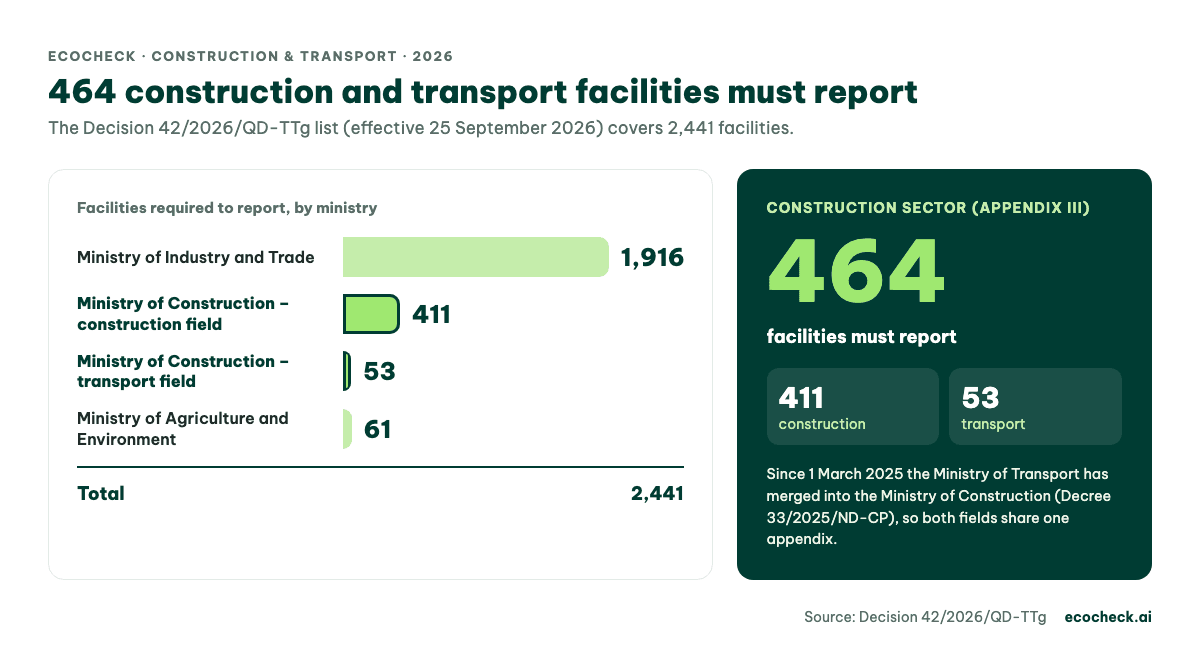
Figure 1: Facilities required to run a GHG inventory under Decision 42/2026/QD-TTg: Industry and Trade 1,916, construction 411, transport 53, Agriculture and Environment 61; construction sector total 464
Which companies must conduct a GHG inventory in 2026?
A facility is included in the list if it meets any of the following criteria:
- Annual greenhouse gas emissions of 3,000 tonnes of CO2 equivalent (tCO2e) or more;
- Industrial plants or production facilities with total annual energy consumption of 1,000 tonnes of oil equivalent (TOE) or more;
- Freight transport companies with total annual fuel consumption of 1,000 TOE or more;
- Commercial buildings with total annual energy consumption of 1,000 TOE or more;
- Solid waste treatment facilities with an annual operating capacity of 65,000 tonnes or more.
The most reliable way to check is to look up the facility name in Appendix III. If you are close to the threshold, run a quick estimate with our free GHG inventory obligation checker.
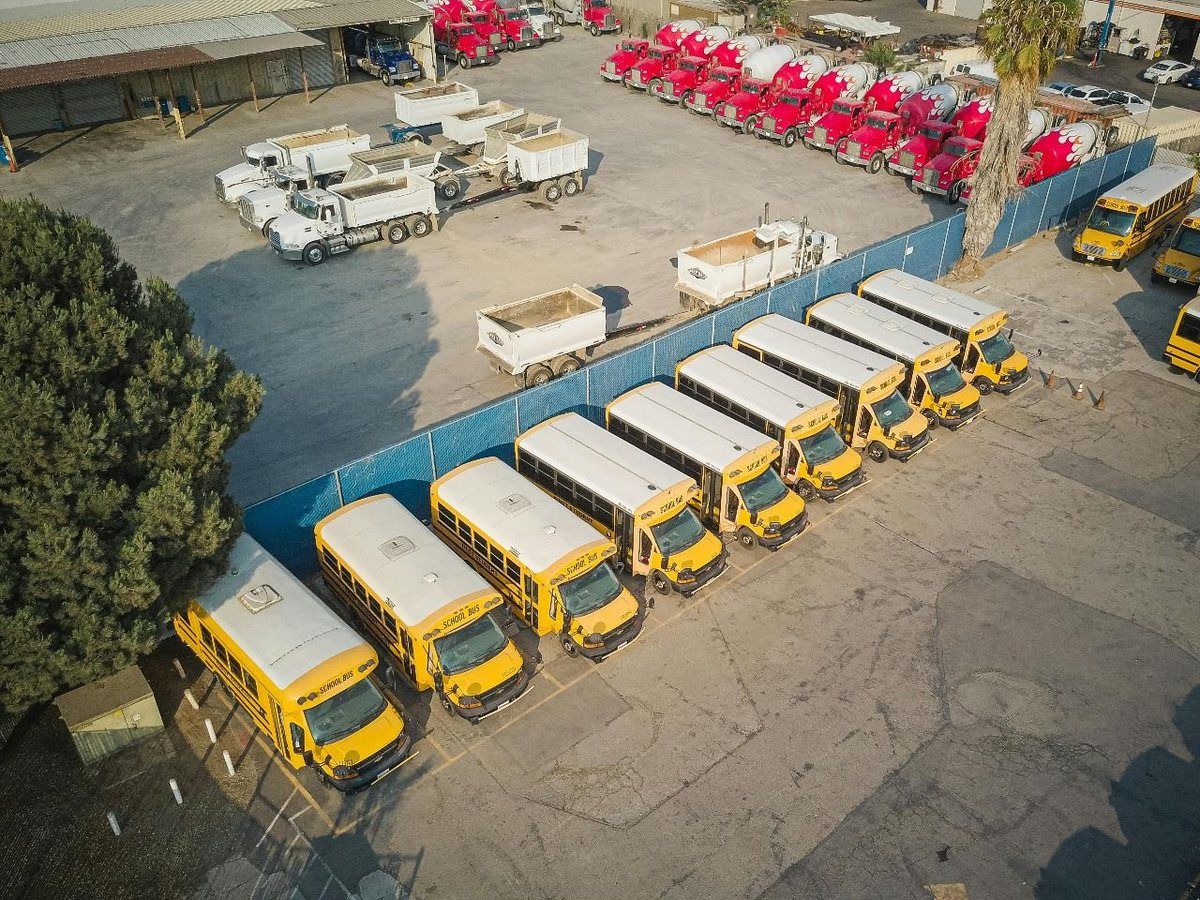
A bus fleet depot, an emission source in the transport sector
Construction field: which facilities must report and what data is needed?
Facility-level inventories in the construction field follow Circular 13/2024/TT-BXD (issued 20 December 2024, effective 5 February 2025) on procedures and technical regulations for GHG inventory and MRV in the construction sector. There are two main source groups: industrial processes (clinker and lime calcination) and energy consumption (fuels, grid electricity).
| Facility type | Main emission sources | Data to collect |
|---|---|---|
| Cement plants (with clinker kilns) | Clinker production (decarbonation); combustion of coal, oil and alternative fuels; electricity | Clinker output; CaO and MgO content; cement kiln dust (CKD); fuel quantities and calorific values; electricity consumption |
| Cement grinding stations, concrete batching plants | Electricity; diesel for mixer trucks, loaders and generators | Electricity bills; fuel issue slips; production output |
| Lime production | Calcination of limestone/dolomite; fuel combustion in lime kilns | Lime output by type; input raw material quantities; kiln fuel |
| Glass production | Decomposition of carbonates in the batch (soda ash, limestone, dolomite); gas and oil combustion in melting furnaces | Carbonate raw material quantities; cullet (recycled glass) ratio; fuel; electricity |
| Ceramics, tiles, fired bricks | Carbonates in clay and additives; coal and gas combustion for kilns and dryers | Raw material quantities and carbonate content; production output; fuel by kiln; electricity |
| Steel structure and precast component plants | Electricity for cutting and welding; gas for drying and painting ovens; diesel for forklifts and cranes | Electricity consumption; LPG/natural gas; diesel; output in tonnes of structures |
| Buildings and facilities consuming ≥ 1,000 TOE/year | Electricity; backup generators; refrigerant leakage (HFCs) | 12 months of electricity bills; generator fuel; refrigerant top-up quantities |
Cement plants should note one more point: the cement industry is part of the pilot phase of emission allowance allocation, together with thermal power and iron and steel (110 facilities, including 51 cement plants). Inventory data will therefore also be checked against allowances, which requires more accurate clinker and fuel data.
Real-world example: EcoCheck carried out a 2024 GHG inventory for Vinh Long Concrete Joint Stock Company, covering emissions from fuel combustion, electricity consumption and both in-house and outsourced transport, together with an emission reduction roadmap.
Transport field: which facilities must report and what data is needed?
Facility-level inventories in the transport field follow Circular 63/2024/TT-BGTVT (issued 30 December 2024, effective 15 February 2025). The scope covers emissions from fuel combustion by the facility's vehicles and transport equipment across 5 sub-sectors: road, rail, inland waterway, maritime and aviation (the last two cover domestic transport only; fishing vessels are excluded).
| Facility type | Main emission sources | Data to collect |
|---|---|---|
| Airlines | Jet A-1 fuel for domestic flights; ground vehicles | Fuel by route and aircraft; number of domestic flights; ground equipment fuel |
| Shipping and inland waterway companies | Fuel oil (FO) and diesel oil (DO) for main and auxiliary engines of vessels on domestic routes | Vessel list and engine power; fuel logs; domestic voyages |
| Ports, terminals, warehouses (if named in the list) | Diesel for cranes, forklifts and tractor units; electricity | Number of equipment units; fuel dispensed; electricity consumption |
| Logistics and road freight companies | Diesel and gasoline for truck and tractor fleets | Number of vehicles; km/year; fuel consumption rates; total litres of fuel |
| Railways | Diesel for locomotives; electricity for electric trains (if any) | Number of locomotives; fuel by train/route; train-km |
| Buses, passenger transport | Diesel and CNG for the fleet; charging electricity for electric buses | Number of vehicles; operating km; monthly fuel and charging electricity |
Common challenges: outsourced vehicles mixed with self-operated ones, and fuel recorded in VND instead of litres.
What steps does EcoCheck's GHG inventory service include?
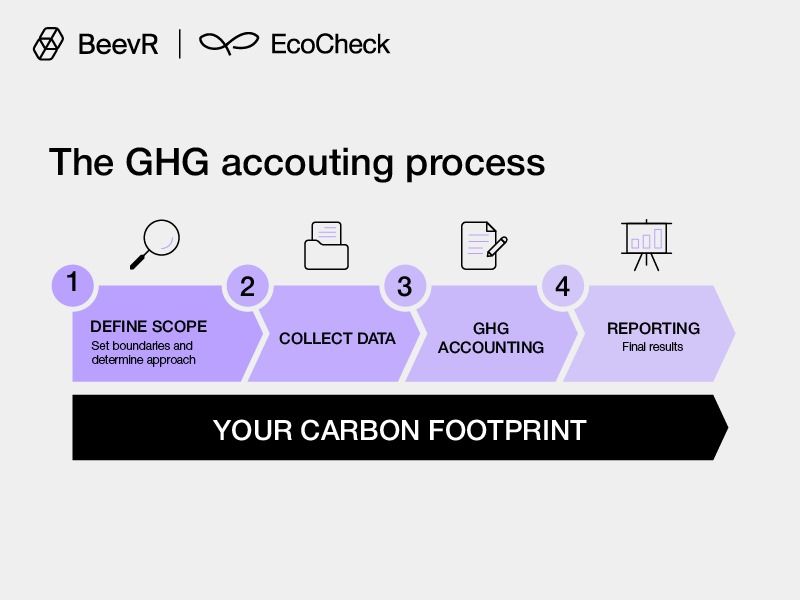
The EcoCheck GHG inventory service follows the steps set out in the sector-specific Circulars of the Ministry of Construction (and the former Ministry of Transport), while remaining compatible with ISO 14064-1 and the GHG Protocol:
- Define boundaries and scope: cross-check against Appendix III, define the boundary and emission sources.
- Set up the methodology and data collection templates: dedicated checklists for kilns, vehicle fleets, vessel fleets, etc.
- Collect activity data: 12 months of the inventory year.
- Select emission factors: per the line ministry's guidance, officially published grid emission factors, and IPCC factors where no national factor exists.
- Calculate emissions on the EcoCheck platform, broken down by source and scope.
- Quality control and uncertainty assessment.
- Recalculate when boundaries, data or methodology change.
- Prepare the facility-level inventory report in the prescribed format.
- Support report submission and clarifications, and hand over to the in-house team.
What is the 2026–2027 GHG inventory timeline?
| Milestone | What to do |
|---|---|
| 25 September 2026 | Decision 42/2026/QD-TTg takes effect; check whether your facility is named in Appendix III |
| Q4 2026 | Select a consultant, finalise boundaries, standardise fuel, electricity and production records |
| 31 December 2026 | Close the books for the 2026 inventory year |
| January–February 2027 | Calculations, quality control, report finalisation |
| Before 31 March 2027 | Submit the facility-level inventory report to the provincial People's Committee |
Timing depends on data quality: facilities with many branches, dispersed vehicle fleets or multiple kilns need extra time for data standardisation, so it is best to start in Q4 2026.
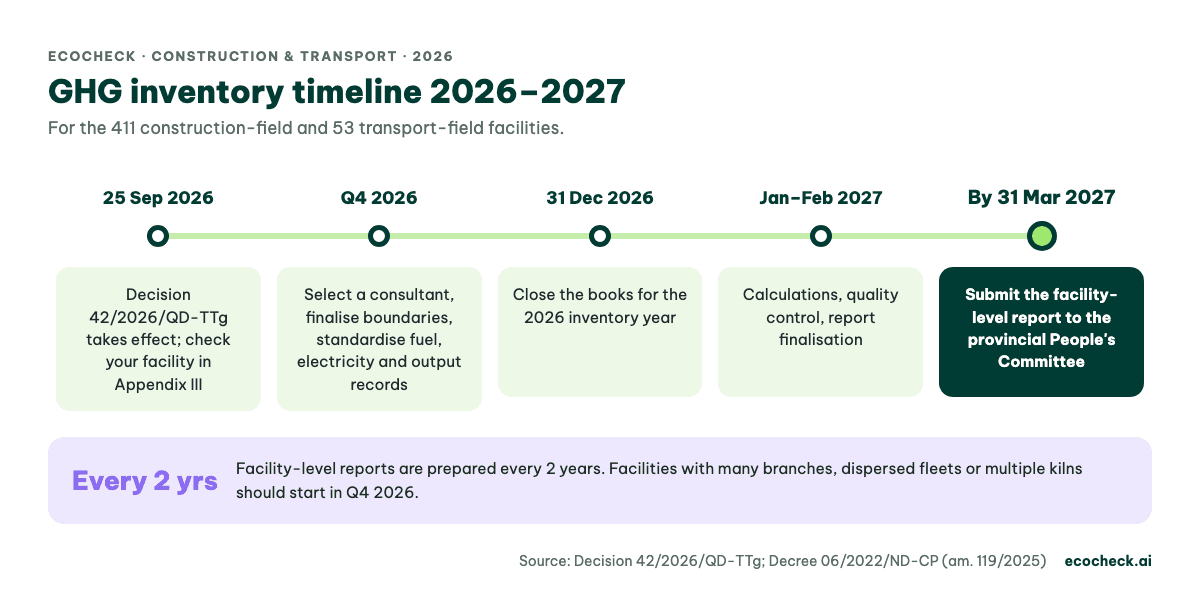
Figure 2: 2026–2027 GHG inventory timeline for construction and transport: from 25 September 2026 to submission to the provincial People's Committee before 31 March 2027
How much does a GHG inventory service cost?
There is no standard published price list on the market. Market prices for one inventory cycle typically range from several tens of millions to over one hundred million VND per facility. Factors that drive costs up include: the number of emission sources (multiple kilns, multiple fuel types), the number of facilities/branches, data readiness, and whether the scope extends to Scope 3. Cement plants are usually at the higher end because of process emissions; for transport companies, the key factor is whether fuel data has been digitised. See details in our article on GHG inventory costs in 2026.
Should you do the inventory in-house or hire a service provider?
| Criterion | In-house | Hire EcoCheck |
|---|---|---|
| Suitable when | You already have staff who understand Circular 13/2024/TT-BXD or 63/2024/TT-BGTVT, and emission sources are simple | You have industrial processes (clinker, lime, glass), large vehicle/vessel fleets, many branches, or it is your first inventory cycle |
| Main risks | Wrong emission factors, missing sources, reports in the wrong format that must be re-explained | Data must be provided on time |
| Next cycles | Depends on the individual doing the work | Data is stored on the platform, and the in-house team is trained to update it themselves |
A common approach: hire a service provider for the first cycle to establish a sound methodology and baseline data, then have the in-house team handle later cycles using the software.
Frequently asked questions
Which transport companies must conduct a GHG inventory in 2026?
Transport companies named in Appendix III of Decision 42/2026/QD-TTg (53 facilities in the transport field). Criteria: freight transport consuming 1,000 TOE of fuel or more per year, or emitting 3,000 tCO2e or more per year.
Which building materials plants must conduct a GHG inventory?
The 411 construction-field facilities named in Appendix III, including cement, lime, glass, ceramics and brick producers and energy-intensive buildings, that meet the threshold of 3,000 tCO2e/year or 1,000 TOE/year.
When is the next GHG inventory report deadline?
Facility-level inventory reports are prepared every 2 years and submitted to the provincial People's Committee before 31 March. The next deadline is 31 March 2027, covering data for 2025 and 2026.
Which guidance documents govern inventories in the construction and transport sectors?
The construction field follows Circular 13/2024/TT-BXD; the transport field follows Circular 63/2024/TT-BGTVT. Both implement Decree 06/2022/ND-CP, as amended and supplemented by Decree 119/2025/ND-CP and Decree 83/2026/ND-CP.
How much does a GHG inventory cost per facility?
Typically from several tens of millions to over one hundred million VND per facility per cycle, depending on the number of emission sources and data quality.
Do we need an inventory if we are not on the list?
It is not mandatory under Decision 42/2026, but a voluntary inventory is advisable if you are close to the threshold, customers request emissions data, or you export to markets that apply CBAM.
Start your 2026 GHG inventory with EcoCheck
Send us your facility name and type of operation, and EcoCheck will check it against Appendix III, send you a data checklist and a quote based on your actual scope. Get a consultation and quote for GHG inventory services or call our hotline at 037.6869.366.





![Top 5 Công Cụ Tính Toán Phát Thải Khí Nhà Kính [Cập Nhật 2026]](https://cms.ecocheck.ai/uploads/Eco_Check_Top_5_cong_cu_va_phan_mem_ho_tro_kiem_ke_khi_nha_kinh_d9d03bf693.png)
![Phương pháp Kiểm kê Khí nhà kính: GHG Protocol & ISO 14064 [2026]](https://cms.ecocheck.ai/uploads/Cac_phuong_phap_va_tieu_chuan_kiem_ke_khi_nha_kinh_pho_bien_e645f7df80.png)