What are the steps in the greenhouse gas inventory process?
What is the legal basis for the 2026 greenhouse gas inventory process?
How are the 8 steps of 2026 greenhouse gas reporting carried out in detail?
Step 1: Check whether your facilities are on the list
Step 2: Define boundaries and emission sources
Step 3: Collect activity data for 2025 and 2026
Step 4: Choose methods and emission factors
Step 5: Calculate, quality control and quality assurance
Step 6: Prepare the facility-level inventory report
Step 7: Submit to the Provincial People’s Committee before 31 March 2027
Step 8: Review, revision and record-keeping
Who submits what, to whom and by when, up to 31 March 2027?
What is MRV and how are inventory reports reviewed and verified?
Where do companies most often go wrong?
Should you do it yourself or hire an inventory provider?
Frequently asked questions
How many steps are there in the greenhouse gas inventory process?
To whom and when is the greenhouse gas inventory report submitted?
Who verifies facility-level inventory reports?
Which reports must facilities submit in 2027?
How long does a greenhouse gas inventory take?
GHG Inventory Process in Vietnam 2026: 8 Steps, Deadline 31 March 2027
The 2026 greenhouse gas inventory process has 8 steps: check the list, define boundaries and emission sources, collect 2025–2026 data, choose methods and factors under the sector circulars, calculate and control quality, prepare the report using the prescribed template, submit it to the Provincial People’s Committee before 31 March 2027, then respond to the provincial review and finalize the file. The legal basis is Decree 06/2022/ND-CP as amended by Decree 119/2025/ND-CP, applying to the 2,441 facilities listed in Decision 42/2026/QD-TTg (effective 25 September 2026). Facility-level inventory reports are prepared every two years; the 2027 cycle covers data for 2025 and 2026.
Note on the 110 facilities with emission allowances (thermal power, steel, cement): they do not file the inventory report with the provincial People's Committee by 31 March. Instead they send a verified inventory report to the Ministry of Agriculture and Environment before 1 December each year, starting in 2027 (Article 11, Decree 06/2022/ND-CP as amended by Decree 119/2025/ND-CP). The annual mitigation report is still due by 31 March.
Our article 9 steps to do your own greenhouse gas inventory covers the technical calculation. This article lays out the full legal process: who submits what, to whom, by when, and how the authorities review it.
What are the steps in the greenhouse gas inventory process?
Summary of the 8 steps, who carries them out and the output of each:
| Step | What to do | Who | Output |
|---|---|---|---|
| 1 | Check whether facilities are on the Decision 42/2026 list | Company | List of facilities with obligations |
| 2 | Define boundaries and emission sources | Company, consultant | Boundary diagram, source list |
| 3 | Collect 2025–2026 activity data | Facility departments | Dataset with supporting documents |
| 4 | Choose methods and emission factors | Inventory provider | Methodology table, factor sources |
| 5 | Calculate, quality control and quality assurance | Inventory provider | Results by source and by gas |
| 6 | Prepare the facility-level inventory report using the template | Facility (signed and sealed) | Completed report |
| 7 | Submit to the Provincial People’s Committee before 31 March 2027 | Facility | Submitted dossier |
| 8 | Review, clarification, finalization, record-keeping | Provincial People’s Committee (receives and reviews); facility | Final report |
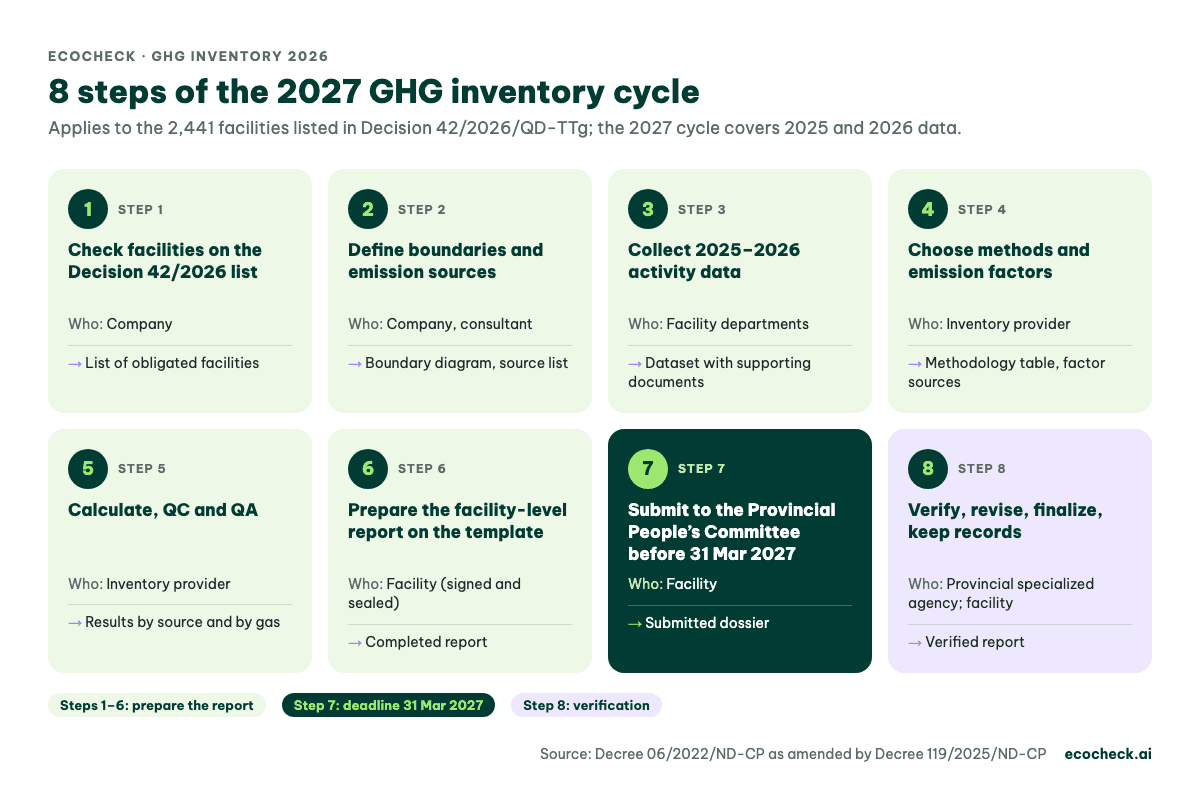
Figure 1: The 2026 greenhouse gas inventory process in 8 steps, from checking the Decision 42/2026 list to submitting to the Provincial People’s Committee before 31 March 2027 and review
What is the legal basis for the 2026 greenhouse gas inventory process?
- Decree 06/2022/ND-CP, amended by Decree 119/2025/ND-CP (effective 1 August 2025) and Decree 83/2026/ND-CP: inventory obligations, reporting cycle (every two years), receiving authority; the province receives and reviews; only facilities allocated allowances need independent verification.
- Decision 42/2026/QD-TTg (issued 10 August 2026, effective 25 September 2026, replacing Decision 13/2024/QD-TTg): the list of 2,441 facilities, including 1,916 under the Ministry of Industry and Trade, 411 in construction, 53 in transport and 61 under the Ministry of Agriculture and Environment.
- Sector technical guidance circulars: Circular 38/2023/TT-BCT (Industry and Trade), Circular 13/2024/TT-BXD (Construction), Circular 63/2024/TT-BGTVT (Transport).
- Circular 01/2022/TT-BTNMT (as amended): technical MRV guidance; the provincial verification procedure for facility reports no longer applies after Decree 119/2025/ND-CP.
ISO 14064-1 and the GHG Protocol are not mandatory for reports submitted to the government, but they are useful when international customers request data.

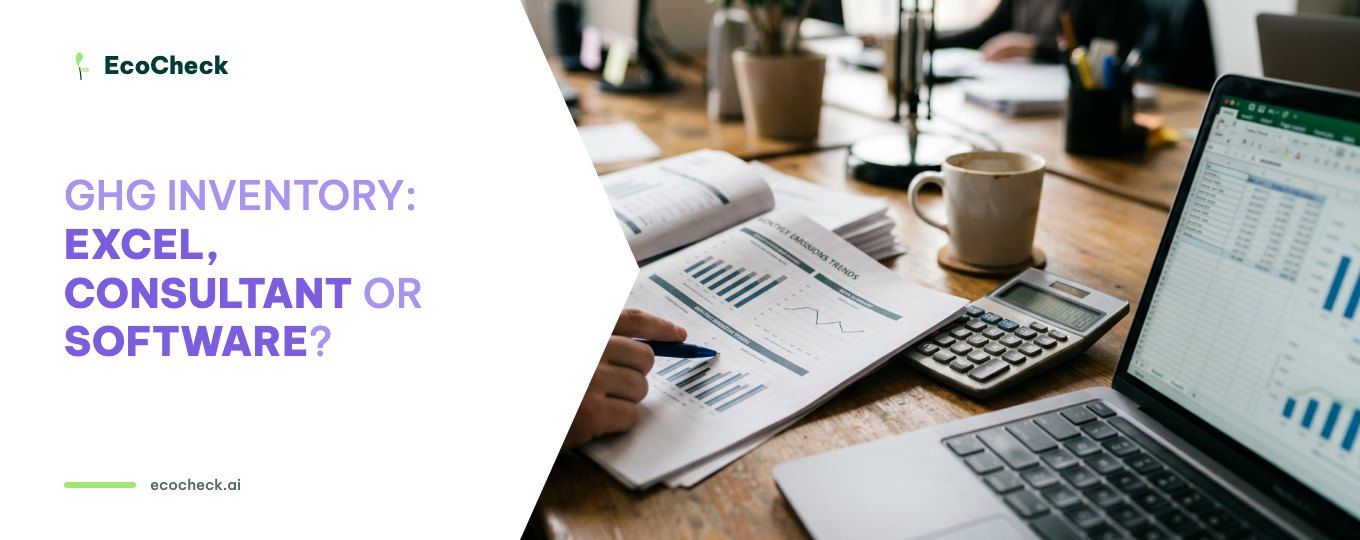
Emission records, spreadsheets and a calculator used to prepare a GHG inventory report
How are the 8 steps of 2026 greenhouse gas reporting carried out in detail?
Step 1: Check whether your facilities are on the list
Obligations are determined per production facility, not per company. Search by legal entity name and the address of each plant in the appendix to Decision 42/2026/QD-TTg, or use EcoCheck’s greenhouse gas inventory obligation lookup tool. Newly added facilities should confirm their first submission cycle with the relevant provincial department.
Step 2: Define boundaries and emission sources
Draw the facility boundary and list every source: fuel combustion equipment, vehicles, industrial process emissions, electricity consumption, refrigerants and waste treatment. Missing sources at this step is the most common error found in reviews and inspections.
Step 3: Collect activity data for 2025 and 2026
Collect electricity bills by meter, fuel receipt and issue logs, quantities of raw materials causing process emissions, and monthly output. Every figure must be linked to an original document. 2025 data already exists, so if it has not been stored systematically it must be recovered immediately.
Step 4: Choose methods and emission factors
Apply the methods set out in the circular of the ministry overseeing your sector and emission factors published by the competent authority; state the source of each factor clearly. Methods must be consistent between the two years and with the previous cycle.
Step 5: Calculate, quality control and quality assurance
Calculate emissions by source and by gas, converted to CO₂ equivalent. Carry out quality control (checking data entry errors, units, year-on-year comparisons) and assess the uncertainty of the data.
Step 6: Prepare the facility-level inventory report
Prepare it using the report template in the appendix to Decree 06/2022/ND-CP (as amended), including facility information, methods, activity data, factors and results for both years. See the structure in our article on the greenhouse gas inventory report template.
Step 7: Submit to the Provincial People’s Committee before 31 March 2027
The report is sent to the Provincial People’s Committee where the facility operates. By the same deadline, 2027 is also the first year facilities submit their annual facility-level emission mitigation report (for 2026).
Step 8: Review, revision and record-keeping
Under Decree 119/2025/ND-CP the Provincial People’s Committee receives, reviews and compiles the report; it no longer verifies it as before. The facility clarifies or adds information if asked, then finalizes. Keep all spreadsheets and supporting documents for the next cycle and for inspections.
Steps 2 to 6 correspond to EcoCheck’s 9-step service process, which also includes a handover step so companies can update future cycles themselves.
Who submits what, to whom and by when, up to 31 March 2027?
| Date | Task | Responsible party |
|---|---|---|
| 25 September 2026 | Decision 42/2026/QD-TTg takes effect; the list of 2,441 facilities applies | — |
| October–December 2026 | Check the list, select an inventory provider, recover 2025 data, collect 2026 data monthly | Facility |
| 31 December 2026 | End of the second data year of the reporting cycle | — |
| January–March 2027 | Finalize 2026 data, calculate, run quality control, prepare the inventory report and mitigation report | Facility, consultant |
| Before 31 March 2027 | Submit the facility-level inventory report (2025–2026 data) and the facility-level mitigation report (2026) | Facility submits to the Provincial People’s Committee |
| After receiving the report | Receive, review and request additions if needed (no longer verifies under Decree 119/2025) | Provincial People’s Committee |
| Before 30 June 2027 | Compile facilities’ mitigation results and send them to the Ministry of Agriculture and Environment and the sector ministries | Provincial People’s Committee |
| Before 31 March 2029 | Next inventory reporting cycle (2027–2028 data) | Facility |
For the long-term roadmap to 2030, see our article on the greenhouse gas inventory roadmap.
What is MRV and how are inventory reports reviewed and verified?
MRV stands for Measurement, Reporting and Verification. Since Decree 119/2025/ND-CP took effect (1 August 2025), the Provincial People’s Committee only receives, reviews and compiles inventory reports and sends the results to the Ministry of Agriculture and Environment and the sector ministries before 30 June; according to the Department of Climate Change, provinces no longer appraise inventory reports as before (Nong nghiep va Moi truong newspaper, 22 May 2026).
Even without provincial verification, reports can still be reviewed and inspected: make sure all sources are covered, methods and factors are appropriate, quality control is in place and figures trace back to source documents.
The 110 thermal power, steel and cement facilities allocated pilot allowances (total cap under Decision 263/QD-TTg of 9 February 2026, allocated per facility by Decision 699/QD-BNNMT of 27 February 2026) must hire an accredited independent verifier and send the verified inventory report to the Ministry of Agriculture and Environment before 1 December, from 2027.
Where do companies most often go wrong?
- Checking the list by company name instead of by facility, leading to missed or unnecessary inventories.
- Missing sources: backup generators, forklifts, refrigerants, process emissions.
- Missing 2025 documents: aggregated figures cannot be reconciled with invoices.
- Changing methods between the two years without explanation, making the data incomparable.
- Starting too late: demand for services piles up in Q1 2027, close to the submission deadline.
Should you do it yourself or hire an inventory provider?
Doing it yourself works when the facility has few sources, complete data and staff who understand the methodology. Hire a service provider when it is your first cycle, you have process emissions, multiple facilities, or need to recover data. For facilities that already have fuel and electricity data, EcoCheck can complete the report in 5 days. Market prices typically range from several tens of millions to over one hundred million VND per facility per cycle (see greenhouse gas inventory costs in 2026).
Next step: check your facilities with the free lookup tool, then get advice on our greenhouse gas inventory service to meet the 31 March 2027 deadline.
Frequently asked questions
How many steps are there in the greenhouse gas inventory process?
Legally there are 8 steps: check the list, define boundaries, collect data, choose methods and factors, calculate and control quality, prepare the report, submit to the Provincial People’s Committee, and review and finalization.
To whom and when is the greenhouse gas inventory report submitted?
It is submitted to the Provincial People’s Committee before 31 March, every two years. The next cycle is due before 31 March 2027 and covers data for 2025 and 2026.
Who verifies facility-level inventory reports?
For ordinary listed facilities there is no verification step: the Provincial People’s Committee receives, reviews and compiles reports (Decree 119/2025/ND-CP). For the 110 facilities with allowances, an accredited independent verifier verifies the report, which goes to the Ministry of Agriculture and Environment before 1 December from 2027.
Which reports must facilities submit in 2027?
Before 31 March 2027: the facility-level inventory report (2025–2026 data) and the first facility-level emission mitigation report (for 2026), both sent to the Provincial People’s Committee.
How long does a greenhouse gas inventory take?
If fuel and electricity data are readily available, the report can be completed in 5 days. If documents need to be recovered or there are many production lines, it usually takes a few weeks.
Is your business required to report GHG emissions?
EcoCheck automatically calculates Scope 1/2/3 and exports NĐ06/TT38-compliant reports in one click — saving 90% of the time vs. Excel.
Latest posts

![Vietnam Carbon Price: VN2025 Allowances on HNX [Oct 2026]](https://cms.ecocheck.ai/uploads/ecocheck_vietnam_carbon_price_vn2025_allowances_hnx_8e7c642d53.jpg)