Why choose your approach early in 2026?
How much money and effort does each approach take?
DIY in Excel: when is it enough?
Hiring a consultant: what are you paying for?
Using software: what does it solve, and what not?
Decision table: which approach fits which situation?
How does EcoCheck combine software, experts and AI?
Frequently asked questions
Can a company do its own GHG inventory?
How much does a GHG inventory consultant cost in Vietnam?
Is an Excel-based GHG inventory accepted?
If we hire a consultant, do we still need software?
How long does a DIY inventory take?
GHG Inventory: Excel, Consultant or Software? An Honest 2026 Comparison
Doing it yourself in Excel costs the least money but the most effort, and carries the highest risk at verification; hiring a consultant is fast and safe for a first inventory, typically costing from a few tens of millions to over one hundred million VND per facility per period; software costs from zero to a few tens of millions of VND per year and keeps your data for future periods, but you still need someone who understands the method. For most facilities on the mandatory list, the sensible answer is a mix: software to store and calculate data, experts for the first period and for verification.
This article compares the three approaches on cost, effort, risk and fit, with a decision table. Every cost figure has a source; where something is an estimate, we say so.
Disclosure: EcoCheck sells both software and inventory services, so we have an interest in two of the three options. We have tried to be fair, including the cases where Excel is enough.
Why choose your approach early in 2026?
Decision 42/2026/QD-TTg (effective 25 September 2026) puts 2,441 facilities on the mandatory GHG inventory list (see Decision 42/2026/QD-TTg). The facility inventory report, covering 2025 and 2026 data, must be filed with the provincial People's Committee before 31 March 2027. From 2027, facilities also file an annual mitigation report. This is recurring work, not a one-off.
Many facilities are on the list for the first time, have no dedicated staff, and 2025 is already behind them. A poor choice of approach often shows up late, when the authority asks for explanations during verification. Not sure whether your facility is covered? Use the free GHG inventory obligation checker first.
How much money and effort does each approach take?
| Criterion | DIY in Excel | Hire a consultant | Use software |
|---|---|---|---|
| Cash cost (indicative) | Near zero for tools (free GHG Protocol spreadsheets); training about VND 10–15M per person | A few tens of millions to over VND 100M per facility per period; one firm publishes VND 50–150M | From zero (free plans) to about VND 59–131M per year (EcoCheck Pro, Pro+); enterprise platforms can cost tens of thousands of USD per year |
| Internal effort | High: about 1–3 months of staff time | Low to medium: supply data and documents, answer questions | Medium in the first period, lower afterwards because setup is reused |
| Know-how needed | Must understand methods, factors and templates | Consultant handles it; you need enough to check their work | The tool guides you; you still need someone who knows boundaries and sources |
| Main risks | Formula errors, outdated factors, missed sources, reliance on one person | Uneven quality, little handover, re-hiring next period | Wrong inputs still give wrong results; software does not explain itself to verifiers |
| Next reporting period | Redo the work, hard if the preparer has left | Usually re-hire from scratch | Data and methods are kept and updated |
Sources: service costs from EcoCheck's GHG inventory cost 2026 article; the VND 50–150M range, training cost and 1–3 months of staff time from VINCEF (page undated); software prices from EcoCheck pricing (VND 4,950,000 and 10,950,000 per month excluding VAT, times 12) and Microsoft Sustainability Manager (US$4,000–12,000 per tenant per month). Checked 9 October 2026. These are indicative ranges, not quotes.
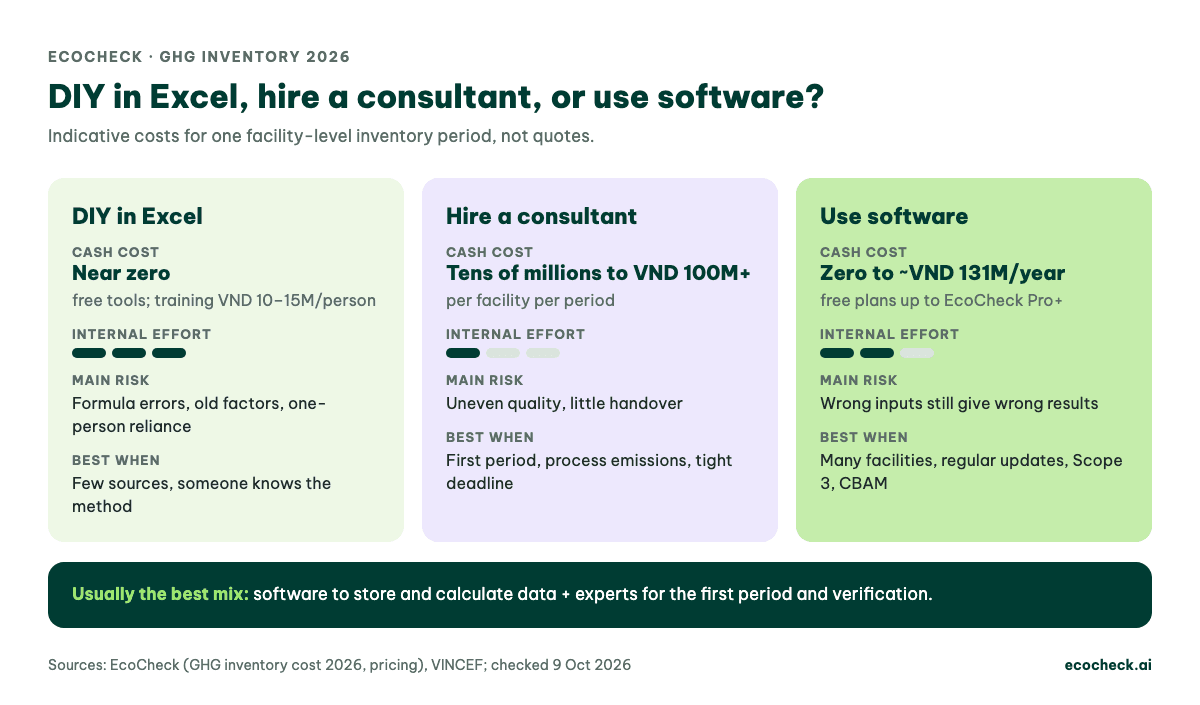
Figure 1: Comparison of three GHG inventory approaches: DIY in Excel, hiring a consultant, using software, by cost, effort, risk and fit
DIY in Excel: when is it enough?
Excel is enough when a facility has only a few sources (purchased electricity, diesel for generators, forklifts), the data sits in invoices, and one person is willing to learn the method. The GHG Protocol publishes free spreadsheets by source type that show how the calculations work.
- Pros: no tool cost, and the company understands its own numbers.
- Risks: spreadsheets have no Decree 06 template or Vietnamese factors; outdated grid factors are easy to use by mistake; there is no record of who changed which cell; if the preparer leaves, the next period starts almost from scratch.
- Avoid it when: you have industrial process emissions (cement, steel, chemicals), several facilities, or customers asking for Scope 3.
To try a manual calculation first, see our Scope 1 and 2 calculator guide with formulas and factors.

A team reviewing GHG inventory data and spreadsheets
Hiring a consultant: what are you paying for?
You pay for experience: drawing the right boundary, not missing sources, choosing methods under the sector circulars, and explaining the report when the authority verifies it. For a first inventory this is usually the part most worth paying for.
- Pros: fast, low legal risk, suitable when 2025 data must be reconstructed.
- Risks: quality varies widely between firms; many cheap quotes have a reduced scope; the deliverable is often just a report file, with no system to update next time.
- When hiring, ask: which scopes, how many facilities, whether data collection and checks are included, whether verification support is included, and whether spreadsheets or a system are handed over. See also 7 criteria for choosing a consultant.
Using software: what does it solve, and what not?
Software keeps data by month and by source, applies factors and exports reports in the required format, so later periods are much lighter. Several people can enter data, with permissions and logs. For a comparison of specific tools, see top 5 GHG emissions calculation tools 2026.
- Pros: history is kept, recalculation is quick when factors change, and it is easy to extend to Scope 3 or CBAM.
- What it does not solve: software does not know which sources you missed, does not draw your boundary, and does not sit with the verifier. Wrong inputs still produce a wrong report.
- Hidden costs: first-period setup time, optional expert fees, and automated data integration fees.
Decision table: which approach fits which situation?
| Your situation | Best fit | Why |
|---|---|---|
| Not yet mandatory, just want a rough figure | Excel or a free software plan | Near-zero cost, enough for an estimate |
| One facility, few sources, environmental staff, not the first period | DIY, ideally in software | Method is settled; only data needs updating |
| First period, must file before 31 March 2027 | Consultant, working in software to keep the data | High verification risk and little time |
| Process emissions (cement, steel, chemicals) or many production lines | Consultant with sector expertise | Complex methods, easy to get wrong |
| Several facilities, several data entry users | Software with permissions and multi-facility roll-up | Excel versions are hard to control |
| Exporting steel, aluminium, cement or fertiliser to the EU | Software with CBAM, plus experts | Needs SEE by CN code and data for importers |
| International customers ask for Scope 3 | Software covering 15 Scope 3 categories | Large supply chain data, updated yearly |
How does EcoCheck combine software, experts and AI?
With EcoCheck you do not have to pick just one. This is how we usually work with a facility in its first period:
- Software as the base: inventory ledgers per facility, emission sources from Decree 06 and GHG Protocol templates, Vietnamese emission factors, reports under Decree 06 and ISO 14064-1. Basic is free; Pro is VND 4,950,000/month and Pro+ VND 10,950,000/month (see pricing).
- Experts when needed: a 9-step full-service inventory including verification support and a handover step so the company can update later periods itself. For facilities that already have fuel and electricity data, EcoCheck can complete the report in 5 days (see the 2026 GHG inventory process).
- AI for the repetitive work: connect EcoCheck to ChatGPT or Claude to record monthly data, ask for the largest source, or build a report by just asking. The AI calls EcoCheck's calculation tools rather than calculating on its own; the workspace owner decides whether AI can read or write, and every command is logged (learn about EcoCheck for AI).
Limits to know: on Pro and Pro+, GHG consultants are a paid option, not included; in the price list, the full-service inventory belongs to the Advanced plan, priced on request. AI speeds up data entry but does not replace human review before filing.
Next step: check your inventory obligation in 20 seconds, then choose a plan or contact us for advice on the right approach for your facility.
Frequently asked questions
Can a company do its own GHG inventory?
Yes. Decree 06/2022/ND-CP does not require hiring a consultant. The facility prepares the report using the template and sector methods, and is responsible for it during verification.
How much does a GHG inventory consultant cost in Vietnam?
Usually from a few tens of millions to over VND 100 million per facility per period, depending on the number of sources and facilities and whether Scope 3 is included. Some firms publish a range of about VND 50–150 million.
Is an Excel-based GHG inventory accepted?
Yes, the law does not prescribe a calculation tool. What matters is the right template and method, cited factor sources and supporting documents for every figure.
If we hire a consultant, do we still need software?
It is not required, but it helps. From 2027 facilities file an annual mitigation report and an inventory every two years; if the data lives in software, the next period does not start from zero.
How long does a DIY inventory take?
Some firms estimate about 1–3 months of staff time for the first period, depending on how available the data is. Later periods are faster if the method and data are kept.
Doanh nghiệp bạn thuộc diện phải kiểm kê khí nhà kính?
EcoCheck tự động tính Scope 1/2/3, xuất báo cáo chuẩn NĐ06/TT38 chỉ 1-click — tiết kiệm 90% thời gian so với Excel.
Bài viết mới nhất








![Phương pháp Kiểm kê Khí nhà kính: GHG Protocol & ISO 14064 [2026]](https://cms.ecocheck.ai/uploads/Cac_phuong_phap_va_tieu_chuan_kiem_ke_khi_nha_kinh_pho_bien_e645f7df80.png)