What is the formula for Scope 1 and Scope 2 GHG emissions?
Which fuel emission factors apply in Vietnam?
How do you convert litres, kg and tonnes of fuel to TJ?
Worked example: Scope 1 and 2 emissions for a factory
Step 1: Convert activity data to mass
Step 2: Convert mass to energy (TJ)
Step 3: Multiply by the factor for each gas
Step 4: Calculate Scope 2
Step 5: Add up the results
How do you use the Scope 1 and 2 calculation template?
When is a spreadsheet no longer enough?
Frequently asked questions
How many kg of CO₂ does 1 litre of diesel emit?
What is Vietnam's official emission factor list?
Which factor applies to electricity?
Do I have to calculate CH₄ and N₂O from fuel combustion?
Can this spreadsheet replace the inventory report filed with the authorities?
GHG Emissions Calculator for Vietnam (Scope 1 & 2): Formula & Factors
Calculating Scope 1 and Scope 2 greenhouse gas emissions needs one formula: Emissions = Activity data × Emission factor. For fuels, convert the activity data to energy (TJ) and add CH₄ and N₂O using global warming potentials (GWP). For electricity, multiply MWh by the latest official grid factor, 0.6592 tCO₂/MWh. Quick conversions using the factors in Decision 2626/QD-BTNMT and the IPCC 2006 default calorific values: 1 litre of diesel burned in a generator gives about 2.69 kg CO₂e, 1 litre of petrol in a car about 2.33 kg CO₂e, 1 kg of LPG about 2.99 kg CO₂e, and 1 tonne of anthracite about 2.64 t CO₂e. This page gives the factor tables with sources, a fully worked example for one factory, and a calculation template you can copy into Excel.
Last updated: 7 October 2026.
What is the formula for Scope 1 and Scope 2 GHG emissions?
Scope 1 covers direct emissions from sources the company owns or controls: boilers, generators, vehicles and forklifts. Scope 2 covers indirect emissions from purchased electricity. If the boundary between the two is unclear, see direct vs indirect emissions.
Scope 1 – fuel combustion (IPCC 2006 Tier 1 method, also the structure used in Circular 38/2023/TT-BCT):
E (tCO₂e) = Fuel (TJ) × [EFCO₂ + EFCH₄ × GWPCH₄ + EFN₂O × GWPN₂O] ÷ 1,000
- Fuel (TJ) = fuel mass (Gg, i.e. thousand tonnes) × net calorific value, NCV (TJ/Gg).
- EF is the emission factor in kg of gas per TJ.
- Divide by 1,000 to convert kg to tonnes.
Scope 2 – grid electricity:
E (tCO₂) = Electricity consumed (MWh) × 0.6592 tCO₂/MWh
0.6592 is the 2023 factor from Official Letter 1726/BĐKH-PTCBT dated 3 December 2024, the latest official value as of 7 October 2026.
Which fuel emission factors apply in Vietnam?
The former Ministry of Natural Resources and Environment (now the Ministry of Agriculture and Environment) published the national factor list in Decision 2626/QD-BTNMT dated 10 October 2022. Annex I of the decision covers fuel combustion, all at IPCC Tier 1. CH₄ and N₂O factors vary by the sector using the fuel, so pick the right row. The table below shows the most commonly used rows:
| Fuel | Emission source (per Decision 2626) | CO₂ (kg/TJ) | CH₄ (kg/TJ) | N₂O (kg/TJ) | Row in Annex I |
|---|---|---|---|---|---|
| Diesel oil (DO) | Manufacturing industries and construction (boilers, generators) | 74,100 | 3 | 0.6 | 1.28–1.30 |
| Diesel oil (DO) | Road transport | 74,100 | 3.9 | 3.9 | 1.46–1.48 |
| Diesel oil (DO) | Commercial and services | 74,100 | 10 | 0.6 | 1.70–1.72 |
| Petrol (gasoline) | Road transport | 69,300 | 33 | 3.2 | 1.49–1.51 |
| Fuel oil (FO) | Manufacturing industries and construction | 77,400 | 3 | 0.6 | 1.31–1.33 |
| Liquefied petroleum gas (LPG) | Manufacturing industries and construction | 63,100 | 1 | 0.1 | 1.34–1.36 |
| Natural gas | Manufacturing industries and construction | 56,100 | 1 | 0.1 | 1.37–1.39 |
| Anthracite | Manufacturing industries and construction | 98,300 | 10 | 1.5 | 1.25–1.27 |
| Sub-bituminous coal | Energy industries | 96,100 | 1 | 1.5 | 1.4–1.6 |
The CO₂ values match the defaults in Tables 1.4 and 2.3 of Volume 2 of the 2006 IPCC Guidelines. Decision 2626 has no row for petrol used in stationary equipment at a plant (for example, a petrol generator). In that case, use the IPCC 2006 Table 2.3 defaults (CO₂ 69,300, CH₄ 3, N₂O 0.6 kg/TJ) and cite the source. Circular 38/2023/TT-BCT also says IPCC guidance applies only when no factor has been published by the competent authority.

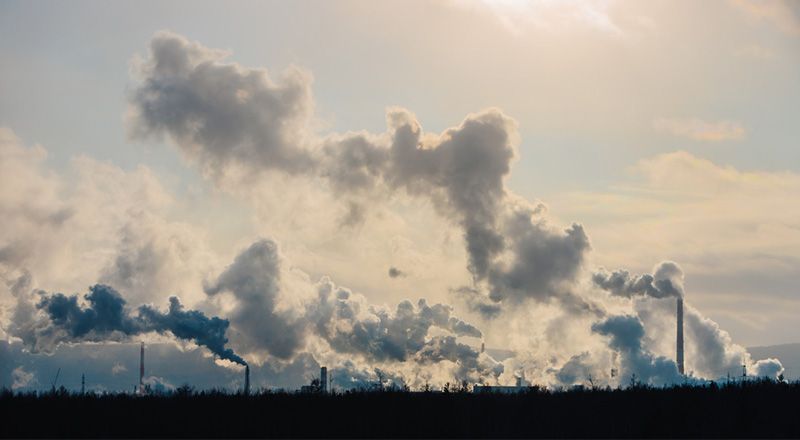
Fuel and combustion equipment at a plant, a Scope 1 emission source
How do you convert litres, kg and tonnes of fuel to TJ?
Decision 2626 gives factors in kg/TJ but no calorific values, while invoices show litres, kg or tonnes. You need two conversion parameters:
- Density, to convert litres to kg. TCVN 5689:2018 sets diesel density at 15 °C between 820 and 860 kg/m³. This page uses 0.84 kg/litre. For petrol, the standard only requires the measured value to be reported, so this page assumes 0.74 kg/litre. If the delivery note or the batch quality certificate shows a measured value, use it.
- Net calorific value (NCV), to convert mass to energy. The defaults come from IPCC 2006, Volume 2, Table 1.2. Coal calorific values vary widely by grade, so use your supplier's analysis where you have it.
| Fuel (use) | Unit | Density | NCV (TJ/Gg) | kg CO₂ / unit | kg CO₂e / unit |
|---|---|---|---|---|---|
| Diesel (generator, boiler) | litre | 0.84 kg/l (assumed) | 43.0 | 2.677 | 2.685 |
| Diesel (road trucks) | litre | 0.84 kg/l (assumed) | 43.0 | 2.677 | 2.718 |
| Petrol (cars) | litre | 0.74 kg/l (assumed) | 44.3 | 2.272 | 2.330 |
| LPG (forklifts, industrial kitchens) | kg | — | 47.3 | 2.985 | 2.987 |
| Fuel oil FO (boilers) | kg | — | 40.4 | 3.127 | 3.137 |
| Natural gas (furnaces) | GJ on NCV basis | — | — | 56.10 | 56.15 |
| Natural gas (invoiced in MMBTU on GCV basis) | MMBTU | — | NCV ≈ 0.9 × GCV | 53.27 | 53.32 |
| Anthracite (boilers) | tonne | — | 26.7 | 2,624.6 | 2,642.7 |
The CO₂e column uses GWPs from the IPCC Fifth Assessment Report (AR5): CH₄ = 28, N₂O = 265. These are also the GWPs that the Paris Agreement's enhanced transparency framework requires for national inventories. Circular 38/2023/TT-BCT only says to "apply the latest IPCC guidance" and does not name a specific report. With AR6 values (fossil CH₄ 29.8, N₂O 273), fuel-combustion results change by less than 0.1%. Choose one GWP set, state it in the report and use it consistently. For the list of GWPs by gas, see greenhouse gases and the GWP table.
According to the IPCC, the NCV of natural gas is about 10% lower than its gross calorific value (GCV). If your gas invoice shows MMBTU on a GCV basis, multiply by 0.9 before applying factors per TJ. Unit conversion: 1 MMBTU = 1.055056 GJ.
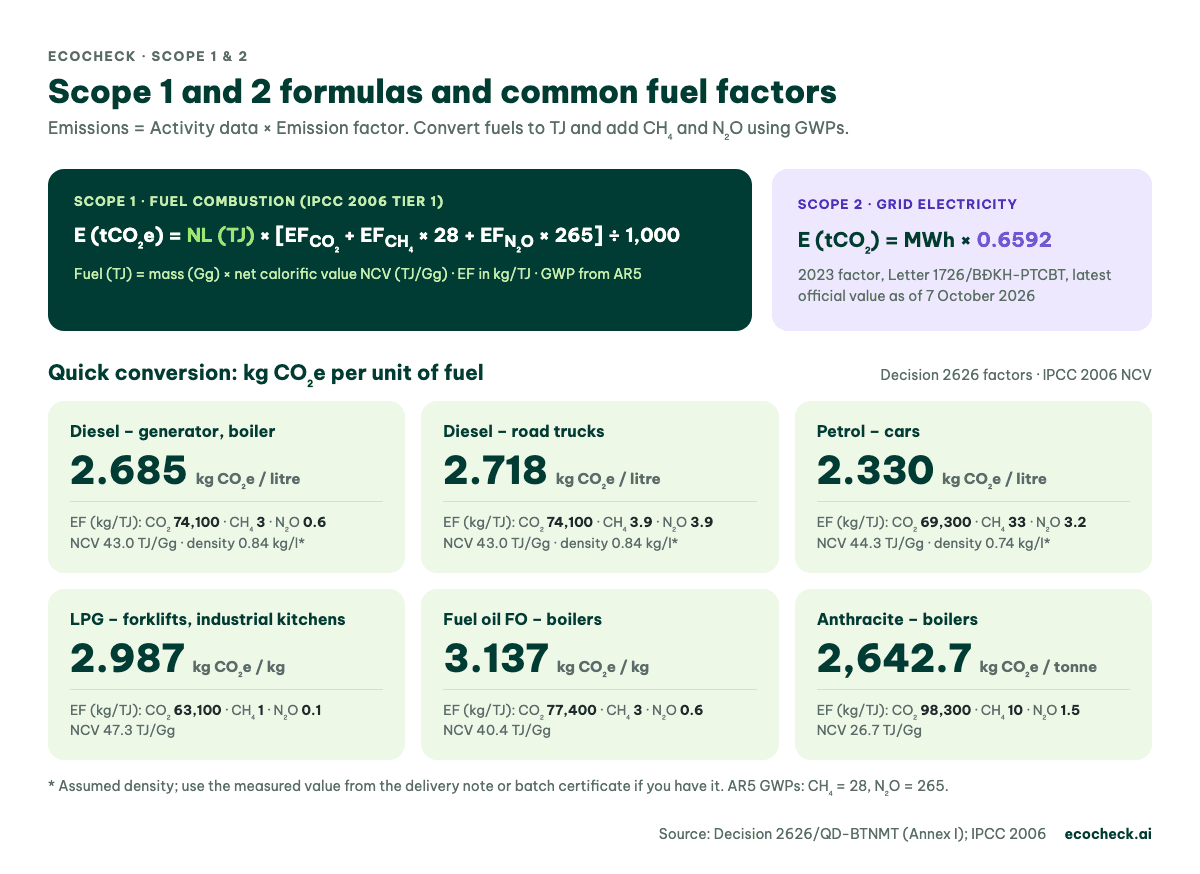
Figure 1: Scope 1 and Scope 2 emission formulas with quick kg CO₂e conversions for diesel, petrol, LPG, fuel oil and anthracite
Worked example: Scope 1 and 2 emissions for a factory
A factory has the following 2025 data: 1,850,000 kWh of grid electricity, 420 tonnes of anthracite burned in a boiler, 6,000 litres of diesel for the backup generator, 2,500 kg of LPG for forklifts, 18,000 litres of diesel for delivery trucks, and 4,000 litres of petrol for cars.
Step 1: Convert activity data to mass
Generator diesel: 6,000 × 0.84 = 5,040 kg = 5.04 tonnes. Truck diesel: 18,000 × 0.84 = 15,120 kg. Petrol: 4,000 × 0.74 = 2,960 kg. Coal and LPG are already in mass units.
Step 2: Convert mass to energy (TJ)
Coal: 420 tonnes = 0.42 Gg × 26.7 = 11.214 TJ. Generator diesel: 0.00504 Gg × 43.0 = 0.21672 TJ. LPG: 0.0025 Gg × 47.3 = 0.11825 TJ. Truck diesel: 0.01512 × 43.0 = 0.65016 TJ. Petrol: 0.00296 × 44.3 = 0.13113 TJ.
Step 3: Multiply by the factor for each gas
Take coal as the example. CO₂ = 11.214 × 98,300 = 1,102,336 kg. CH₄ = 11.214 × 10 = 112.1 kg, times GWP 28 gives 3,140 kg CO₂e. N₂O = 11.214 × 1.5 = 16.8 kg, times GWP 265 gives 4,458 kg CO₂e. The total is 1,109.93 tCO₂e.
Step 4: Calculate Scope 2
1,850,000 kWh = 1,850 MWh × 0.6592 = 1,219.52 tCO₂.
Step 5: Add up the results
| Source | Scope | Activity data | TJ | CO₂ (t) | CH₄ + N₂O (tCO₂e) | Total (tCO₂e) |
|---|---|---|---|---|---|---|
| Anthracite boiler | Scope 1 | 420 t | 11.214 | 1,102.34 | 7.60 | 1,109.93 |
| Diesel generator | Scope 1 | 6,000 l | 0.217 | 16.06 | 0.05 | 16.11 |
| LPG forklifts | Scope 1 | 2,500 kg | 0.118 | 7.46 | 0.01 | 7.47 |
| Diesel trucks | Scope 1 | 18,000 l | 0.650 | 48.18 | 0.74 | 48.92 |
| Petrol cars | Scope 1 | 4,000 l | 0.131 | 9.09 | 0.23 | 9.32 |
| Scope 1 subtotal | 1,191.75 | |||||
| Grid electricity | Scope 2 | 1,850 MWh | — | 1,219.52 | — | 1,219.52 |
| Total Scope 1 + 2 | 2,411.27 |
Three points stand out. First, the coal boiler and grid electricity make up 96.6% of the total, so these two sources need the most complete supporting documents. Second, CH₄ and N₂O are only about 0.4% of the total, but they must still be calculated because the report requires every gas. Third, the same diesel has a much higher N₂O factor in trucks than in a generator, so stationary and mobile sources must be kept separate. Note that 2,411 tCO₂e covers only energy-related Scope 1 and 2. A full report also includes industrial process emissions, refrigerants and waste treatment if the facility has those sources.
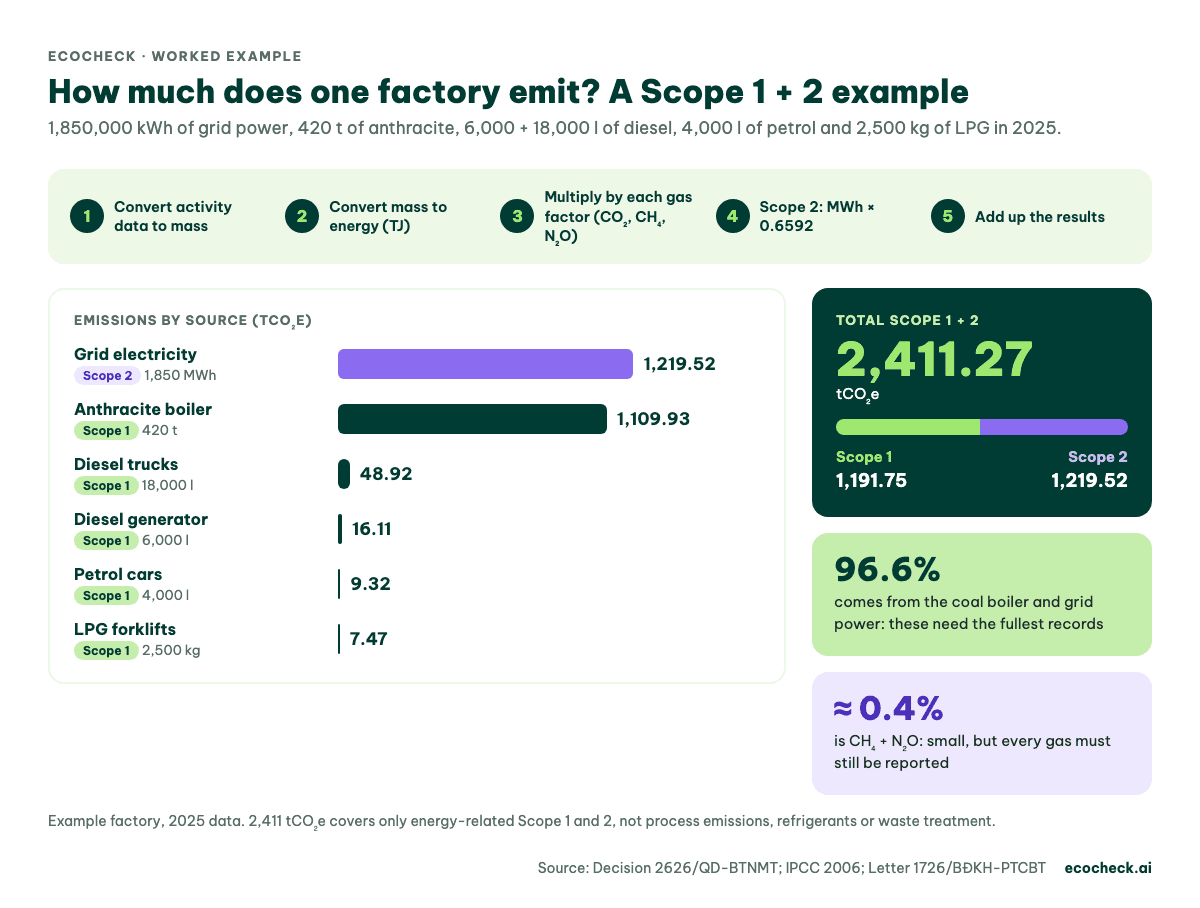
Figure 2: Factory example: total Scope 1 + 2 emissions of 2,411.27 tCO₂e, Scope 1 1,191.75 and Scope 2 1,219.52 tCO₂e
How do you use the Scope 1 and 2 calculation template?
Copy the table below into Excel or Google Sheets. Each emission source at each facility gets one row. Columns G to J hold the formulas.
| Column | Column name | Content / formula | Example (diesel generator) |
|---|---|---|---|
| A | Emission source | Name of equipment or vehicle | 500 kVA backup generator |
| B | Scope | Scope 1 stationary / Scope 1 mobile / Scope 2 | Scope 1 stationary |
| C | Fuel | Name as in Decision 2626 | Diesel oil |
| D | Activity data | 12-month total | 6,000 |
| E | Unit and evidence | Unit, invoice or issue-slip number | litres; stock issue slips 01–12/2025 |
| F | Density (t/unit) | From batch certificate, or assumed | 0.00084 |
| G | Energy (TJ) | = D × F ÷ 1,000 × NCV | 0.21672 |
| H | EF CO₂ / CH₄ / N₂O (kg/TJ) | Cite the Decision 2626 row | 74,100 / 3 / 0.6 (rows 1.28–1.30) |
| I | GWP | State AR5 or AR6 | AR5: 28 / 265 |
| J | Emissions (tCO₂e) | = G × (EFCO₂ + EFCH₄ × 28 + EFN₂O × 265) ÷ 1,000 | 16.11 |
| K | QA/QC notes | Entered by, checked by, date | Stock accountant / ESG, 15/01/2026 |
For electricity rows (Scope 2), skip columns F, G and I. Column J is then D (MWh) × 0.6592, and column H reads "Letter 1726/BĐKH-PTCBT, 2023". Put each data year on its own sheet, because the 31 March 2027 report needs data for both 2025 and 2026. This template matches the activity-data section of the GHG inventory report template.
When is a spreadsheet no longer enough?
A spreadsheet works for quick estimates, or for a facility with only a few combustion sources and electricity. Move to a dedicated tool when any of the following applies:
- You have process emissions (clinker, lime, steel, chemicals) that need sector-specific methods under the sector circulars.
- You have several facilities and must split data by each listed facility.
- You must trace every number back to source documents when the reviewing authority asks.
- Factors change, for example when a 2024 grid factor is published, and you would have to edit many files.
First, check whether your facility must conduct an inventory using the free GHG inventory obligation checker. The EcoCheck platform has the Decision 2626 factors, calorific values and grid factor built in, converts units automatically and attaches evidence to each data row. If you need specialists to prepare the full report, see the EcoCheck GHG inventory service. To compare EcoCheck with other software, see the top 5 GHG emissions calculation tools. The full sequence from data collection to submission is in 9 steps to conduct a GHG inventory.
Frequently asked questions
How many kg of CO₂ does 1 litre of diesel emit?
About 2.68 kg CO₂, using 74,100 kg CO₂/TJ from Decision 2626/QD-BTNMT, an NCV of 43.0 TJ/Gg (IPCC 2006) and a density of 0.84 kg/litre. Adding CH₄ and N₂O gives about 2.69 kg CO₂e for a generator and 2.72 kg CO₂e for a truck.
What is Vietnam's official emission factor list?
Decision 2626/QD-BTNMT dated 10 October 2022 of the Ministry of Natural Resources and Environment publishes the emission factor list for GHG inventories, in 4 annexes: energy; industrial processes and product use; agriculture, forestry and land use; and waste.
Which factor applies to electricity?
Use the latest official grid factor, 0.6592 tCO₂/MWh (2023, Official Letter 1726/BĐKH-PTCBT). Values for 2024 and 2025 are estimates only at this stage.
Do I have to calculate CH₄ and N₂O from fuel combustion?
Yes. The inventory is calculated gas by gas and then converted to CO₂ equivalent. For fuel combustion, CH₄ and N₂O are usually under 1% of the total, but they must still be included.
Can this spreadsheet replace the inventory report filed with the authorities?
No. The spreadsheet is only the calculation. A facility-level inventory report also needs a description of the boundary, methods and quality control, must follow the prescribed template, and must be filed with the provincial People's Committee before 31 March 2027.










![Top 5 Công Cụ Tính Toán Phát Thải Khí Nhà Kính [Cập Nhật 2026]](https://cms.ecocheck.ai/uploads/Eco_Check_Top_5_cong_cu_va_phan_mem_ho_tro_kiem_ke_khi_nha_kinh_d9d03bf693.png)
![Phương pháp Kiểm kê Khí nhà kính: GHG Protocol & ISO 14064 [2026]](https://cms.ecocheck.ai/uploads/Cac_phuong_phap_va_tieu_chuan_kiem_ke_khi_nha_kinh_pho_bien_e645f7df80.png)