Which industrial companies must conduct a GHG inventory in 2026?
When is the 2026–2027 GHG inventory report deadline?
Which emission sources does each industry need to inventory?
What does an industrial GHG inventory service include?
How many steps does a plant GHG inventory involve, and how long does it take?
What documents and data should a plant prepare?
How much does an industrial GHG inventory service cost?
What else should steel, cement and thermal power plants consider (allowances, CBAM)?
Emission allowance pilot
EU CBAM
Should you do the inventory in-house or hire a service provider?
Frequently asked questions
Which industrial companies must conduct a GHG inventory in 2026?
When is the next GHG inventory report deadline?
How long does a GHG inventory for a plant take?
How much does a GHG inventory service for a plant cost?
What are industrial process emissions?
Does a GHG inventory help with CBAM compliance?
Industrial GHG Inventory Services in Vietnam 2026
In 2026, plants named in the list attached to Decision 42/2026/QD-TTg (effective 25 September 2026, covering 2,441 facilities, of which 1,916 fall under the Ministry of Industry and Trade) must conduct a facility-level greenhouse gas (GHG) inventory, prepare a report every two years and submit it to the provincial People's Committee before 31 March; the next deadline is 31 March 2027, covering data for 2025 and 2026. An industrial GHG inventory service covers defining the facility boundary, collecting fuel, electricity and raw material data, selecting emission factors, calculating Scope 1 and 2 (optionally Scope 3), quality control, preparing the report in the prescribed format and supporting verification.
Note on the 110 facilities with emission allowances (thermal power, steel, cement): they do not file the inventory report with the provincial People's Committee by 31 March. Instead they send a verified inventory report to the Ministry of Agriculture and Environment before 1 December each year, starting in 2027 (Article 11, Decree 06/2022/ND-CP as amended by Decree 119/2025/ND-CP). The annual mitigation report is still due by 31 March.
Definitions are covered in our article on industrial emissions inventory; this article is for plants choosing an inventory provider for the 2027 reporting cycle.
Which industrial companies must conduct a GHG inventory in 2026?
The obligation applies when a facility is named in the list attached to Decision 42/2026/QD-TTg, issued on 10 August 2026, which replaces Decision 13/2024/QD-TTg. The list contains 2,441 facilities, 275 more than the 2,166 facilities on the 2024 list:
| Managing ministry | Number of facilities |
|---|---|
| Industry and Trade | 1,916 |
| Construction (construction field) | 411 |
| Construction (transport field) | 53 |
| Agriculture and Environment | 61 |
| Total | 2,441 |
The Decision identifies six sectors subject to inventory: energy; transport; construction; industrial processes; agriculture, forestry and land use; and waste. Under Decree 06/2022/ND-CP, the criteria for including a facility in the list are emissions of 3,000 tonnes of CO₂ equivalent/year or more, or thermal power plants and industrial production facilities consuming 1,000 TOE/year or more. However, the final basis is the list itself, not your own calculation. When checking:
- Check by individual production site: a company with three plants may have only one plant on the list.
- Check by legal entity name as shown on the enterprise registration certificate, not by brand name.
- Facilities that were on the 2024 list but are no longer on the 2026 list are exempt from submitting a report in 2027 (according to a summary by VNCPC).
Run a quick check with EcoCheck's free lookup tool (about 20 seconds, no sign-up required), then cross-check against the appendix. Detailed analysis of the list: Decision 42/2026/QD-TTg: 2,441 facilities must conduct a GHG inventory.
When is the 2026–2027 GHG inventory report deadline?
Under Article 11 of Decree 06/2022/ND-CP, as amended by Decree 119/2025/ND-CP (effective 1 August 2025) and Decree 83/2026/ND-CP, listed facilities prepare an inventory report every two years from 2024 onwards and submit it to the provincial People's Committee before 31 March. The next cycle is due before 31 March 2027 and covers data for 2025 and 2026.
Most of the data for the next cycle has therefore already been generated; if 2025 records were not kept systematically, recovering them will take up most of the project time. Facilities newly added under Decision 42 should confirm their first submission cycle with the relevant provincial department. For other milestones, see our article on the GHG inventory roadmap.

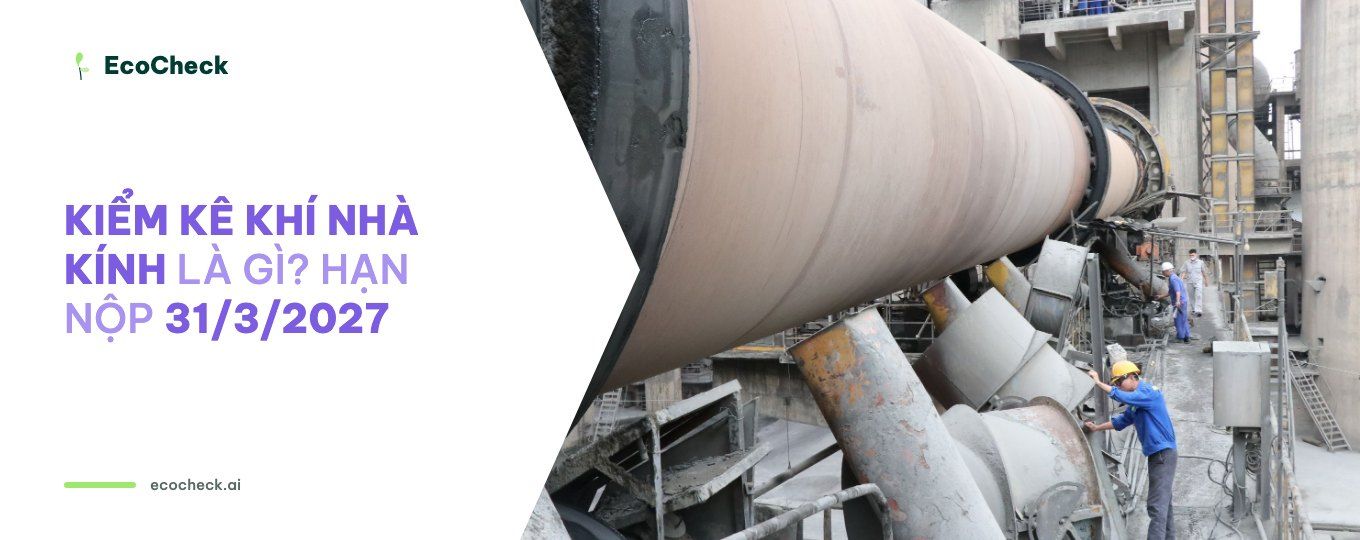
A worker operating machinery in an industrial plant
Which emission sources does each industry need to inventory?
The biggest difference between industries is whether there are industrial process emissions, i.e. emissions from chemical reactions of raw materials rather than from fuel combustion. This is the part most often missed when companies do it themselves. Facilities under the Ministry of Industry and Trade apply the methodology in Circular 38/2023/TT-BCT (corrected by Decision 334/QD-BCT in 2025).
| Industry | Main emission sources | Notes |
|---|---|---|
| Iron and steel | Coke in blast furnaces and converters; electricity for electric arc furnaces (EAF); electrodes; limestone flux | Large Scope 1, with process emissions; EAF plants have high Scope 2. Part of the allowance pilot group and subject to CBAM. |
| Cement, clinker | Limestone decomposition during clinker production; kiln fuel; electricity for mills | Process emissions must be calculated separately from combustion emissions. Part of the allowance pilot group and subject to CBAM. |
| Thermal power | Combustion of coal, gas and oil; limestone for flue gas desulphurisation | Almost entirely Scope 1; requires calorific values and fuel analysis results. Part of the allowance pilot group. |
| Chemicals, fertilisers | Ammonia production (gas and coal as feedstock); nitric acid (N₂O); boilers | Includes process emissions and non-CO₂ gases. Fertilisers are subject to CBAM. |
| Textiles, dyeing | Boilers (coal, biomass, oil); electricity | Mainly Scope 1 from boilers and Scope 2; separate fuel data by boiler. |
| Paper, pulp | Boilers; electricity; wastewater treatment | Mainly Scope 1 and 2; organic wastewater can generate CH₄. |
| Food and beverages | Boilers; refrigeration systems; electricity; wastewater | Refrigerant leakage (HFCs) is Scope 1 and is often overlooked. |
| Plastics, packaging | Electricity for injection, extrusion and blow moulding machines; chillers; backup generators | Scope 2 is usually the largest; Scope 3 (plastic resin) matters if export customers require it. |
This table is for initial scoping and does not replace an on-site survey. See also our article on GHG inventory for the steel industry.
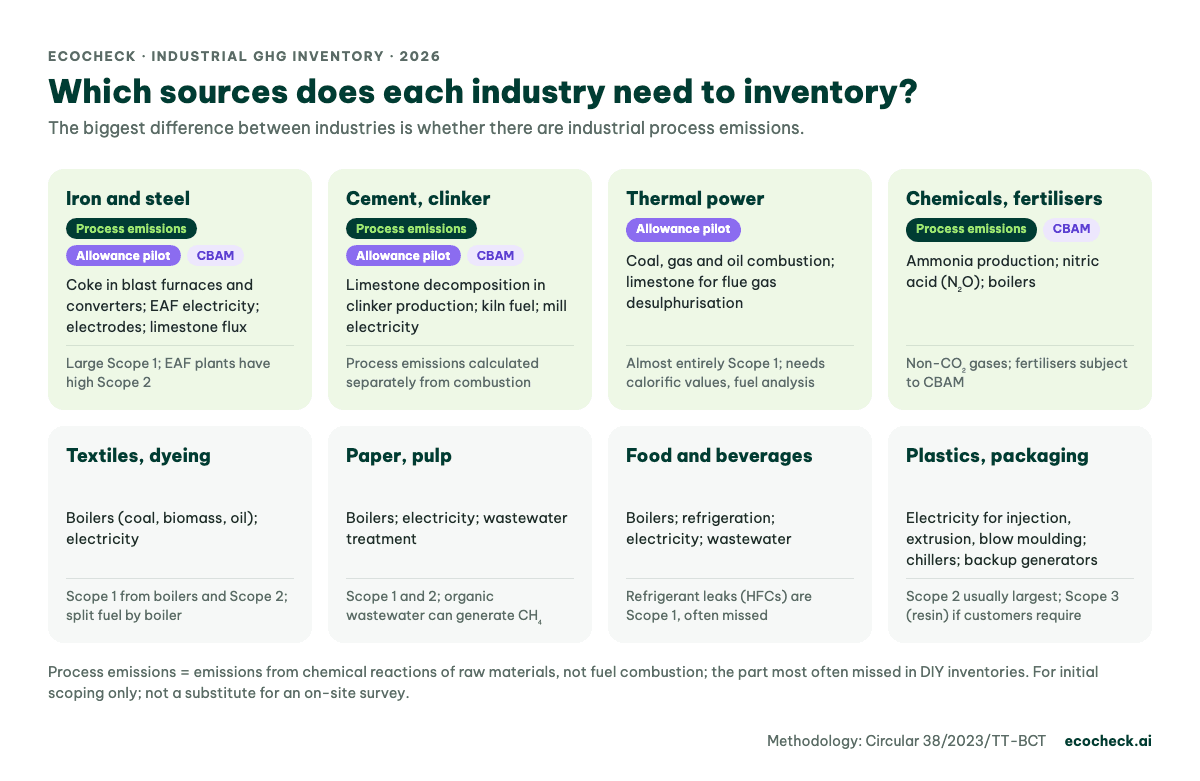
Figure 1: Main emission sources to inventory across 8 industries: steel, cement, thermal power, chemicals and fertilisers, textiles, paper, food, plastics, flagged for process emissions, allowance pilot and CBAM
What does an industrial GHG inventory service include?
A complete service package should deliver:
- A facility-level inventory report in the prescribed format, ready to submit to the provincial People's Committee.
- Traceable calculation workbooks: every data point linked to source documents, every emission factor with a clearly stated source.
- Verification support and clarifications when requested by the authorities.
- Process handover so the plant can update the inventory itself next cycle instead of starting from scratch.
EcoCheck works in line with Decree 06/2022/ND-CP, ISO 14064-1:2018 and the GHG Protocol, combining experts with a software platform that stores data and generates reports. Details on the EcoCheck GHG inventory service page.
How many steps does a plant GHG inventory involve, and how long does it take?
EcoCheck's service process has 9 steps:
- Define the facility's boundaries and operational scope.
- Select emission factors.
- Select and collect activity data.
- Calculate emissions by source.
- Inventory quality control.
- Assess the level of the inventory activities (data uncertainty).
- Calculate aggregated results.
- Prepare the facility-level inventory report.
- Hand over and train the company to prepare reports itself in later cycles.
Timing depends mainly on data. A plant that already has fuel and electricity data on hand can complete the report in 5 days. A plant that has to track down invoices, split data by equipment, or has multiple production lines and process emissions usually takes a few weeks.
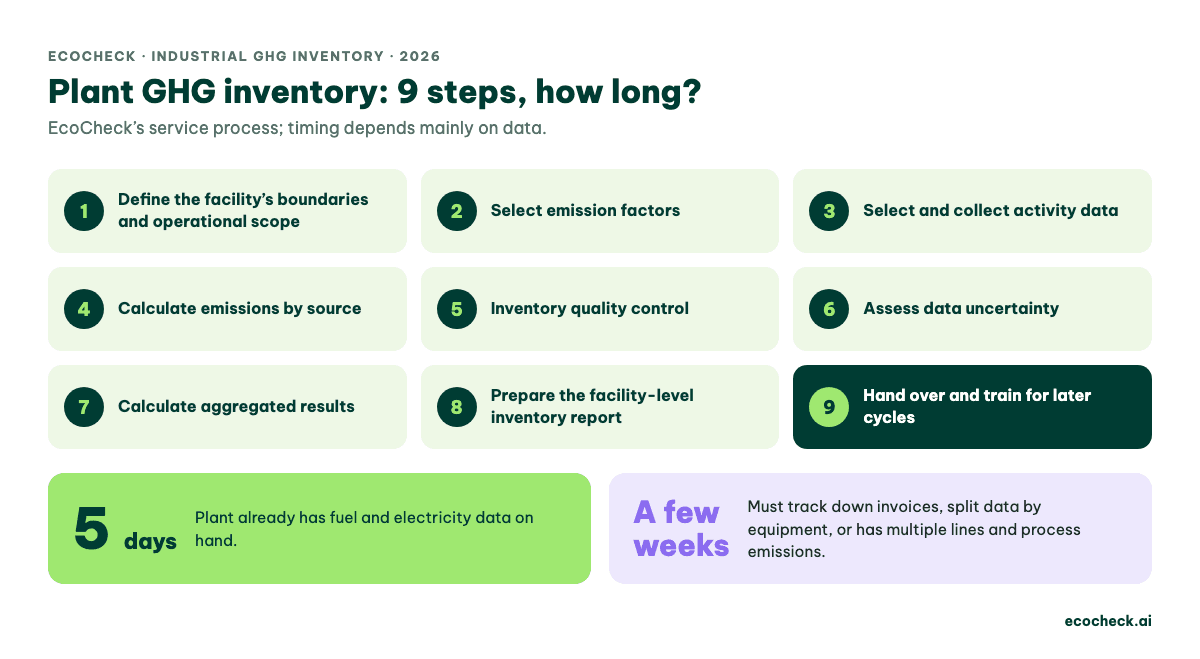
Figure 2: EcoCheck's 9-step plant GHG inventory service process and duration: 5 days with data on hand, a few weeks if data must be recovered
What documents and data should a plant prepare?
Prepare in advance for both 2025 and 2026:
- Enterprise registration certificate, address and boundary map of each facility.
- Process flow diagrams; a list of combustion equipment (boilers, kilns, generators, forklifts) with fuel types.
- Monthly electricity bills for each meter; rooftop solar or direct power purchase agreements (if any).
- Fuel receipt, issue and inventory records (coal, DO/FO oil, LPG, gas, biomass), ideally by equipment.
- Data on raw materials that generate process emissions: limestone, dolomite, coke, electrodes, etc.
- Monthly production output to calculate emission intensity.
- Refrigerant charging records for air conditioners, chillers and cold stores; purchased steam or heat (if any).
- If covering Scope 3: quantities of main raw materials, outsourced transport, and waste transferred.
- The previous inventory report (if any) to keep the methodology consistent.
How much does an industrial GHG inventory service cost?
There is no standard published price list. For most manufacturers, market prices for one inventory cycle typically range from several tens of millions to over one hundred million VND per facility. Facilities with few sources and only Scope 1 and 2 are at the lower end; plants with multiple production lines, process emissions or additional Scope 3 work are at the higher end. Scope 3 and messy input data are the two biggest cost drivers.
When comparing quotes, ask clearly about the Scope coverage, the number of facilities, and whether data collection and verification support are included. See also: GHG inventory costs in 2026.
What else should steel, cement and thermal power plants consider (allowances, CBAM)?
Emission allowance pilot
Decision 263/QD-TTg dated 9 February 2026 allocates pilot allowances to 110 facilities (34 thermal power, 25 iron and steel, 51 cement), totalling about 243.1 million tCO₂e for 2025 and 268.4 million tCO₂e for 2026. Under the roadmap in Decree 119/2025/ND-CP, the pilot phase runs until the end of 2028, and from 2029 the system moves to mechanisms such as allowance auctions. For this group, inventory data determines whether a facility has a surplus or shortfall of allowances, and must be verified by an independent body. See: emission allowance allocation 2025–2026.
EU CBAM
CBAM officially applies from 1 January 2026 to imports into the EU of cement, iron and steel, aluminium, fertilisers, electricity and hydrogen. Under Regulation (EU) 2025/2083, CBAM certificates go on sale from 1 February 2027; the first annual declaration (for goods imported in 2026) is due by 30 September 2027. EU importers will ask Vietnamese plants for embedded emissions per product, so exporting plants should design their inventory so that data can be split by production line and reused for CBAM reporting.
Should you do the inventory in-house or hire a service provider?
Doing it in-house makes sense when the plant has a single facility, few emission sources (mainly electricity and one boiler), complete data and staff who understand the methodology.
Hiring a service provider is advisable when this is your first inventory cycle; you have process emissions (steel, cement, chemicals); you have multiple facilities; you are in the allowance group or have EU customers requesting CBAM data; or your 2025 data needs to be recovered.
Example: for Thuan Phat Dat Plastic Manufacturing and Trading Co., Ltd., EcoCheck carried out a full 3-scope inventory for 2022, produced the report in the Ministry of Industry and Trade format, trained the team so the company could run its own inventory from 2023, and built a long-term emission reduction roadmap.
Next step: check your plant with our free lookup tool, then get a consultation and quote for GHG inventory services tailored to your industry and size, before demand peaks close to the 31 March 2027 deadline.
Frequently asked questions
Which industrial companies must conduct a GHG inventory in 2026?
Facilities named in the list attached to Decision 42/2026/QD-TTg (effective 25 September 2026), totalling 2,441 facilities, of which 1,916 fall under the Ministry of Industry and Trade. The obligation is determined per production facility, not per company.
When is the next GHG inventory report deadline?
Before 31 March 2027, submitted to the provincial People's Committee. Reports are prepared every two years; this cycle covers data for 2025 and 2026, under Decree 06/2022/ND-CP as amended by Decree 119/2025/ND-CP.
How long does a GHG inventory for a plant take?
If fuel and electricity data are already available, EcoCheck can complete the report in 5 days. If data has to be recovered or the plant has multiple production lines, it usually takes a few weeks.
How much does a GHG inventory service for a plant cost?
Typically from several tens of millions to over one hundred million VND per facility per cycle, depending on the number of emission sources, Scope coverage and data condition.
What are industrial process emissions?
They are emissions from chemical reactions of raw materials rather than from fuel combustion, for example cement clinker production, using coke to reduce iron ore, and ammonia production. These must be calculated separately.
Does a GHG inventory help with CBAM compliance?
Partly. Facility-level inventory data is an input for CBAM, but CBAM requires embedded emissions per product, so data needs to be split by production line.





![Top 5 Công Cụ Tính Toán Phát Thải Khí Nhà Kính [Cập Nhật 2026]](https://cms.ecocheck.ai/uploads/Eco_Check_Top_5_cong_cu_va_phan_mem_ho_tro_kiem_ke_khi_nha_kinh_d9d03bf693.png)
![Phương pháp Kiểm kê Khí nhà kính: GHG Protocol & ISO 14064 [2026]](https://cms.ecocheck.ai/uploads/Cac_phuong_phap_va_tieu_chuan_kiem_ke_khi_nha_kinh_pho_bien_e645f7df80.png)