What is Vietnam's carbon exchange?
Vietnam's carbon market roadmap to 2029
Which businesses can trade on the carbon exchange?
What do businesses need to prepare to join the carbon market?
How does Vietnam's carbon exchange differ from the EU's CBAM?
Vietnam's Carbon Exchange: How Can Businesses Trade?
On 29 June 2026, Vietnam's domestic carbon exchange officially began operating at the Hanoi Stock Exchange (HNX), with its first product being the emission allowance code VN2025 — a total volume of more than 511 million tonnes of CO₂ equivalent for the 2025–2026 compliance period. With 110 thermal power, steel and cement facilities already allocated allowances, buying and selling allowances and carbon credits is no longer theoretical. This article explains how the exchange works and what businesses need to prepare to participate.
What is Vietnam's carbon exchange?
It is a centralised marketplace for two types of "carbon commodities": emission allowances (emission caps allocated by the State to facilities) and carbon credits (certificates for reducing/removing 1 tonne of CO₂e from projects). Facilities that emit less than their allowance can sell the surplus; facilities that exceed the cap must buy more or offset with credits up to a prescribed ratio. The exchange is built and operated by HNX under the Scheme in Decision 232/QD-TTg (24 January 2025), within the legal framework of Decree 06/2022/ND-CP, Decree 119/2025/ND-CP, and Decree 29/2026/ND-CP (19 January 2026) on the organisation and operation of the domestic carbon exchange. For the foundational concept, see what are carbon credits.

Screens showing market data charts
Vietnam's carbon market roadmap to 2029
| Milestone | Event |
|---|---|
| 24/01/2025 | Decision 232/QD-TTg approves the Scheme to establish and develop the carbon market |
| 02/2026 | Decision 263/QD-TTg allocates pilot allowances for 2025–2026 to 110 facilities (34 thermal power, 25 steel, 51 cement) |
| 19/01/2026 | Decree 29/2026/ND-CP — legal framework for the organisation and operation of the domestic carbon exchange |
| 29/06/2026 | Carbon exchange goes live at HNX — allowance code VN2025, more than 511 million tonnes of CO₂e |
| 2025 – end of 2028 | Pilot phase: no trading fees, finalisation of the measurement – reporting – verification (MRV) mechanism, expansion of the allocation list |
| From 2029 | Carbon market operates officially nationwide |
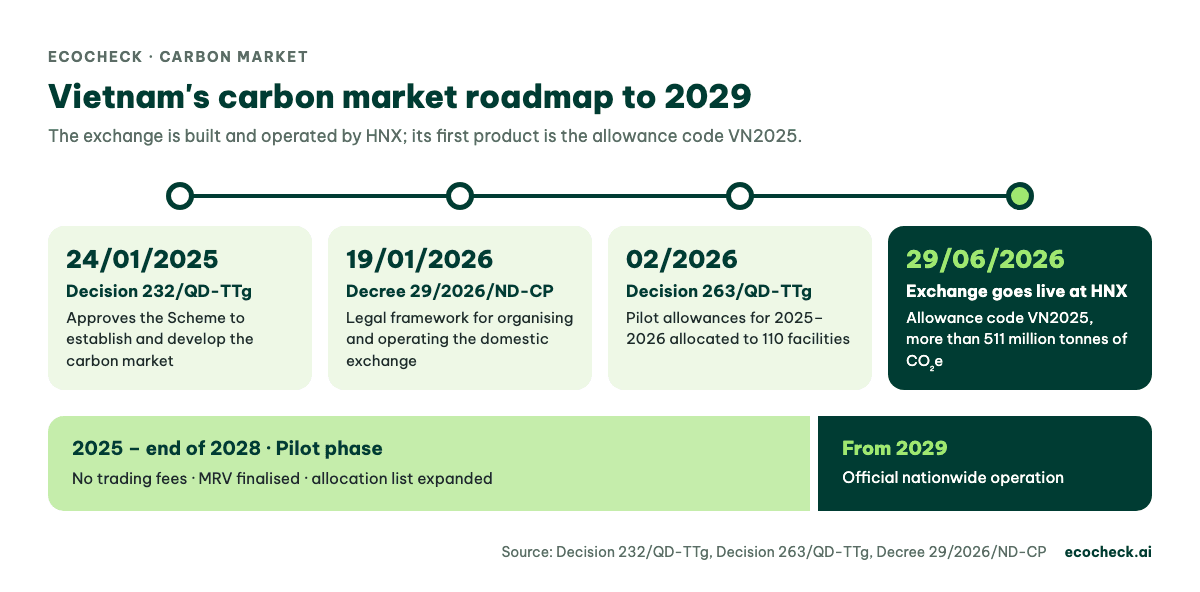
Figure 1: Vietnam carbon market roadmap from Decision 232/QD-TTg (24/01/2025) to the HNX carbon exchange (29/06/2026) and official operation from 2029
Which businesses can trade on the carbon exchange?
The pilot phase focuses on facilities that have been allocated allowances — the thermal power, iron and steel, and cement groups in Decision 263/QD-TTg. These facilities can trade allowances with one another and use carbon credits to offset part of their obligations as regulated by Decree 119/2025/ND-CP. Businesses outside the list cannot yet trade allowances directly, but they can take part in the credit market as project owners generating credits (renewable energy, afforestation, energy efficiency) — and, more importantly, get their data systems ready, because the allocation list will expand during 2027–2028. For background, see emission allowance allocation for 2025–2026.
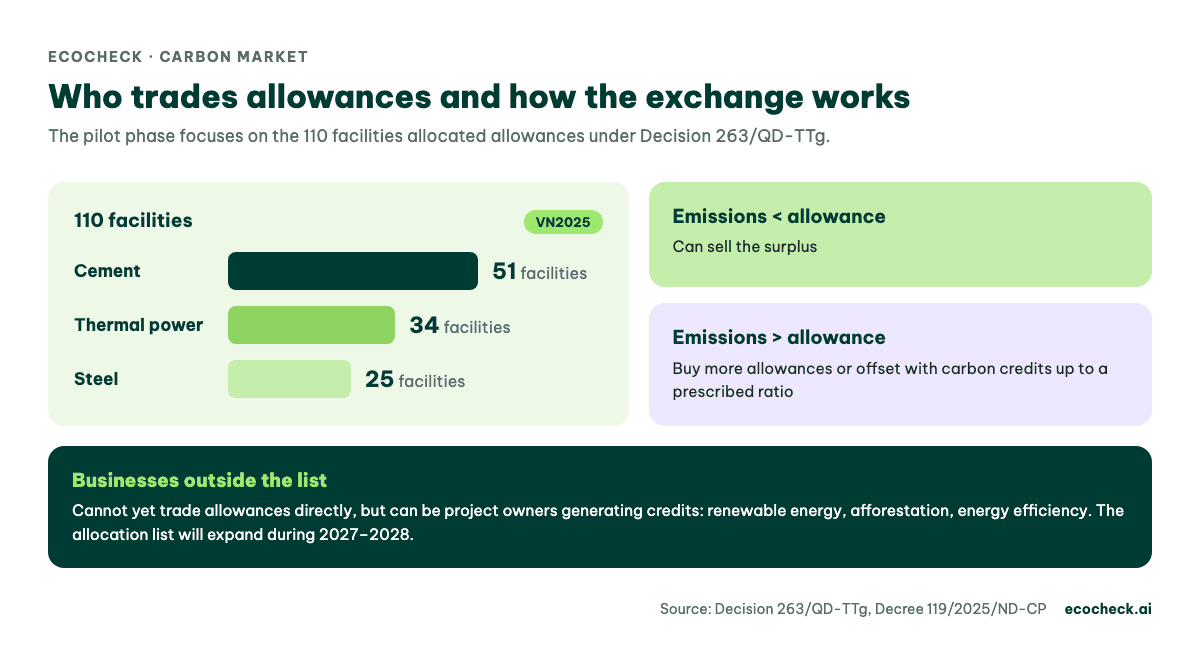
Figure 2: 110 facilities allocated allowances (51 cement, 34 thermal power, 25 steel) and how allowance trading works on the carbon exchange
What do businesses need to prepare to join the carbon market?
Three essential foundations, in order:
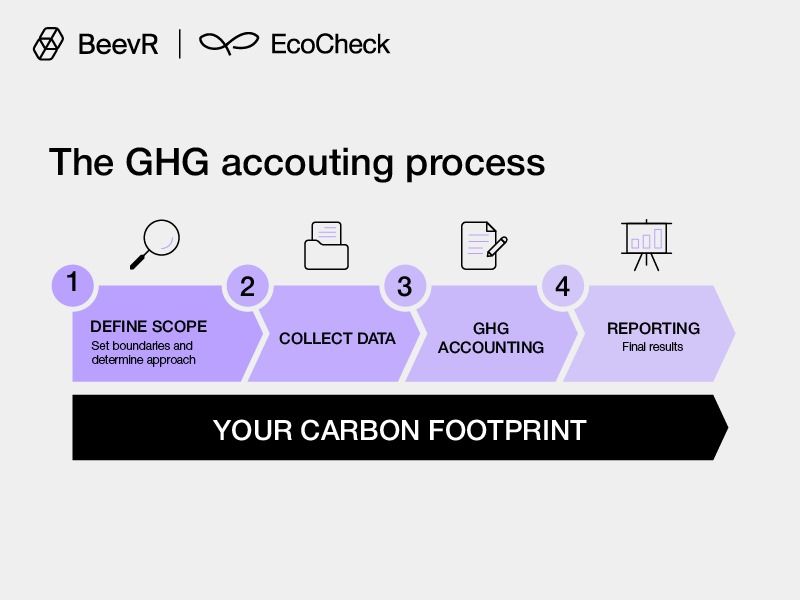
1. Verified inventory data. First, determine whether your business is required to conduct an inventory using the free lookup tool (30 seconds). Whether you are a buyer or a seller on the exchange is determined by the gap between your actual emissions and your allowance — and actual emissions must go through independent measurement, reporting and verification (MRV). Without reliable data, you do not know whether you have a surplus or a shortfall, and you cannot prove it to regulators. Start with the GHG inventory roadmap.
2. Continuous tracking of your allowance position. The business value lies in timing: knowing early how many tonnes you will be over or under lets you decide to buy, sell or hold when prices are favourable — instead of scrambling to buy at the end of the compliance period.
3. An emission reduction plan with cost–benefit analysis. Once every tonne of CO₂e has a market price, reduction measures can be compared directly with the cost of buying allowances: implement the measures that are cheaper than the market price, and buy allowances when they are more expensive. That is how the carbon market turns emission reduction into a financial calculation. See emission reduction solutions for businesses.
How does Vietnam's carbon exchange differ from the EU's CBAM?
The two mechanisms are independent but reinforce each other: the domestic carbon exchange prices emissions for facilities in Vietnam; CBAM is the EU carbon charge levied on imported goods from 2026. What they have in common is that both require the same foundation of reliable emissions data — inventory correctly once, and use it for both domestic obligations and data for EU customers. Exporters of steel, aluminium and cement face both layers: see What is CBAM? The 2026–2027 roadmap.
EcoCheck helps businesses build the data foundation for the carbon market: automated inventories using IPCC/GHG Protocol factors, monthly/quarterly tracking of your position against allowances, and reports ready for MRV verification. Learn about EcoCheck's GHG inventory service to get started before the allocation list expands.



![Top 5 Công Cụ Tính Toán Phát Thải Khí Nhà Kính [Cập Nhật 2026]](https://cms.ecocheck.ai/uploads/Eco_Check_Top_5_cong_cu_va_phan_mem_ho_tro_kiem_ke_khi_nha_kinh_d9d03bf693.png)
![Phương pháp Kiểm kê Khí nhà kính: GHG Protocol & ISO 14064 [2026]](https://cms.ecocheck.ai/uploads/Cac_phuong_phap_va_tieu_chuan_kiem_ke_khi_nha_kinh_pho_bien_e645f7df80.png)