What is the CBAM extension to downstream products?
What did the European Parliament vote on 15 September 2026?
When will the CBAM extension apply?
Which Vietnamese metal products are on the list?
How are emissions of downstream products calculated?
What changes in the CBAM anti-circumvention rules?
What should Vietnamese metal-product exporters do now?
Frequently asked questions
Has the CBAM downstream extension been adopted?
When will the CBAM extension apply?
How many products will be added to CBAM?
Are screws and bolts subject to CBAM?
Do emissions from processing in a Vietnamese factory count?
Do exporters have to buy CBAM certificates?
CBAM Downstream Extension: Proposed for 2028, Which HS Codes
On 15 September 2026 the European Parliament adopted its negotiating position on extending CBAM to downstream products that contain a lot of steel and aluminium. The vote was 464 in favour, 50 against and 159 abstentions. This is not yet law. The European Commission proposed adding about 180 products (17 December 2025). The Council of the EU wants 200 more CN codes on top of that (12 June 2026). Parliament wants an even wider list. Both the Commission proposal and the Council position set the start date at 1 January 2028. The draft lists include nails, springs, steel wire rope, steel household articles, refrigerators, washing machines, electric motors, transformers, vehicle parts and metal furniture. The three institutions are now in trilogue negotiations, so the final list may differ from all three versions above.
Updated 7 October 2026. Every product list in this article is a proposal, not adopted law. We will update the article once a trilogue deal is reached and the text is published in the EU Official Journal.
This article covers only the scope extension. For the basics, see What is CBAM. The first declaration deadline of 30 September 2027 is covered in CBAM 2027: what Vietnamese exporters need to do. To turn emissions into euros, see CBAM certificate price Q3 2026 and how to calculate CBAM costs.
What is the CBAM extension to downstream products?
CBAM currently covers six groups of goods: cement, electricity, fertilisers, iron and steel, aluminium and hydrogen. Most of these are raw or semi-finished materials. The risk is that producers outside the EU switch to selling processed goods, for example a washing machine instead of steel sheet. The steel inside then escapes CBAM, because washing machines are not on the list.
Proposal COM(2025) 989 (procedure 2025/0419(COD)) amends Regulation (EU) 2023/956 in three ways:
- Wider scope covering steel- and aluminium-intensive downstream products. According to the Commission, steel or aluminium makes up about 79% of these products on average.
- Anti-circumvention: it introduces the concept of "abusive practices" and tightens the conditions for using actual emissions data.
- A new method for the emissions of imported electricity. This part does not directly affect goods from Vietnam.
What did the European Parliament vote on 15 September 2026?
According to Parliament's Legislative Observatory (OEIL), on 15 September 2026 Parliament adopted amendments to the Commission proposal by 464 votes to 50, with 159 abstentions (text T10-0276/2026). The file was then referred back to the Environment Committee (ENVI) to open interinstitutional negotiations. So this was a partial first-reading vote that gives Parliament a negotiating mandate. It did not adopt the law. The rapporteur is Mohammed Chahim (S&D, Netherlands).
Main changes in Parliament's position:
- A wider scope than the Commission proposed. Parliament backed the extension to finished steel and aluminium goods such as fasteners, wire, springs and household articles, and added further products. According to the European Parliamentary Research Service (EPRS), the text adopted by ENVI covers 457 product lines.
- Abusive practices: country-level default values would apply from the outset to "good–country" combinations classed as high risk. Companies could still use actual data if they show they meet set criteria.
- Scrap: declarants would report how much steel or aluminium scrap a product contains, and whether it is pre-consumer scrap, post-consumer scrap or a mix of both.
- Distance sales: importers for distance sales, or their representatives, would report the total value and volume of CBAM goods sold through that channel.
- Two Commission ideas dropped: the option to remove goods from the list during severe price shocks, and the option to count Paris Agreement Article 6 credits against CBAM obligations.
| Institution | Date | Downstream scope | Status |
|---|---|---|---|
| European Commission | 17 Dec 2025 | About 180 steel and aluminium products | Proposal COM(2025) 989 |
| Council of the EU (finance ministers) | 12 Jun 2026 | The Commission list plus 200 more CN codes | General approach |
| European Parliament | 15 Sep 2026 | Wider than the Commission (457 lines per EPRS, ENVI text) | Negotiating mandate, 464–50–159 |
| Trilogue | After 15 Sep 2026 | Not yet agreed | Under negotiation, no deal |
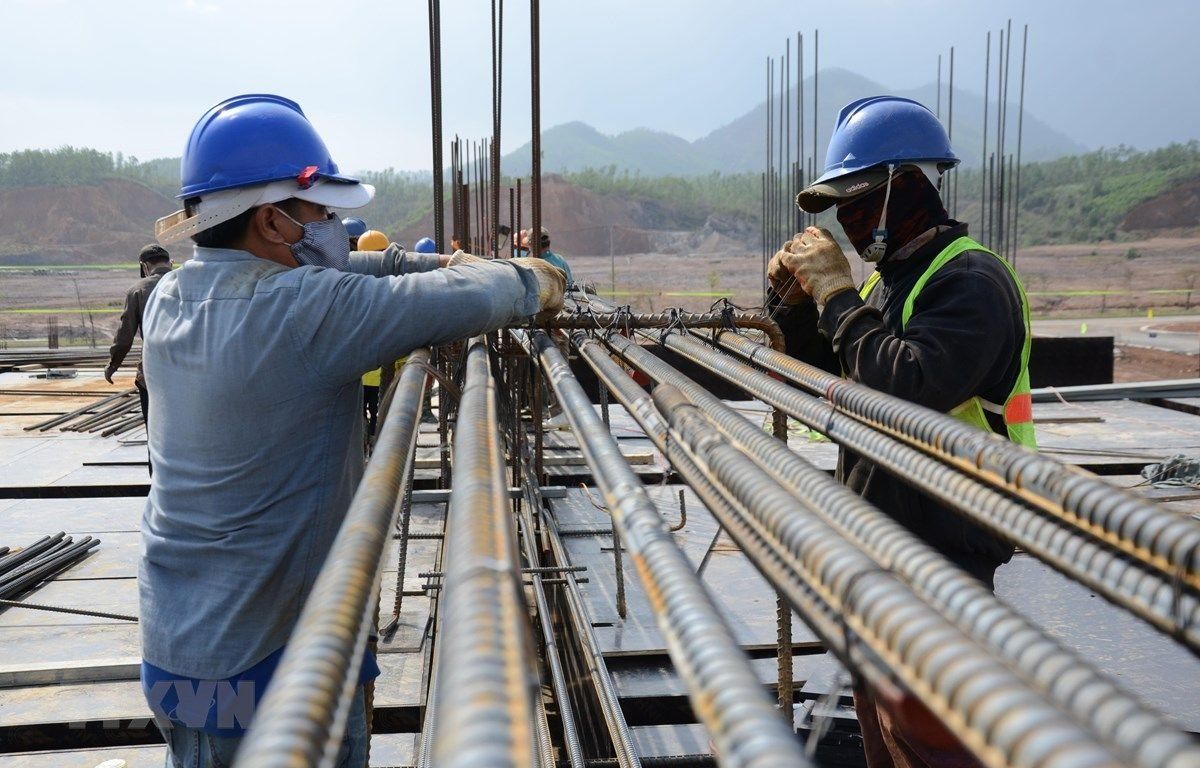
Workers checking steel materials on site
When will the CBAM extension apply?
Both the Commission proposal and the Council's general approach say the extension applies from 1 January 2028. As of 7 October 2026 there is no trilogue deal. Trade press reports that the institutions want to close a deal before the end of 2026 so that the 2028 date still holds. That is a target, not an official commitment. After a deal, Parliament and the Council must still formally adopt the text before it is published in the Official Journal.
If the 2028 date and the current rules hold, all downstream goods imported into the EU from 1 January 2028 will count. The annual declaration for 2028 imports would then be due on 30 September 2029. The 50-tonne threshold per importer per year stays unchanged in the proposal. However, the 2027 threshold review will include import data for downstream goods, to keep exempted emissions at no more than 1%.
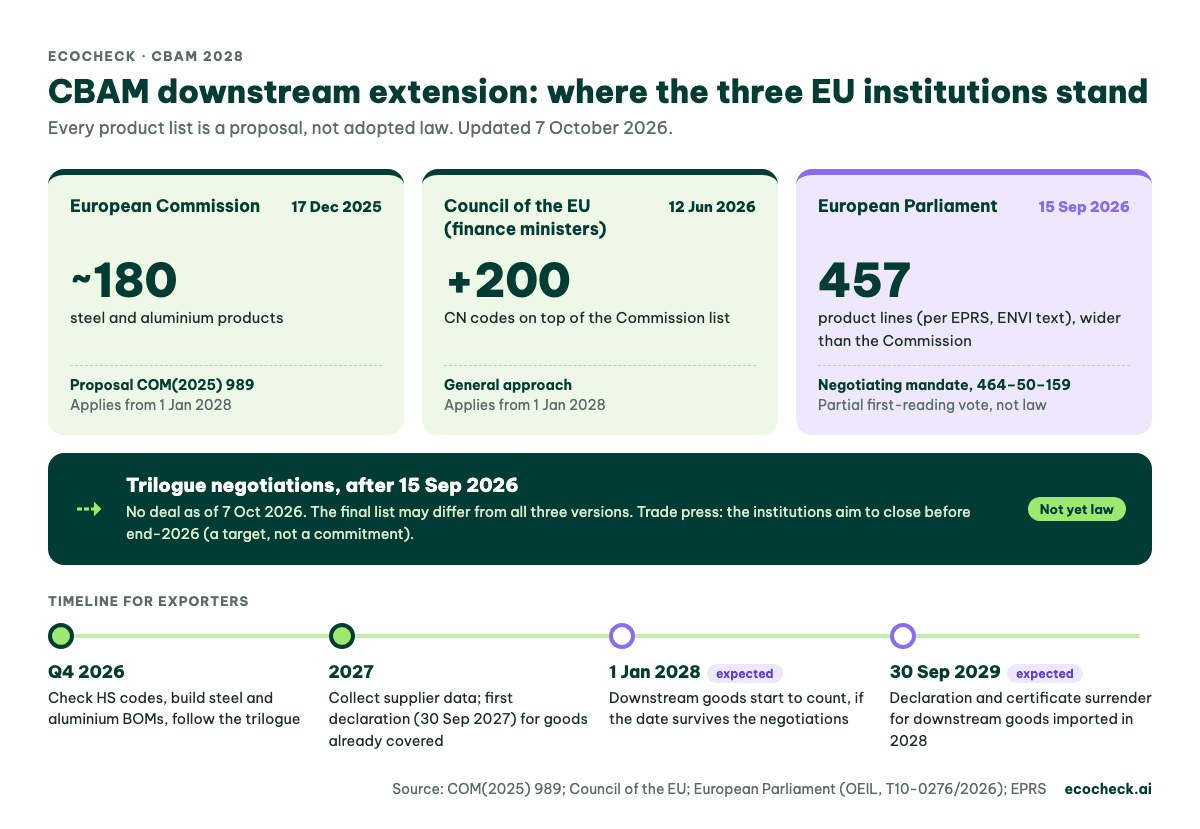
Figure 1: Positions of the European Commission (about 180 products, 17 Dec 2025), the Council (200 more CN codes, 12 Jun 2026) and Parliament (457 lines, 15 Sep 2026) on extending CBAM to downstream goods, trilogue with no deal yet, expected start 1 Jan 2028
Which Vietnamese metal products are on the list?
Many companies assume screws and bolts will enter CBAM in 2028. In fact, iron and steel screws, bolts, nuts, rivets and washers (heading 7318) have been in CBAM since 2023. So have "other articles of iron or steel" (7326), steel structures (7308) and aluminium articles under 7610 and 7616. If you already export these goods to the EU, the obligations apply now, not from 2028.
The table below splits goods into three groups: already covered, in the Commission proposal, and added by the Council. It lists only the groups most common among Vietnamese exporters.
| HS/CN code | Products | Status |
|---|---|---|
| 7301–7311, 7318, 7326 | Tubes, structures, tanks, screws and bolts, other iron or steel articles | Already covered (current Annex I) |
| 7601–7614, 7616 | Unwrought aluminium, bars, profiles, plates, foil, aluminium structures, other aluminium articles | Already covered |
| 7312 10, 7314 | Stranded steel wire and cables; steel grill, netting and fencing | Commission proposal |
| 7317 | Nails, tacks, staples | Commission proposal |
| 7320 | Steel springs | Commission (some codes); Council adds leaf springs and coil compression and tension springs |
| 7323 94, 7323 99 | Steel table, kitchen and household articles | Commission proposal; Council adds 7323 93 (stainless steel) |
| 7325 | Cast articles of iron or steel | Commission proposal |
| 8302, 8309 | Base metal mountings for furniture and doors; stoppers, caps and lids | Commission; Council extends to door, window and building fittings |
| 8418, 8450, 8451 | Combined refrigerator-freezers, washing machines, dryers | Commission; Council adds household refrigerators, freezers and heat pumps (8418 61) |
| 8402, 8403 | Steam boilers, central heating boilers | Council addition |
| 8501, 8504 | Electric motors, generators, transformers, inductors | Commission (some codes); Council adds many more |
| 8544 | Insulated wire and cable containing steel or aluminium | Commission proposal |
| 8202 | Hand saws and saw blades | Council addition |
| 8704, 8706–8708, 8716 | Trucks, chassis, bodies, gearboxes, road wheels, suspension, trailers | Commission; Council adds many 8708 parts and 8716 trailers |
| 8425–8431, 8474, 8479 | Winches, cranes, conveyors, industrial robots, construction machinery and parts | Commission proposal |
| 9401 79, 9403 10/20, 9406 | Seats with metal frames, metal furniture, prefabricated buildings | Commission; Council adds steel modular building units (9406 20) |
Note that many codes carry the prefix "ex", meaning they apply only when the product contains steel or aluminium. Under the proposal, products made entirely of materials outside CBAM are excluded. Makers of wooden, plastic or household goods with metal frames should check the exact 8-digit code with their EU importer, not just the 4-digit heading.
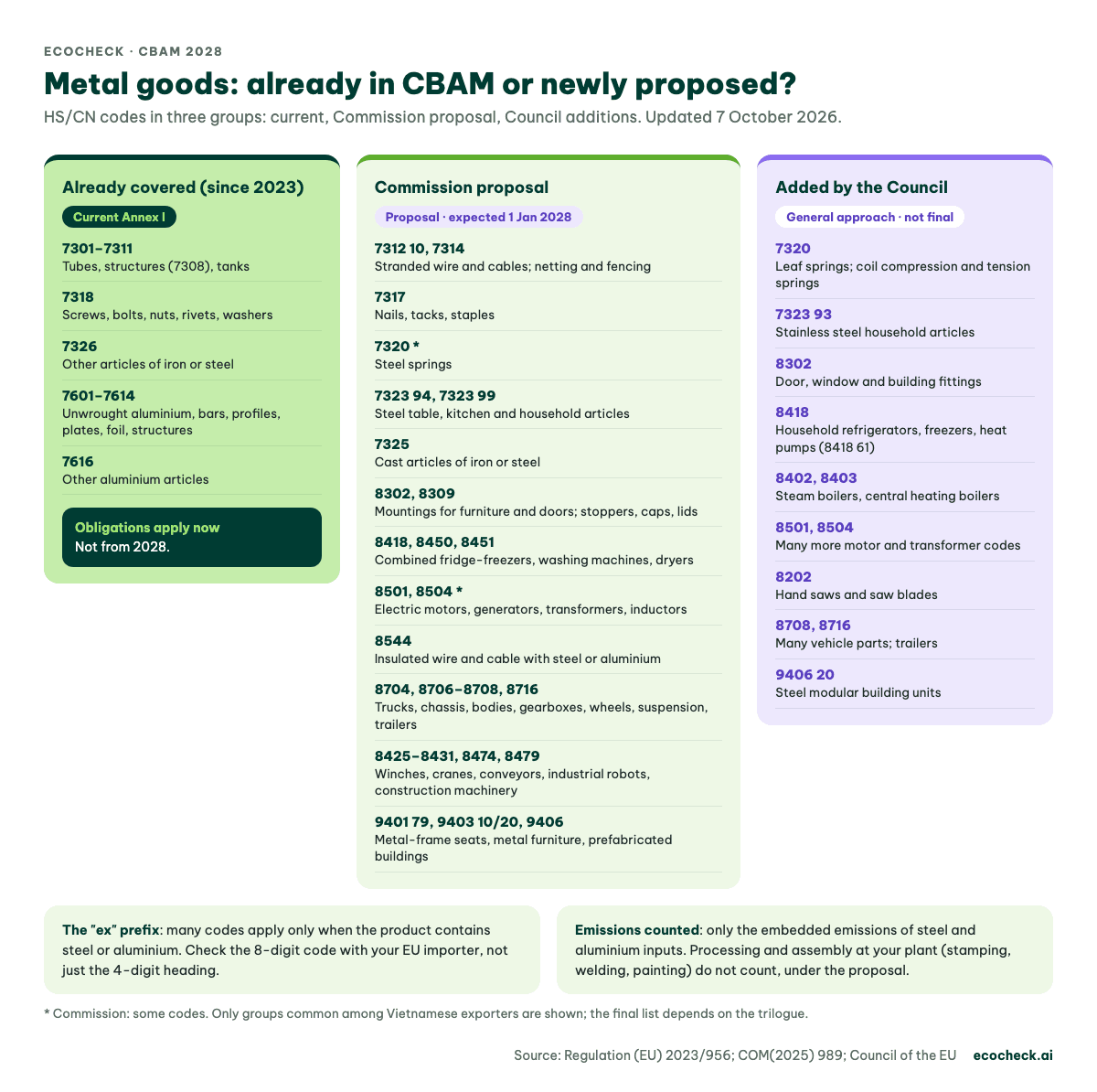
Figure 2: Metal HS codes already covered by CBAM (7301–7311, 7318, 7326, 7601–7614, 7616) versus goods in the Commission proposal and Council additions such as nails, springs, steel wire rope, refrigerators, washing machines and electric motors
How are emissions of downstream products calculated?
This matters most for fabricators. The proposal (recital 42) limits the embedded emissions of downstream goods to the emissions contained in input materials (precursors), mainly steel and aluminium. Emissions from your own processing and assembly (stamping, welding, painting, assembly) are not counted towards the CBAM obligation. For a washing machine, only the emissions of the steel sheet and aluminium inside count, not the electricity and gas used to assemble it.
| Element | Rule in the proposal | Data the company needs |
|---|---|---|
| Input mass | Based on the steel and aluminium content of the product | Bill of materials (BOM): kg of steel and kg of aluminium per unit |
| Embedded emissions of inputs | Verified actual data, or EU default values | Emissions data from the supplying steel or aluminium plant, per installation |
| Pre-consumer scrap | Counted as an input material (new Annex VIII) | Separate records for pre-consumer and post-consumer scrap |
| Mark-up on default values | May not apply to downstream goods with complex supply chains | Watch the implementing rules on default values for downstream goods |
The Commission will need to publish default values for the new codes. None exist yet for downstream goods. Turning embedded emissions into cost (subtract the free allocation adjustment, multiply by the certificate price) works the same way as for steel and aluminium today; see the worked examples in how to calculate CBAM costs.
What changes in the CBAM anti-circumvention rules?
Vietnamese exporters should pay attention to this even if their products are already covered. Under the Commission proposal, authorised CBAM declarants must prove the goods were actually produced at the declared installation. The Commission would also be empowered to identify "good–origin" combinations at high risk of abusive practices. For those combinations, extra conditions apply before actual data can be used. Parliament wants to go further: country-level default values would apply from the outset to high-risk combinations unless a company proves it is not engaged in abusive practices. One of the risk indicators Parliament proposes is how much emission intensities vary between producers in the same country.
In practice, verified actual emissions data that can be traced back to a specific steel plant will become more valuable. "Estimated" data will be harder to get accepted.
What should Vietnamese metal-product exporters do now?
The list is not final, but the data you need is almost the same whichever version the trilogue chooses. In order of priority:
- Check the 8-digit HS codes of everything you export to the EU against three lists: current, Commission and Council. If your goods fall under 7318, 7326, 7308 or 7616, you already have obligations from 2026.
- Build a steel and aluminium bill of materials per product: kg of steel and aluminium per unit, which supplier it comes from, and the CN code of the input.
- Request data from steel and aluminium suppliers: name and address of the production installation, route (blast furnace or electric arc furnace) and specific embedded emissions. This matters even more for inputs imported from third countries as anti-circumvention rules tighten.
- Track scrap: record pre-consumer scrap (offcuts and trimmings from the factory) separately from post-consumer scrap.
- Talk to your EU importer: ask whether they expect to exceed the 50-tonne threshold and which data template they want. Many importers will start asking suppliers in 2027 to prepare for 2028.
- Follow the trilogue: when the list is final, re-check your codes and update your data plan.
| Milestone | Action |
|---|---|
| Q4 2026 | Check HS codes, build steel and aluminium BOMs, follow the trilogue |
| 2027 | Collect supplier data; first declaration (30 September 2027) for goods already covered |
| 1 January 2028 (expected) | Downstream goods start to count, if the date survives the negotiations |
| 30 September 2029 (expected) | Declaration and certificate surrender for downstream goods imported in 2028 |
Next step: EcoCheck helps companies map their CN codes against the CBAM lists, calculate embedded emissions from steel and aluminium content, and prepare a dataset for EU importers through our CBAM reporting service. See also CBAM consulting services and the CBAM reporting guide.
Frequently asked questions
Has the CBAM downstream extension been adopted?
No. On 15 September 2026 the European Parliament adopted only its negotiating position (464 in favour, 50 against, 159 abstentions). The Council adopted its position on 12 June 2026. As of 7 October 2026 the three institutions are in trilogue and there is no deal yet.
When will the CBAM extension apply?
The Commission proposal and the Council position both set 1 January 2028. The date is only certain once the final text is adopted and published in the EU Official Journal.
How many products will be added to CBAM?
The Commission proposed about 180 products. The Council added 200 CN codes. Parliament wants a wider list: the ENVI committee text covers 457 lines, according to EPRS. The final number depends on the trilogue.
Are screws and bolts subject to CBAM?
Yes, and they were before the extension. Iron and steel screws, bolts, nuts and washers (heading 7318) are already in Annex I of Regulation (EU) 2023/956. The extension adds nails (7317), springs (7320), steel wire rope (7312) and many other products.
Do emissions from processing in a Vietnamese factory count?
Not under the proposal. For downstream goods, only the emissions embedded in input materials count, mainly steel, aluminium and pre-consumer scrap. Electricity and fuel used for processing and assembly do not count towards the CBAM obligation.
Do exporters have to buy CBAM certificates?
Not directly. The EU importer files the declaration and surrenders the certificates. However, importers will ask suppliers for emissions data, or build the cost based on default values into the purchase price.



![Top 5 Công Cụ Tính Toán Phát Thải Khí Nhà Kính [Cập Nhật 2026]](https://cms.ecocheck.ai/uploads/Eco_Check_Top_5_cong_cu_va_phan_mem_ho_tro_kiem_ke_khi_nha_kinh_d9d03bf693.png)
![Phương pháp Kiểm kê Khí nhà kính: GHG Protocol & ISO 14064 [2026]](https://cms.ecocheck.ai/uploads/Cac_phuong_phap_va_tieu_chuan_kiem_ke_khi_nha_kinh_pho_bien_e645f7df80.png)