What is CBAM?
CBAM timeline: key milestones for businesses
How does CBAM affect Vietnamese businesses?
How should exporters prepare for CBAM?
How is CBAM different from a carbon tax and carbon credits?
What Is CBAM? 2026–2027 Timeline & How Exporters Should Prepare
CBAM (Carbon Border Adjustment Mechanism) is an EU policy that puts a carbon price on imported goods with high emissions intensity: iron and steel, aluminium, cement, fertilizers, electricity and hydrogen. From 1 January 2026, CBAM enters its definitive phase — Vietnamese businesses exporting these goods to the EU must provide correctly calculated emissions data; otherwise EU importers will have to pay higher carbon costs or stop buying.
What is CBAM?
CBAM is a mechanism established by the EU under Regulation (EU) 2023/956 to prevent "carbon leakage" — where companies shift production to countries with looser emissions rules and then export back into the EU. How it works: EU importers must declare the embedded emissions in imported goods and purchase a corresponding number of CBAM certificates, priced against the allowance price on the EU carbon market (EU ETS). The more carbon-intensive the goods, the higher the import cost — which is why the emissions data of Vietnamese manufacturers becomes a direct competitive factor.
CBAM timeline: key milestones for businesses
| Date | What happens |
|---|---|
| 1 October 2023 – 31 December 2025 | Transitional phase: EU importers only report emissions quarterly, with no payment required |
| From 1 January 2026 | Definitive phase: only "authorised CBAM declarants" may import CBAM goods; annual emissions declaration obligations begin |
| 20 October 2025 (Omnibus Regulation enters into force) | Simplification: exemption for importers below 50 tonnes of CBAM goods per year (taking most SMEs out of scope) and removal of the old €150 exemption threshold |
| 1 February 2027 | The EU begins selling CBAM certificates via a central platform — certificates covering emissions of goods imported in 2026 |
| From 2027 (end of each quarter) | Importers must hold certificates covering at least 50% of the embedded emissions of goods imported during the year |
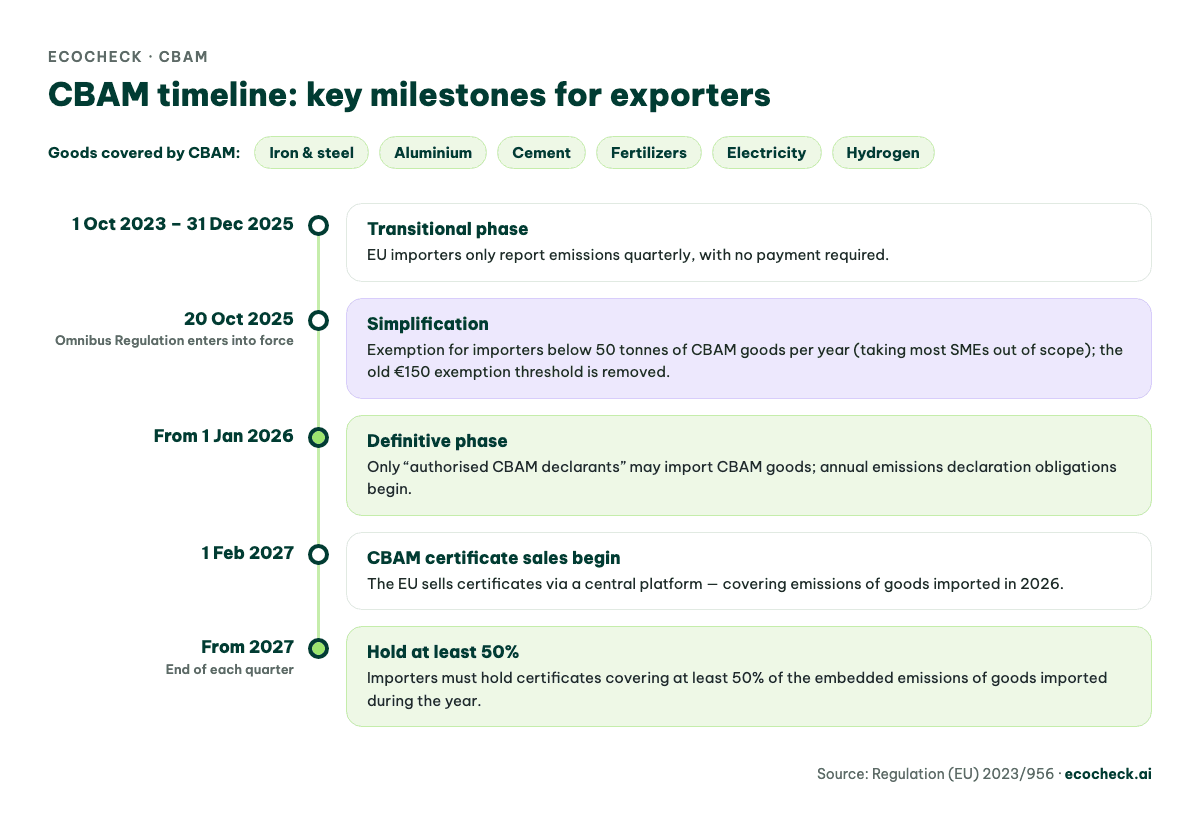
Figure 1: CBAM timeline: transitional phase 1 Oct 2023–31 Dec 2025, Omnibus Regulation 20 Oct 2025, definitive phase from 1 Jan 2026, CBAM certificate sales from 1 Feb 2027, holding at least 50% of certificates from 2027
How does CBAM affect Vietnamese businesses?
CBAM applies to EU importers, but the costs and data obligations flow back to Vietnamese manufacturers. Three concrete impacts:
1. EU customers will ask for your emissions data. To file their declarations, importers need actual emissions data for each shipment from the manufacturer — calculated using the EU-prescribed methodology. If you cannot provide it, they must use default values (usually higher than actual), so your goods incur higher carbon costs than those of competitors with good data.
2. High emissions = lost price advantage. From 2027, every tonne of CO₂ embedded in goods is a real monetary cost. Steel, aluminium, cement and fertilizer producers with lower emissions intensity will win contracts.
3. A standards-compliant inventory is the ticket to play. CBAM data must be consistent with the facility's GHG inventory — already a domestic obligation under Decree 06/2022/ND-CP. Do it right once and use it for both; see the GHG inventory roadmap [2026 update].
An industrial plant surrounded by greenery
How should exporters prepare for CBAM?
Four steps, in order: (1) determine whether your products fall within CBAM scope (CN codes for steel, aluminium, cement, fertilizers, electricity, hydrogen); (2) set up emissions measurement at facility and product level using the EU methodology — starting with a Scope 1 and 2 inventory in line with ISO 14064; (3) standardize the process for supplying data to importing customers each quarter; (4) plan to reduce emissions intensity to maintain a long-term price advantage. Detailed technical guidance is in our article how to prepare a CBAM report.
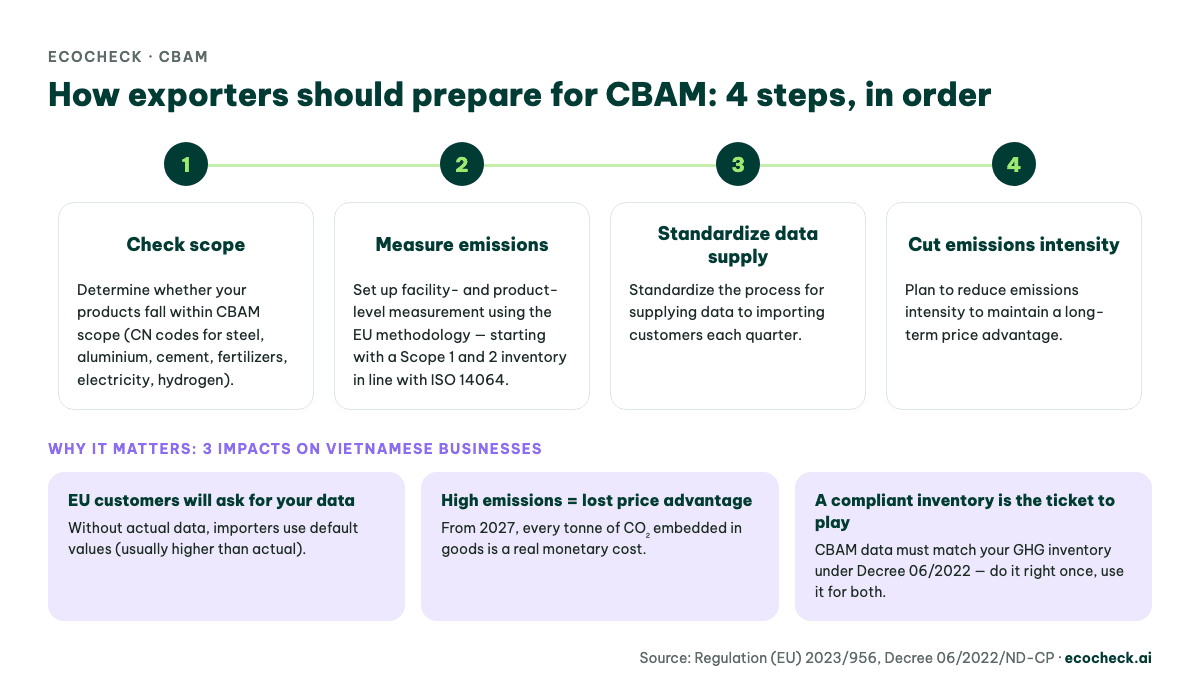
Figure 2: 4 steps for exporters to prepare for CBAM: check scope, measure emissions, standardize data supply, cut emissions intensity, plus 3 impacts of CBAM
How is CBAM different from a carbon tax and carbon credits?
A carbon tax is a fixed levy on each tonne of domestic emissions; CBAM is the EU's "border carbon charge" on imported goods, pegged to the EU ETS market price rather than fixed; carbon credits, meanwhile, are tradable offsetting instruments. Note: CBAM certificates are not carbon credits, and voluntary credits currently cannot be used to offset CBAM obligations. Read more: what is a carbon tax and what are carbon credits.
EcoCheck helps exporters build an emissions data foundation that meets a dual standard — satisfying GHG inventory requirements under Decree 06/2022 while being ready to supply CBAM data to EU customers: automated inventories using IPCC/GHG Protocol emission factors, and traceable reports for independent verification. Learn about the EcoCheck GHG inventory service.
Read more: Vietnam's carbon exchange officially launches — the domestic carbon pricing layer, running in parallel with the EU's CBAM.
Need help with implementation? See our CBAM consulting service: preparing emissions reports for EU-bound exports.






![Top 5 Công Cụ Tính Toán Phát Thải Khí Nhà Kính [Cập Nhật 2026]](https://cms.ecocheck.ai/uploads/Eco_Check_Top_5_cong_cu_va_phan_mem_ho_tro_kiem_ke_khi_nha_kinh_d9d03bf693.png)
![Phương pháp Kiểm kê Khí nhà kính: GHG Protocol & ISO 14064 [2026]](https://cms.ecocheck.ai/uploads/Cac_phuong_phap_va_tieu_chuan_kiem_ke_khi_nha_kinh_pho_bien_e645f7df80.png)