What is the CBAM certificate price for each quarter of 2026?
How is the CBAM cost calculated?
What are the CBAM default values for Vietnam?
Example: what does CBAM cost for 1 tonne of Vietnamese hot-rolled steel?
What does CBAM cost for Vietnamese aluminium, cement and fertilisers?
How much can actual data reduce the CBAM cost?
How much will the CBAM cost rise in 2027?
Who pays the CBAM cost, and when?
What should exporters do with these numbers?
Frequently asked questions
What is the CBAM certificate price for Q3 2026?
How is the CBAM certificate price set?
How do you calculate the CBAM cost per tonne?
What is the CBAM default value for Vietnamese steel?
Why does the CBAM cost rise every year?
Do Vietnamese exporters pay the CBAM cost?
CBAM Certificate Price Q3 2026 (EUR 82.32) and How to Calculate CBAM Costs
The CBAM certificate price for Q3 2026 is EUR 82.32 per tCO₂e, published by the European Commission on 5 October 2026. That is EUR 7.04 (about 9.4%) higher than Q2 (EUR 75.28). At this price and using the EU default values for goods from Vietnam, the 2026 CBAM cost is roughly EUR 103 per tonne of hot-rolled steel, EUR 173 per tonne of aluminium profiles, EUR 77 per tonne of Portland cement and EUR 130 per tonne of urea. The EU importer pays, but the figure will show up in price negotiations with Vietnamese exporters. Using verified actual emissions data can cut the cost significantly compared with default values.
This article focuses on the price and the calculation. Deadlines, the 50-tonne threshold and the actions needed before 30 September 2027 are covered in CBAM 2027: what Vietnamese exporters need to do.
What is the CBAM certificate price for each quarter of 2026?
The CBAM certificate price is the weighted average of EU ETS allowance auction clearing prices. In 2026 the Commission calculates the price quarterly, in the first calendar week after each quarter ends:
| Import quarter | Published | Price (EUR/tCO₂e) | Change vs previous quarter |
|---|---|---|---|
| Q1 2026 | 7 April 2026 | 75.36 | — |
| Q2 2026 | 6 July 2026 | 75.28 | −0.08 |
| Q3 2026 | 5 October 2026 | 82.32 | +7.04 (+9.4%) |
| Q4 2026 | Expected 4 January 2027 | Not yet published | — |
Three points to know:
- Price follows the import quarter: goods imported into the EU in Q3 2026 use the EUR 82.32 price, even though certificates can only be bought from February 2027.
- Sales start on 1 February 2027: certificates for 2026 goods are sold on the EU common central platform from February 2027.
- From 2027 the price is published weekly instead of quarterly.
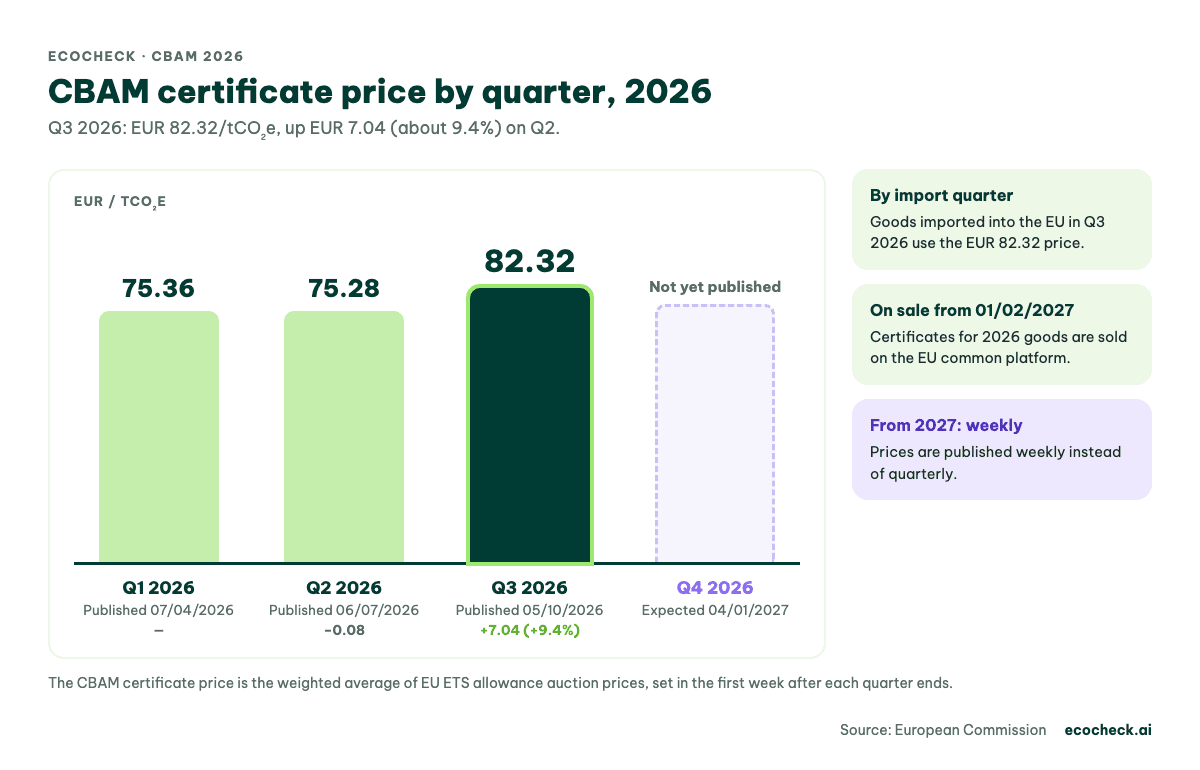
Figure 1: Chart of 2026 CBAM certificate prices: Q1 EUR 75.36, Q2 EUR 75.28, Q3 EUR 82.32 per tCO₂e; Q4 expected 04/01/2027
How is the CBAM cost calculated?
Under Regulation (EU) 2023/956 and Implementing Regulation (EU) 2025/2620, the CBAM cost of a consignment is calculated in four steps:
- Embedded emissions = Mass of goods (tonnes) × Specific embedded emissions (tCO₂e/tonne). Specific embedded emissions come from verified actual data or from the EU default values.
- Free allocation adjustment = Mass × CBAM factor × Cross-sectoral correction factor (CSCF) × CBAM benchmark of the product.
- Certificates to surrender = Embedded emissions − Free allocation adjustment − Carbon price paid in the country of production (if recognised).
- Cost = Certificates × Certificate price for the import quarter.
The CBAM factor reflects the share of free allowances EU producers still receive. It falls each year under Article 10a(1a) of the EU ETS Directive, so the CBAM obligation rises every year:
| Year | 2026 | 2027 | 2028 | 2029 | 2030 | 2031 | 2032 | 2033 | 2034 |
|---|---|---|---|---|---|---|---|---|---|
| CBAM factor | 97.5% | 95% | 90% | 77.5% | 51.5% | 39% | 26.5% | 14% | 0% |
The Commission set the cross-sectoral correction factor (CSCF) for 2026–2030 at 100% in Implementing Decision (EU) 2026/1862, so it does not reduce the adjustment further. The examples below assume the deduction for a carbon price paid in the country of production is zero, because Vietnam has no carbon tax.
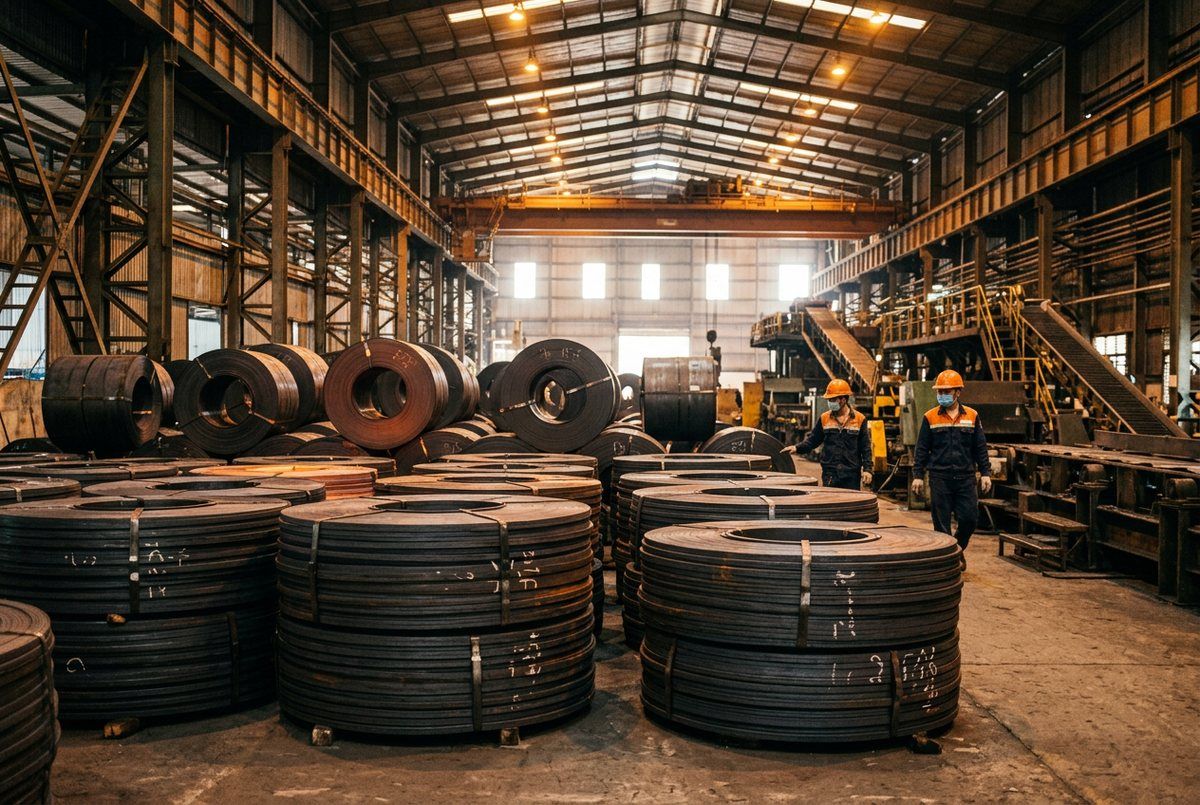
Steel coils for export, a CBAM-covered product
What are the CBAM default values for Vietnam?
Country default values are set in Annex I of Implementing Regulation (EU) 2025/2621. They already include a mark-up: 10% in 2026, 20% in 2027 and 30% from 2028 for steel, aluminium and cement; fertilisers carry only 1%. The table shows selected common export codes (tCO₂e per tonne of product):
| CN code | Product | Base default | 2026 (incl. mark-up) | 2027 | From 2028 | CBAM benchmark (route) |
|---|---|---|---|---|---|---|
| 7208 | Hot-rolled flat steel | 2.350 | 2.585 | 2.820 | 3.055 | 1.370 (BF/BOF) |
| 7214 20 00 | Steel rebar | 2.350 | 2.585 | 2.820 | 3.055 | 1.364 (BF/BOF) |
| 7601 | Unwrought aluminium | 0.360 | 0.396 | 0.432 | 0.468 | 0.091 (secondary aluminium) |
| 7604 10 90 | Non-alloy aluminium profiles | 2.040 | 2.244 | 2.448 | 2.652 | 0.152 (secondary aluminium) |
| 2523 29 00 | Grey Portland cement* | 1.440 | 1.584 | 1.728 | 1.872 | 0.666 |
| 3102 10 19 | Solid urea (over 45% nitrogen) | 2.430 | 2.454 | 2.454 | 2.454 | 0.902 |
*Annex I has no cement values specific to Vietnam, so the "Other countries and territories" table applies. For steel and aluminium, CBAM counts direct emissions only; for cement and fertilisers, the default values include indirect emissions from electricity. When default values are used, the CBAM benchmark follows the production route given for the country of origin in Annex I (BF/BOF for Vietnamese steel, secondary aluminium for Vietnamese aluminium).
Example: what does CBAM cost for 1 tonne of Vietnamese hot-rolled steel?
Assumptions: hot-rolled steel (CN 7208) made in Vietnam, imported into the EU in Q3 2026, with the importer using default values.
| Step | Calculation | Result per tonne |
|---|---|---|
| 1. Embedded emissions | 1 × 2.585 | 2.585 tCO₂e |
| 2. Free allocation adjustment | 1 × 97.5% × 100% × 1.370 | 1.336 tCO₂e |
| 3. Certificates to surrender | 2.585 − 1.336 | 1.249 certificates |
| 4. Cost | 1.249 × EUR 82.32 | ≈ EUR 102.84 |
A 1,000-tonne lot imported in Q3 2026 needs about 1,249 certificates, or about EUR 102,840. If the same lot had been imported in Q1 2026 (EUR 75.36), the cost would be about EUR 94.14 per tonne. The whole difference comes from the higher certificate price.
What does CBAM cost for Vietnamese aluminium, cement and fertilisers?
Applying the same formula to other products (2026 default values, EUR per tonne of product):
| Product (CN code) | Embedded emissions | Free allocation adjustment | Certificates/tonne | Cost at Q1 price (75.36) | Cost at Q3 price (82.32) |
|---|---|---|---|---|---|
| Hot-rolled steel (7208) | 2.585 | 1.336 | 1.249 | 94.14 | 102.84 |
| Steel rebar (7214 20 00) | 2.585 | 1.330 | 1.255 | 94.58 | 103.32 |
| Unwrought aluminium (7601) | 0.396 | 0.089 | 0.307 | 23.16 | 25.30 |
| Aluminium profiles (7604 10 90) | 2.244 | 0.148 | 2.096 | 157.94 | 172.53 |
| Grey Portland cement (2523 29 00) | 1.584 | 0.649 | 0.935 | 70.44 | 76.94 |
| Urea (3102 10 19) | 2.454 | 0.879 | 1.575 | 118.66 | 129.62 |
Two points stand out:
- Aluminium profiles cost more than unwrought aluminium. The Vietnamese default for aluminium profiles (2.244) is more than five times that of unwrought aluminium (0.396), while the secondary-aluminium benchmark is very low, so almost nothing is deducted. This group gains the most from proving lower actual emissions.
- Steel gets a large adjustment. The BF/BOF benchmark of 1.370 offsets just over half of the default emissions in 2026, but this offset shrinks quickly as the CBAM factor falls to 51.5% in 2030.
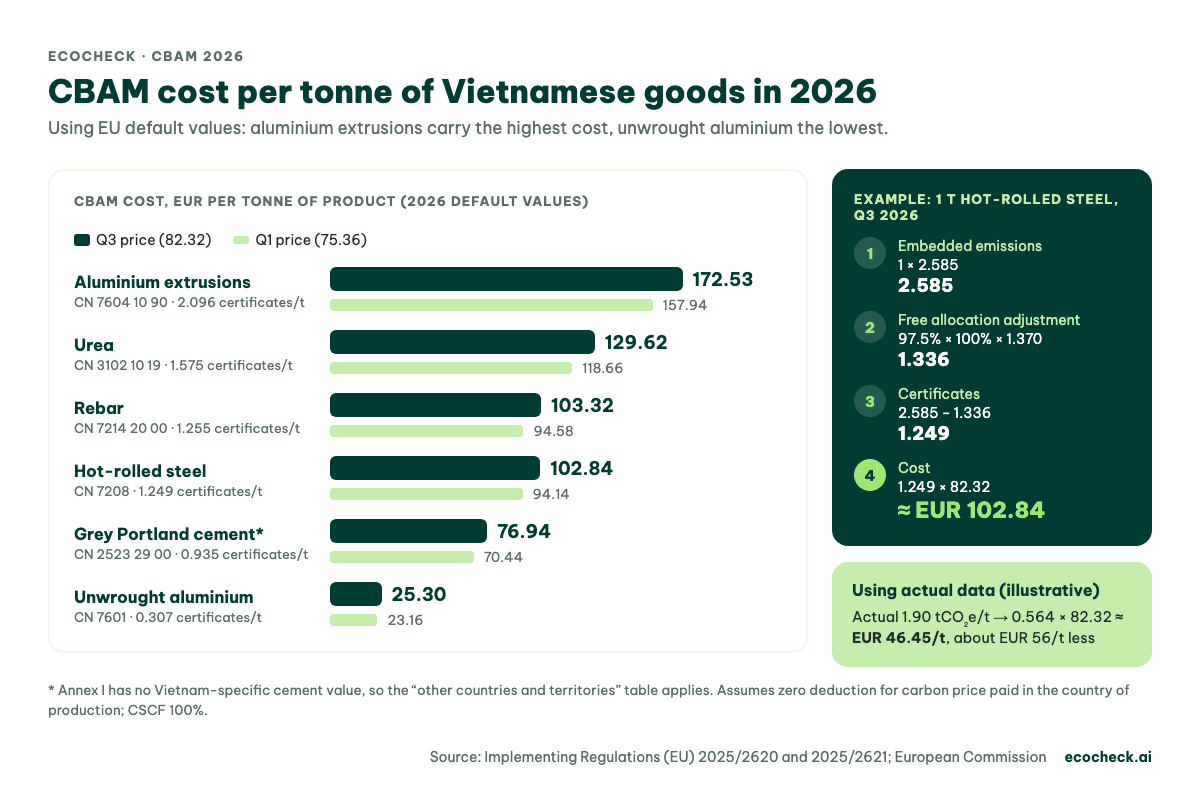
Figure 2: CBAM cost per tonne of Vietnamese goods in 2026 at default values: aluminium extrusions EUR 172.53, urea 129.62, hot-rolled steel 102.84, cement 76.94 at the Q3 price
How much can actual data reduce the CBAM cost?
Illustrative example (assumed figures, not from a specific plant): a Vietnamese blast-furnace steel plant has verified actual embedded emissions of 1.90 tCO₂e per tonne of hot-rolled steel.
- Certificates: 1.90 − 1.336 = 0.564 certificates per tonne.
- Cost at the Q3 2026 price: 0.564 × 82.32 ≈ EUR 46.45 per tonne, about EUR 56 per tonne less than with default values (EUR 102.84).
For a 1,000-tonne lot, the difference is about EUR 56,000. This calculation is simplified: with actual data, the free allocation adjustment is calculated from the benchmarks of each production process and precursor (point 3 of the Annex to Implementing Regulation (EU) 2025/2620), so the real figure may differ. For scrap-based EAF steel the CBAM benchmark is only 0.072, so the benefit comes mainly from low actual emissions rather than from the adjustment.
How much will the CBAM cost rise in 2027?
Two factors push costs up in 2027: the default value mark-up rises from 10% to 20%, and the CBAM factor falls from 97.5% to 95%. If the certificate price stayed at EUR 82.32 (an assumption for comparison only):
| Product (default values) | 2026 | 2027 |
|---|---|---|
| Hot-rolled steel | EUR 102.84/t | EUR 125.00/t |
| Aluminium profiles | EUR 172.53/t | EUR 189.63/t |
| Grey Portland cement | EUR 76.94/t | EUR 90.17/t |
| Urea | EUR 129.62/t | EUR 131.47/t |
Fertilisers rise only slightly because their mark-up is fixed at 1%. From 2028, the 30% mark-up and a 90% CBAM factor widen the gap between default values and actual data even further.
Who pays the CBAM cost, and when?
The EU importer (the authorised CBAM declarant) buys and surrenders the certificates. Importers of less than 50 tonnes of CBAM goods per year are exempt under Regulation (EU) 2025/2083. Certificates for 2026 goods must be surrendered with the CBAM declaration before 30 September 2027. Vietnamese exporters pay nothing to the EU, but the cost is usually built into the price or contract terms. Declaration duties are covered in the CBAM reporting guide; the basics are in what is CBAM.
What should exporters do with these numbers?
- Calculate the cost for each CN code you export to the EU, using the default values above, to see what your customer is paying.
- Estimate actual emissions for your export lines. If they are below the default values, the difference is leverage in price negotiations.
- Prepare verification of 2026 data so your customer can use it in the declaration due before 30 September 2027.
- Reuse the data from your domestic GHG inventory if the plant is on the list, since the 31 March 2027 deadline overlaps with CBAM data preparation.
- Cut emissions per tonne of product: every tonne of CO₂ avoided is one certificate your customer does not have to buy; see GHG emission reduction solutions for businesses.
Next step: EcoCheck calculates embedded emissions by CN code, compares them with the default values and prepares the file for the verifier through our CBAM reporting service, combined with our GHG inventory service so you use one dataset. See also CBAM consulting services.
Frequently asked questions
What is the CBAM certificate price for Q3 2026?
EUR 82.32 per tCO₂e, published by the European Commission on 5 October 2026. The Q1 price was EUR 75.36 and Q2 was EUR 75.28. The Q4 2026 price is expected on 4 January 2027.
How is the CBAM certificate price set?
It is the weighted average of EU ETS allowance auction clearing prices. In 2026 it is calculated quarterly and applied according to the quarter in which goods enter the EU; from 2027 it is published weekly.
How do you calculate the CBAM cost per tonne?
Subtract the free allocation adjustment (CBAM factor × the product's CBAM benchmark) from embedded emissions to get the number of certificates, then multiply by the price for the import quarter. Example for Vietnamese hot-rolled steel at 2026 default values: (2.585 − 0.975 × 1.370) × 82.32 ≈ EUR 102.84 per tonne.
What is the CBAM default value for Vietnamese steel?
Under Implementing Regulation (EU) 2025/2621, Vietnamese hot-rolled steel and rebar have a default value of 2.350 tCO₂e per tonne, which becomes 2.585 in 2026 (plus 10%), 2.820 in 2027 and 3.055 from 2028.
Why does the CBAM cost rise every year?
Because the default value mark-up rises from 10% to 30% by 2028, and the CBAM factor falls from 97.5% in 2026 to 0% in 2034, so the free allocation adjustment keeps shrinking.
Do Vietnamese exporters pay the CBAM cost?
Not directly. The EU importer buys and surrenders certificates, but usually brings the cost into price negotiations or asks suppliers for verified actual emissions data.



![Top 5 Công Cụ Tính Toán Phát Thải Khí Nhà Kính [Cập Nhật 2026]](https://cms.ecocheck.ai/uploads/Eco_Check_Top_5_cong_cu_va_phan_mem_ho_tro_kiem_ke_khi_nha_kinh_d9d03bf693.png)
![Phương pháp Kiểm kê Khí nhà kính: GHG Protocol & ISO 14064 [2026]](https://cms.ecocheck.ai/uploads/Cac_phuong_phap_va_tieu_chuan_kiem_ke_khi_nha_kinh_pho_bien_e645f7df80.png)