Are businesses required to reduce greenhouse gas emissions?
Where should you start reducing emissions?
What do Scope 1 emission reduction solutions include?
Reducing Scope 2 emissions: energy efficiency, rooftop solar or DPPA?
How can you reduce Scope 3 emissions in logistics and the supply chain?
Which solutions need low investment and pay back quickly?
What are the steps to build a 2026–2030 emission reduction plan?
Can carbon credits replace real emission reductions?
How does EcoCheck support emission reduction?
Frequently asked questions
Which businesses must prepare a greenhouse gas emission reduction plan?
When is the facility-level emission mitigation report due?
Which emission reduction solution should come first?
Which businesses can buy electricity directly (DPPA)?
Can carbon credits be used instead of reducing emissions?
Greenhouse Gas Emission Reduction Solutions for Businesses in Vietnam 2026
Greenhouse gas emission reduction for businesses in 2026 should follow this order: run an inventory to identify your largest emission sources, start with low-cost energy-saving measures, then move to renewable electricity (rooftop solar, direct power purchase agreements or DPPA), fuel switching, process improvements and finally the supply chain. For the 2,441 facilities listed in Decision 42/2026/QD-TTg, emission reduction is already an obligation: facilities that have not been allocated emission allowances must have a facility-level emission mitigation plan, and from 2027 they must submit an annual mitigation report to the Provincial People’s Committee before 31 March.
Our article on greenhouse gas emission reduction solutions introduced solutions by sector. This article is the 2026 action version, tied to the new legal obligations.
Are businesses required to reduce greenhouse gas emissions?
Yes, if the facility is on the list of facilities required to conduct a greenhouse gas inventory. Under Decree 06/2022/ND-CP, as amended by Decree 119/2025/ND-CP (effective 1 August 2025), obligations fall into two groups:
| Facility group | Emission reduction obligation | Timeline |
|---|---|---|
| 110 facilities allocated pilot emission allowances (34 thermal power, 25 iron and steel, 51 cement) under Decision 263/QD-TTg | Implement emission reduction measures in line with the allocated allowances; any shortfall must be offset with carbon credits (up to 30% of the allowances) or covered by buying additional allowances | Allowances for 2025 and 2026; pilot runs to the end of 2028, allowance auctions from 2029 |
| Other facilities on the inventory list | Develop and implement a facility-level emission mitigation plan for 2026–2030, updated annually (if applicable) | Plan due by 31 December 2025 (previous list); facilities newly added under Decision 42/2026 should confirm their deadline with the provincial department |
| All facilities on the list | Annual facility-level emission mitigation report showing the reductions achieved in the previous year | Submitted to the Provincial People’s Committee before 31 March each year, first in 2027 (for 2026) |
Total pilot allowances are 243.08 million tonnes CO₂e for 2025 and 268.39 million tonnes CO₂e for 2026. Businesses not on the list are not yet obliged, but still face pressure from export customers and CBAM. Quickly check your facility’s status with the greenhouse gas inventory obligation lookup tool.
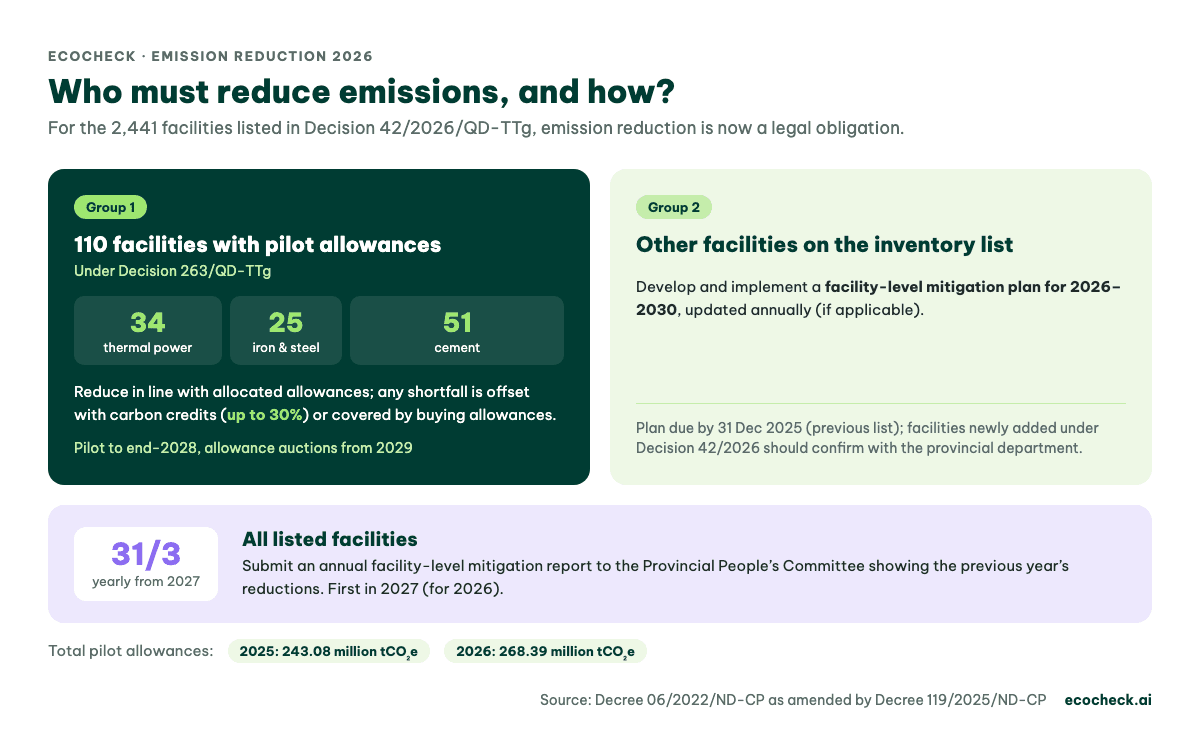
Figure 1: Emission reduction obligations by facility group: 110 pilot allowance facilities, other listed facilities with 2026–2030 mitigation plans, and annual mitigation reports by 31 March from 2027 for all
Where should you start reducing emissions?
Start from your inventory data, not from a list of technologies. The mitigation report must demonstrate reductions against a baseline, so you need a reliable inventory for 2025 and 2026, broken down by:
- Scope 1: on-site fuel combustion (boilers, kilns, generators, internal vehicles), process emissions, refrigerant leaks.
- Scope 2: purchased electricity, steam and heat.
- Scope 3: purchased materials, outsourced transport, waste, use of sold products.
Then rank sources by emissions and focus on the few largest. For a detailed breakdown of the scopes, see our article on Scope 1, 2 and 3 greenhouse gas emissions.
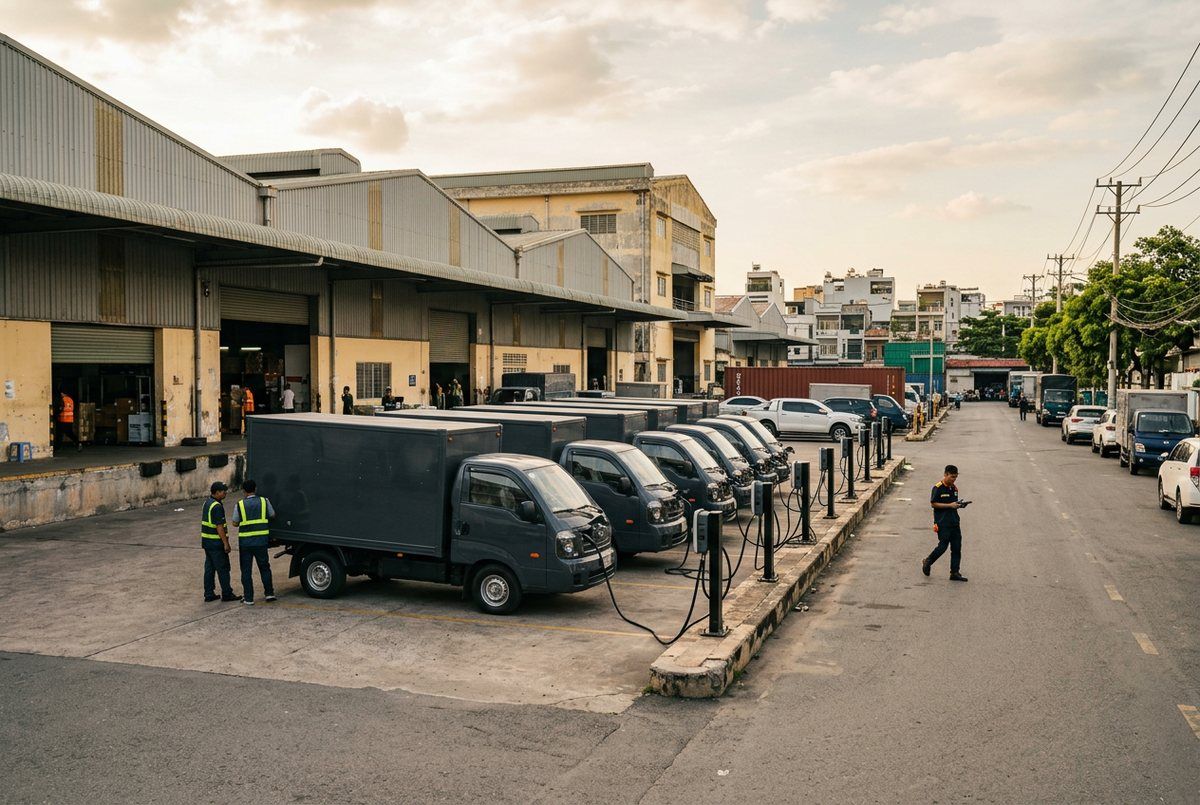
Delivery trucks at a logistics warehouse, a source of Scope 1 and Scope 3 emissions
What do Scope 1 emission reduction solutions include?
Scope 1 is the part a business controls directly, with four main groups of solutions:
- Optimize combustion equipment: tune boiler air-to-fuel ratios, recover heat from flue gas and condensate, insulate steam lines and repair leaking steam traps.
- Fuel switching: replace coal and FO/DO oil with gas or biomass of clear origin, or electrify heat demand (heat pumps, electric furnaces) when the electricity comes from renewable sources.
- Process improvements: emissions from chemical reactions of raw materials, for example reducing the clinker ratio in cement with additives, increasing the share of scrap in steelmaking, and reducing N₂O in nitric acid production.
- Refrigerant control: check for leaks regularly, record top-up quantities and, when replacing equipment, choose refrigerants with a low global warming potential (GWP). This source is often overlooked at food factories and cold stores.
Route optimization and switching to electric vehicles for an owned fleet also fall under Scope 1.
Reducing Scope 2 emissions: energy efficiency, rooftop solar or DPPA?
Do all three in order, as they complement each other:
- Energy efficiency first: install sub-meters by area, variable frequency drives for pumps, fans and air compressors; fix compressed air leaks; switch to LED lighting; optimize chillers.
- Rooftop solar for self-generation and self-consumption: under Decree 58/2025/ND-CP, factories can install systems for their own use; surplus power can be sold to EVN up to 20% of generated output. Systems under 1 MW that do not sell power to the grid only need to notify the regulator. Because grid sales are capped, systems should be sized to the plant’s daytime load.
- Direct power purchase agreements (DPPA): Decree 57/2025/ND-CP (replacing Decree 80/2024/ND-CP) allows large electricity users with average consumption of 200,000 kWh/month or more to buy renewable electricity directly via a private line or through the national grid.
For reporting, keep contracts, invoices and metering data to prove the renewable electricity used.
How can you reduce Scope 3 emissions in logistics and the supply chain?
Scope 3 is often the largest for contract manufacturing, garments, electronics and food businesses, but it sits outside the factory. Practical approaches:
- Logistics: consolidate shipments to raise load factors, optimize routes, shift part of the volume to inland waterways or rail where feasible, and include emission criteria in contracts with carriers.
- Materials: increase recycled content, reduce losses, design lighter packaging and prefer suppliers with product emissions data.
- Suppliers: require key suppliers to conduct inventories and share data, rather than relying on industry-average factors.
Scope 3 is not yet mandatory in facility-level reports under Decree 06/2022, but international customers often request it. For practical lessons, see our article on the green supply chain.
Which solutions need low investment and pay back quickly?
The table below is a qualitative comparison. Actual figures depend on electricity and fuel prices, operating hours and the condition of equipment, so an energy audit is needed before making decisions.
| Solution group | Scope | Investment level | Estimated payback | Notes |
|---|---|---|---|---|
| Energy management, metering, fixing compressed air and steam leaks | 1, 2 | Low | Short | Do this first; generates data for the mitigation report |
| Variable frequency drives, high-efficiency motors, LED, chiller optimization | 2 | Low – medium | Short – medium | Highly effective for equipment with long running hours |
| Boiler optimization, heat recovery | 1 | Low – medium | Short – medium | Also cuts fuel costs |
| Rooftop solar for self-consumption | 2 | Medium | Medium | Surplus sales capped at 20%; roof must be structurally sound |
| DPPA | 2 | Low capital; costs based on contract price | Not applicable | Only for customers using 200,000 kWh/month or more |
| Fuel switching (biomass, gas, heat electrification) | 1 | Medium – high | Medium – long | Depends on fuel prices and supply |
| Process improvements (clinker, scrap steel, N₂O) | 1 | High | Long | Important for allowance-holding facilities and CBAM |
| Logistics (load, route and mode optimization, electric vehicles) | 1, 3 | Low – high | Depends on solution | Load and route optimization needs almost no capital |
| Supply chain (recycled materials, suppliers) | 3 | Low capital; purchase prices may rise | Long | Requires supplier data |
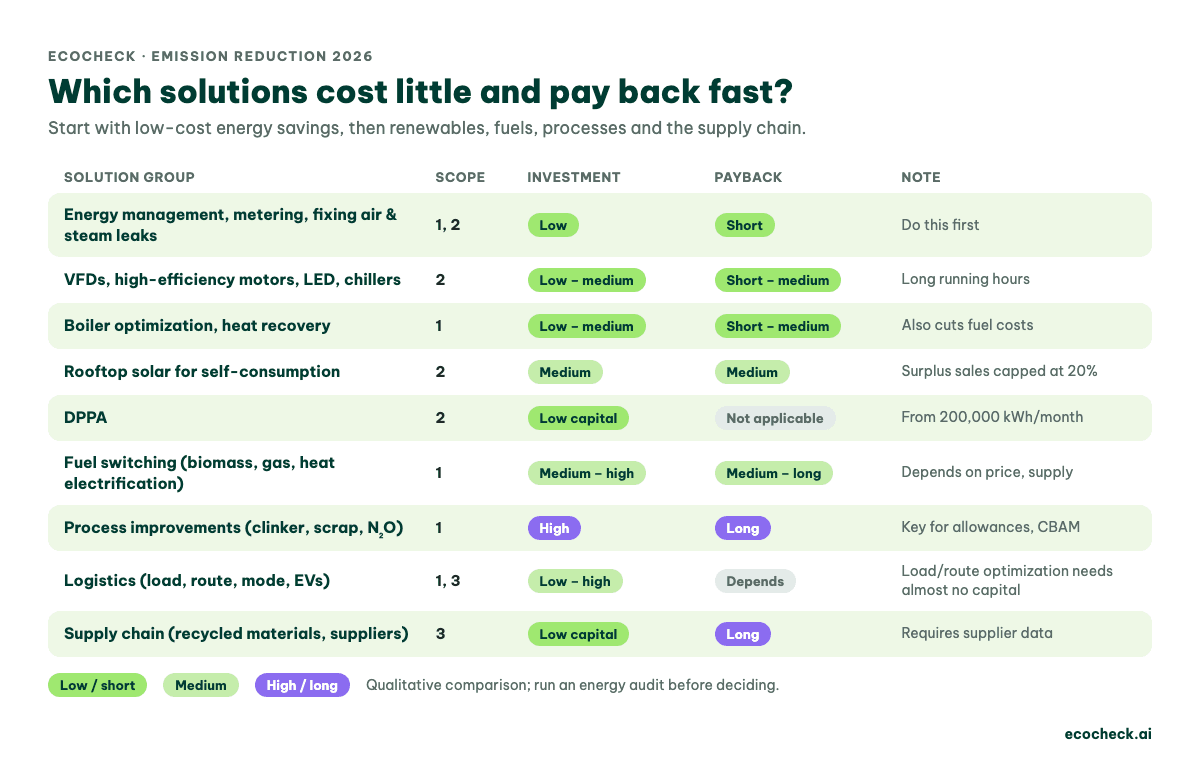
Figure 2: Qualitative comparison of emission reduction solutions by Scope, investment level and payback, from low-cost energy management to high-cost process improvements
What are the steps to build a 2026–2030 emission reduction plan?
- Fix the baseline: complete the 2025 and 2026 inventories (which are also the data for the inventory report due before 31 March 2027).
- Identify hotspots: rank emission sources by volume and by how feasible they are to address.
- Build a list of solutions: for each, estimate the reduction, capital cost, operating cost and implementation time.
- Set targets and a roadmap: break it down by year to 2030, prioritize low-cost solutions first and link major investments to equipment replacement plans.
- Set up measurement and reporting: each solution needs measurable indicators (kWh, tonnes of fuel, tonnes of product) to feed into the annual mitigation report from 2027.
For the detailed legal roadmap, see our article on the greenhouse gas inventory roadmap.
Can carbon credits replace real emission reductions?
No. Carbon credits offset emissions that have not yet been reduced; they do not replace reductions at the source. Under Decree 119/2025/ND-CP, facilities allocated emission allowances may use credits to offset at most 30% of their allocated allowances. The domestic carbon market is in a pilot phase until the end of 2028 and will move to mechanisms such as allowance auctions from 2029, so the cost of an allowance shortfall is likely to rise. See also what are carbon credits and emission allowance allocation for 2025–2026.
For steel, aluminium, cement and fertilisers exported to the EU, reducing emissions also lowers CBAM costs, because CBAM is calculated on the embedded emissions per tonne of product (see what is CBAM).
How does EcoCheck support emission reduction?
EcoCheck conducts inventories under Decree 06/2022/ND-CP, ISO 14064-1 and the GHG Protocol to establish your baseline, builds an emission reduction roadmap and tracks data on its software platform for future reporting cycles. For example, for Thuan Phat Dat Plastic Manufacturing and Trading Co., Ltd., EcoCheck carried out a full inventory across all 3 scopes and built a long-term emission reduction roadmap.
Next step: check whether your facility is on the list with the free lookup tool, then get advice on inventory and an emission reduction roadmap ahead of the 31 March 2027 reporting deadline.
Frequently asked questions
Which businesses must prepare a greenhouse gas emission reduction plan?
Facilities on the list required to conduct a greenhouse gas inventory that have not been allocated emission allowances must develop a facility-level emission mitigation plan for 2026–2030 under Decree 06/2022/ND-CP as amended by Decree 119/2025/ND-CP.
When is the facility-level emission mitigation report due?
Annually, submitted to the Provincial People’s Committee before 31 March, showing the reductions achieved in the previous year. The first submission is in 2027, for 2026 data.
Which emission reduction solution should come first?
Energy management and saving electricity, steam and compressed air: low cost, short payback, and it generates metered data for reporting.
Which businesses can buy electricity directly (DPPA)?
Under Decree 57/2025/ND-CP, large electricity users with average consumption of 200,000 kWh/month or more can buy renewable electricity directly via a private line or through the national grid.
Can carbon credits be used instead of reducing emissions?
Only partly. Facilities allocated emission allowances may use carbon credits to offset at most 30% of their allowances. The rest must come from real reductions or from buying additional allowances.




![Top 5 Công Cụ Tính Toán Phát Thải Khí Nhà Kính [Cập Nhật 2026]](https://cms.ecocheck.ai/uploads/Eco_Check_Top_5_cong_cu_va_phan_mem_ho_tro_kiem_ke_khi_nha_kinh_d9d03bf693.png)
![Phương pháp Kiểm kê Khí nhà kính: GHG Protocol & ISO 14064 [2026]](https://cms.ecocheck.ai/uploads/Cac_phuong_phap_va_tieu_chuan_kiem_ke_khi_nha_kinh_pho_bien_e645f7df80.png)