What does Circular 64/2026/TT-BCT cover?
Which companies must comply with Circular 64?
When and where are energy plans and reports filed?
What does an energy audit under Circular 64 involve?
What does the energy management model require?
How does Circular 64 relate to the GHG inventory?
One data set, three obligations
What is the 2027 energy and GHG filing calendar?
What should companies prepare before 20 November 2026?
Frequently asked questions
When does Circular 64/2026/TT-BCT take effect?
What is a key energy user?
When is the annual energy use plan due?
How often is an energy audit required?
If we already do a GHG inventory, do we still need the energy report?
Do state-budget agencies have to comply?
Vietnam Circular 64/2026/TT-BCT: Energy Plans, Audits and GHG Data
Circular 64/2026/TT-BCT was issued by Vietnam's Ministry of Industry and Trade (MOIT) on 30 September 2026. It takes effect on 20 November 2026 and replaces Circular 25/2020/TT-BCT. It governs energy efficiency plans and reports on how those plans were carried out, energy management models, and energy audits. It mainly applies to designated key energy users: industrial, agricultural and transport facilities using 1,000 TOE or more a year, and buildings using 500 TOE or more a year, under Decree 30/2026/ND-CP. These facilities must submit their annual plan and the previous year's report by 30 April each year on the dataenergy.vn system, and carry out a mandatory energy audit every three years.
Most plants on the key energy user list are also on the GHG inventory list, because the inventory criteria use the same 1,000 TOE/year threshold for industrial facilities. This article summarises Circular 64, the filing calendar and audit content, and shows how one energy data set can serve three obligations: the energy report, the GHG inventory and emission mitigation.
What does Circular 64/2026/TT-BCT cover?
According to MOIT's announcement, the Circular has five groups of provisions:
| Group | Content | Who it applies to |
|---|---|---|
| 1 | Annual list of key energy users | Provincial People's Committees, MOIT |
| 2 | Annual and 5-year energy efficiency plans and implementation reports | Key energy users |
| 3 | Annual energy use plans and reports | State-budget agencies and units using 100,000 kWh of electricity or more a year |
| 4 | Energy management model | Key energy users |
| 5 | Procedure and content of energy audit reports | Key energy users, energy audit organisations |
The Circular does not apply to defence and security. Its legal basis is the Law on Energy Efficiency and Conservation (as amended) and Decree 30/2026/ND-CP of 21 January 2026, which replaced Decree 21/2011/ND-CP.
Which companies must comply with Circular 64?
A company must comply if one of its facilities is on the key energy user list. Under Article 3 of Decree 30/2026/ND-CP, the criteria are:
| Facility type | Threshold | What is counted |
|---|---|---|
| Industrial and agricultural production | 1,000 TOE/year or more | Total electricity, coal, petroleum and other energy at the facility site |
| Transport companies | 1,000 TOE/year or more | Electricity and fuel for vehicles the company manages |
| Buildings (offices, hotels, hospitals, schools, supermarkets, restaurants, etc.) | 500 TOE/year or more | Total energy used at the operating address |
Provincial People's Committees approve and publish the list before 31 March each year and send it to MOIT. Because the list is updated every year, a plant that has just expanded can appear on next year's list even if it was not on this year's. Electricity and fuels are converted to TOE using MOIT's conversion factors. Estimate your own position in advance rather than waiting for the provincial Department of Industry and Trade to tell you.

A construction site with cranes, an energy-intensive operation
When and where are energy plans and reports filed?
| Task | Deadline | Where |
|---|---|---|
| Province approves and publishes the key energy user list | Before 31 March each year (Decree 30/2026) | Provincial People's Committee |
| Current-year plan and report on the previous year's plan | Before 30 April each year | National energy use database (dataenergy.vn) |
| Next 5-year plan and report on the previous 5-year plan | Before 30 April of the first year of the cycle | dataenergy.vn |
| Mandatory energy audit | Every three years | The facility itself or a hired energy audit organisation |
Because the Circular takes effect on 20 November 2026, the filing due before 30 April 2027 (the 2027 plan and the 2026 report) is the first cycle that runs entirely under the new rules. The detailed templates are in the Circular's annexes. Check the full text before filing, because the Circular 25/2020 templates will no longer apply.
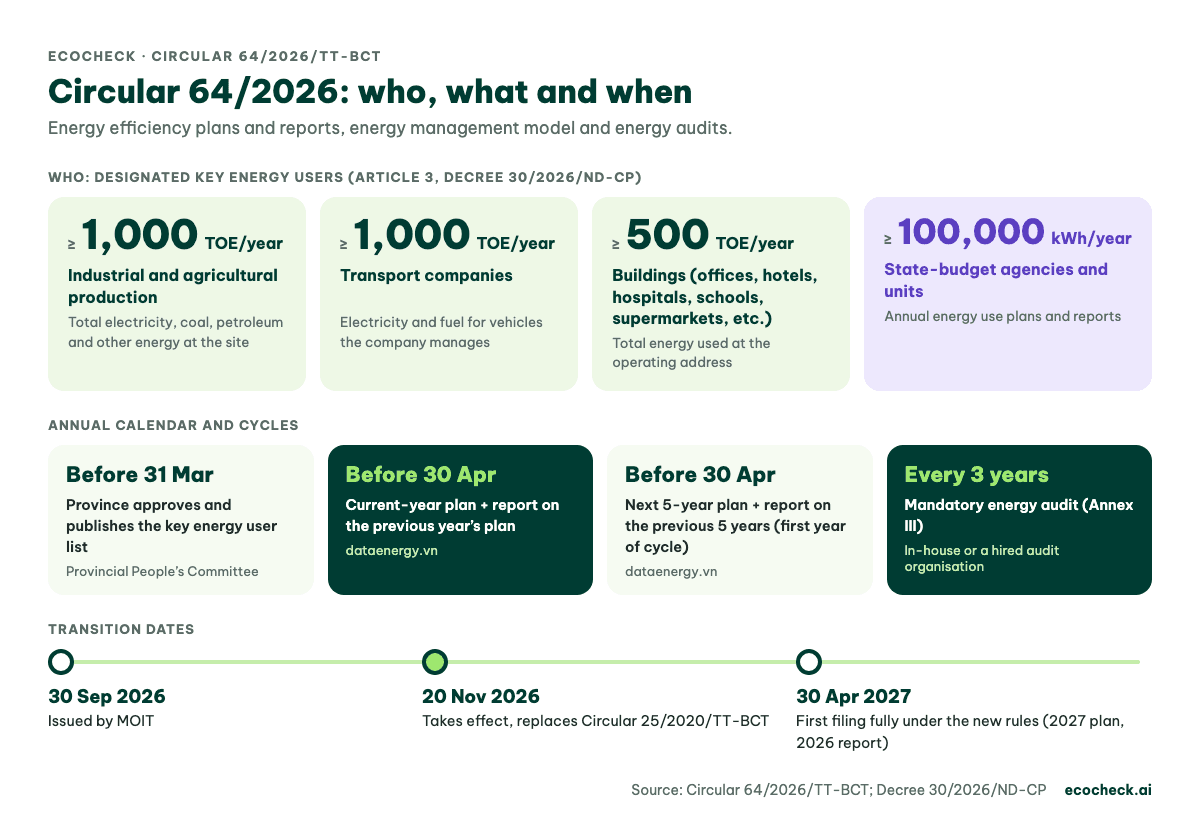
Figure 1: Circular 64/2026/TT-BCT: key energy user thresholds (1,000 TOE/year, buildings 500 TOE/year), annual plan and report due before 30 April on dataenergy.vn, energy audit every three years, effective 20 November 2026
What does an energy audit under Circular 64 involve?
Key energy users must carry out a mandatory energy audit every three years. The audit steps and the content of the audit report are set out in Annex III of the Circular. According to MOIT-sector news reports, the audit report includes:
- Measurement and survey data on current energy use;
- Specific energy consumption (SEC) per product;
- An energy balance diagram for the facility;
- An assessment of energy efficiency and savings potential;
- Proposed energy-saving measures, with investment analysis.
The list of measures in the audit report is a good input for a GHG mitigation plan. Many measures, such as high-efficiency motors, variable speed drives, heat recovery, boiler optimisation and rooftop solar, cut both TOE and tCO₂e. See GHG emission reduction solutions for businesses in Vietnam.
What does the energy management model require?
Key energy users must apply an energy management model that includes:
- Publishing an energy efficiency policy and targets;
- Annual and 5-year plans, with responsibilities assigned;
- Appointing an energy manager;
- Metering and monitoring, setting a baseline, calculating SEC and preparing energy balances;
- Management, operational and technical measures, plus periodic audits;
- Staff training and capacity building.
Metering (sub-meters per line, fuel meters, boiler logs) is the part most worth investing in. It serves both the energy management model and the GHG inventory, and it also lets you split data by product when overseas buyers ask.
How does Circular 64 relate to the GHG inventory?
Under Decree 06/2022/ND-CP, facilities that must carry out a GHG inventory include those emitting 3,000 tCO₂e a year or more, thermal power plants, and industrial facilities using 1,000 TOE a year or more. The current list is Decision 42/2026/QD-TTg, covering 2,441 facilities. Since the 1,000 TOE threshold is shared, an industrial plant on the key energy user list usually also has an inventory obligation. The two lists can still differ, so check both. Use the GHG inventory lookup tool for the GHG list.
One data set, three obligations
| Source data | Energy report (Circular 64) | GHG inventory (Decrees 06, 119) | Mitigation |
|---|---|---|---|
| Grid electricity (kWh from bills) | Converted to TOE, SEC | Indirect emissions = MWh × grid factor | kWh saved by efficiency measures |
| Coal, diesel, fuel oil, LPG, gas, biomass (stock records) | Converted to TOE | Direct emissions from combustion | Fuel switching, boiler optimisation |
| Purchased steam and heat | Counted in energy use | Indirect emissions from purchased energy | Heat recovery |
| Self-consumed solar | Reduces purchased energy | Reduces grid-electricity emissions | A mitigation measure |
| Production output | Denominator of SEC | Emission intensity | Efficiency per unit of product |
For electricity, the inventory uses the national grid emission factor, currently 0.6592 tCO₂/MWh for 2023. See Vietnam's grid emission factor. To turn energy data into tCO₂e quickly, use the Scope 1 and 2 emissions calculator.
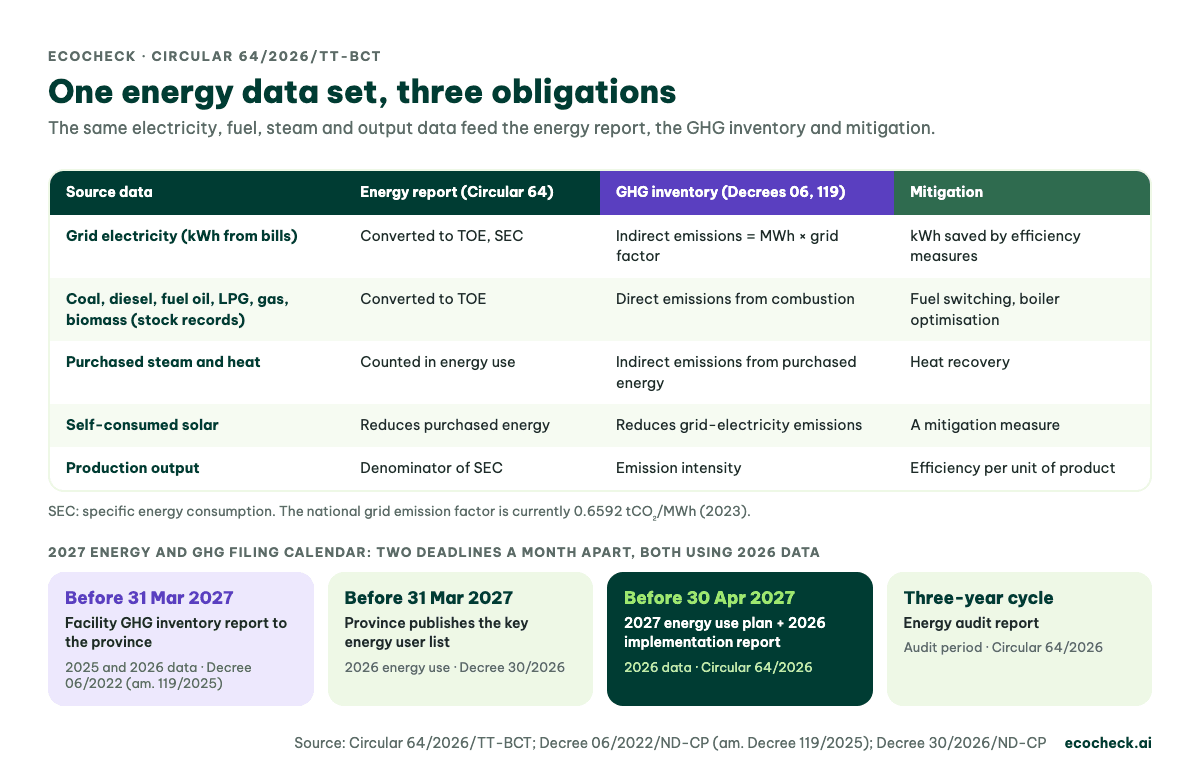
Figure 2: One energy data set serving three obligations: the Circular 64 energy report, the GHG inventory and mitigation, with the 31 March 2027 and 30 April 2027 filing deadlines
What is the 2027 energy and GHG filing calendar?
| Deadline | Report | Data | Legal basis |
|---|---|---|---|
| Before 31 March 2027 | Facility-level GHG inventory report, filed with the provincial People's Committee | 2025 and 2026 | Decree 06/2022, amended by Decree 119/2025 |
| Before 31 March 2027 | Province publishes the key energy user list | 2026 energy use | Decree 30/2026 |
| Before 30 April 2027 | 2027 energy use plan and 2026 implementation report | 2026 | Circular 64/2026 |
| Three-year cycle | Energy audit report | Audit period | Circular 64/2026 |
The 31 March and 30 April deadlines are only a month apart and both use 2026 data. Collecting it once, monthly and with documents, and producing both reports from it is much easier than having two departments do the work twice. The GHG side is covered step by step in the GHG inventory process in Vietnam 2026: 8 steps, and all deadlines are in the 2026–2030 compliance calendar.
What should companies prepare before 20 November 2026?
- Check both lists: the province's key energy user list and the GHG inventory list under Decision 42/2026.
- Check your dataenergy.vn account and who is responsible for filing.
- Pin down your audit cycle: when the last audit was done and when the next three-year audit falls due.
- Standardise a monthly data log for 2026: electricity, each fuel, purchased steam, output. Keep bills and stock records.
- Link energy-saving measures to emission targets: record both the TOE and the tCO₂e saved by each measure.
Next step: EcoCheck uses one set of electricity, fuel and steam data for the GHG inventory report to the province and for the energy data in the Circular 64 report. See the GHG inventory service or the GHG inventory platform.
Frequently asked questions
When does Circular 64/2026/TT-BCT take effect?
On 20 November 2026. It was issued on 30 September 2026 and replaces Circular 25/2020/TT-BCT of 29 September 2020.
What is a key energy user?
Under Decree 30/2026/ND-CP, it is an industrial or agricultural facility or transport company using 1,000 TOE or more a year, or a building using 500 TOE or more a year. Provincial People's Committees publish the list before 31 March each year.
When is the annual energy use plan due?
Before 30 April each year. The filing covers that year's plan and the report on the previous year's plan, submitted on the national energy use database at dataenergy.vn.
How often is an energy audit required?
Every three years for key energy users. The procedure and report content follow Annex III of Circular 64/2026/TT-BCT.
If we already do a GHG inventory, do we still need the energy report?
Yes. They are separate obligations under different laws, filed on different systems. But they share the same electricity and fuel data, so collect it once.
Do state-budget agencies have to comply?
Yes, if they use 100,000 kWh of electricity or more a year. They must prepare annual energy use plans and reports.









![Top 5 Công Cụ Tính Toán Phát Thải Khí Nhà Kính [Cập Nhật 2026]](https://cms.ecocheck.ai/uploads/Eco_Check_Top_5_cong_cu_va_phan_mem_ho_tro_kiem_ke_khi_nha_kinh_d9d03bf693.png)
![Phương pháp Kiểm kê Khí nhà kính: GHG Protocol & ISO 14064 [2026]](https://cms.ecocheck.ai/uploads/Cac_phuong_phap_va_tieu_chuan_kiem_ke_khi_nha_kinh_pho_bien_e645f7df80.png)