What is Vietnam's grid emission factor for each year?
Has an official grid emission factor been published for 2024 or 2025?
Which factor should the inventory report due 31 March 2027 use?
How do you calculate emissions from electricity (Scope 2)?
How is the grid factor calculated, and what are OM, BM and CM?
What is the difference between location-based and market-based Scope 2?
Why does the grid factor change from year to year?
What mistakes do companies make with the grid factor?
How can you calculate quickly and correctly for the 2027 cycle?
Frequently asked questions
What is Vietnam's grid emission factor for 2024?
Which document published the 2023 grid emission factor?
How many kg of CO₂ does 1 kWh of electricity emit in Vietnam?
Can I use the 2025 estimate in my inventory report?
Does self-consumed rooftop solar count toward Scope 2?
Vietnam Grid Emission Factor 2023–2025: Official Values & Estimates
Vietnam's latest official grid emission factor is 0.6592 tCO₂/MWh, for data year 2023. The Department of Climate Change announced it in Official Letter 1726/BĐKH-PTCBT dated 3 December 2024. As of 7 October 2026, we have not found any official value for 2024 or 2025. The figures now circulating for those years, 0.6811 tCO₂/MWh for 2024 and 0.6235 tCO₂/MWh for 2025, are researchers' estimates, not official values. This page gives the year-by-year lookup table, marks which values are official and which are estimates, and shows how to use the factor for Scope 2 in the inventory report due by 31 March 2027.
Last updated: 7 October 2026. We will update this table when an official 2024 value is published.
What is Vietnam's grid emission factor for each year?
The table below lists the national grid emission factor (EF) by data year. The unit is tonnes of CO₂ per MWh, which is the same as kg CO₂ per kWh.
| Data year | Factor (tCO₂/MWh) | Change vs previous year | Status | Document / source |
|---|---|---|---|---|
| 2019 | 0.8458 | — | Official | Announced by the Department of Climate Change in 2020 (letter number not verified) |
| 2020 | 0.8041 | −4.9% | Official | Official Letter 1316/BĐKH-TTBVTOD, 31 December 2021 |
| 2021 | 0.7221 | −10.2% | Official | Official Letter 1278/BĐKH-TTBVTOD, 31 December 2022 |
| 2022 | 0.6766 | −6.3% | Official | Official Letter 327/BĐKH-PTCBT, 19 March 2024 |
| 2023 | 0.6592 | −2.6% | Official, latest | Official Letter 1726/BĐKH-PTCBT, 3 December 2024 |
| 2024 | 0.6811 | +3.3% | Estimate | Research team from Hanoi University of Science and Technology with the Ministry of Agriculture and Environment, published April 2025 |
| 2025 | 0.6235 | −8.5% | Estimate (range 0.3757–0.7863) | Same author group, published in Doanh nghiệp & Kinh tế xanh on 22 January 2026 |
Every official letter was signed by the Department of Climate Change. The Department used to sit under the former Ministry of Natural Resources and Environment and now sits under the Ministry of Agriculture and Environment. Letter 1726 states its purpose: agencies and organisations should refer to the value and apply it consistently in carbon-credit exchange and offset programmes and projects, and in GHG mitigation activities. Each letter gives a single value for the whole grid. There is no split by region or by hour.
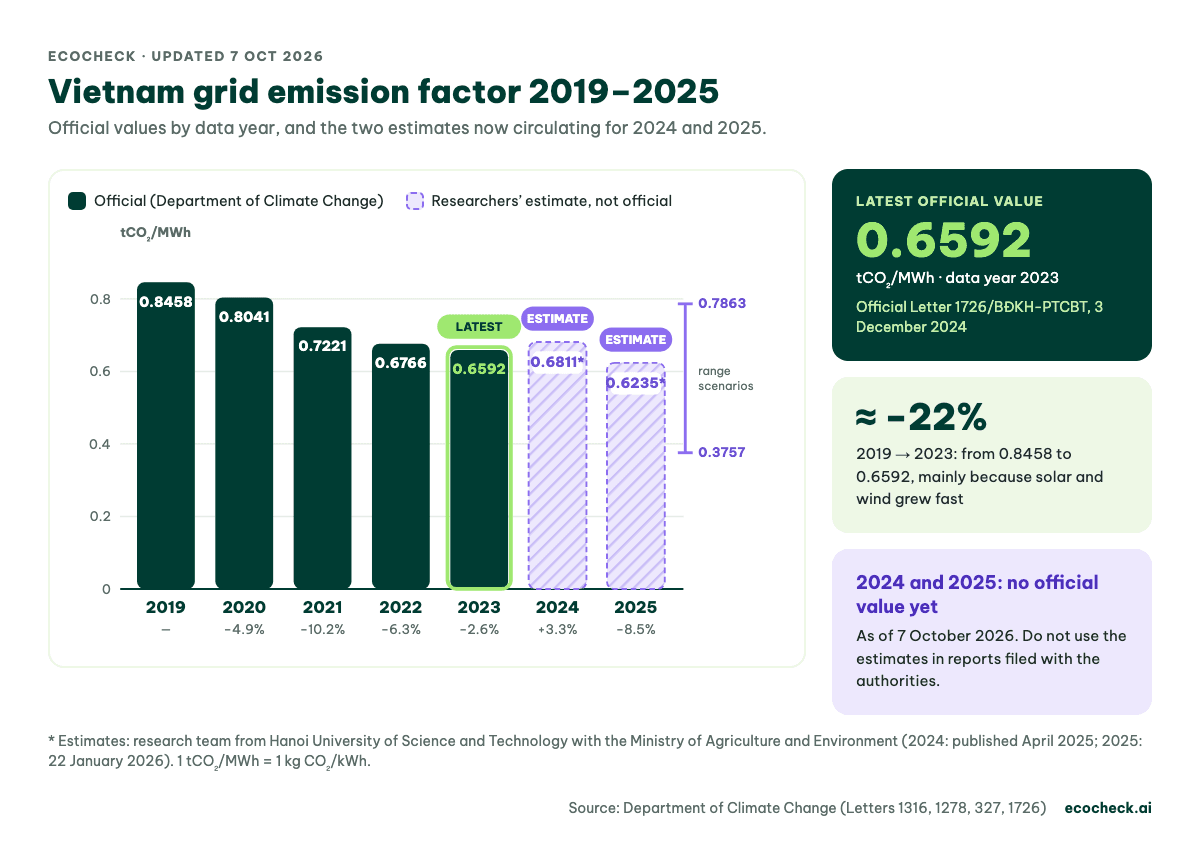
Figure 1: Chart of Vietnam's grid emission factor 2019–2025: official values fall from 0.8458 (2019) to 0.6592 (2023, latest); 2024 (0.6811) and 2025 (0.6235) are estimates
Has an official grid emission factor been published for 2024 or 2025?
No. The article of 22 January 2026 in which the authors estimate the 2025 factor says that, as of January 2026, the competent authority had not announced factors for 2024 or 2025. We checked again on 7 October 2026 and found no letter newer than 1726/BĐKH-PTCBT.
The two estimates were produced as follows:
- 2024: 0.6811 tCO₂/MWh. This is about 3.3% higher than 2023, because coal-fired output rose 17.7% and made up about 49.5% of total generation.
- 2025: 0.6235 tCO₂/MWh. This is the average of the medium scenario (0.4607) and the high scenario (0.7863). The low scenario is 0.3757. The authors attribute the fall mainly to less coal power and more hydropower. The scenarios are far apart, so treat this number as an indication of the trend only.
On the government side, the Institute of Energy (Ministry of Industry and Trade) held a technical workshop on building the 2024 grid emission factor and the coal-power factor for 2020–2024 using TOOL07. The workshop did not release an official figure or a publication date.
Power transmission lines next to an industrial plant
Which factor should the inventory report due 31 March 2027 use?
The 2027 facility-level inventory report covers data years 2025 and 2026. It applies to the 2,441 facilities listed in Decision 42/2026/QD-TTg. We have found no document that says which year's factor must be used for this cycle. Circular 38/2023/TT-BCT (industry and trade sector) requires factors published by the competent authority, and allows IPCC guidance only when no published factor exists. On that basis, a reasonable approach is:
- Use the latest official value at the time you prepare the report. Today that is 0.6592 tCO₂/MWh. State the letter number and the factor's data year in the report.
- Do not put the estimates (0.6811 or 0.6235) in a report filed with the authorities. Use them only for internal analysis, for example to see how much your result would change if the factor rose.
- Check for new announcements before you file. If the 2024 factor is published before 31 March 2027, ask the provincial department which value to apply, and keep the method consistent across both data years.
- Do not use outdated values. Some documents still use 0.7221 (2021) or 0.8041 (2020). These make Scope 2 emissions about 9.5–22% higher than 0.6592 does.
This is our reading of the documents available today, not official guidance. The reviewing authority may have its own requirements, so confirm with the provincial department before you finalise your data.
How do you calculate emissions from electricity (Scope 2)?
Formula:
Scope 2 emissions (tCO₂) = Grid electricity purchased (MWh) × Grid emission factor (tCO₂/MWh)
Circular 38/2023/TT-BCT uses the same structure for indirect emissions from electricity use: activity data multiplied by the emission factor. Take the kWh for each meter from the electricity bills, add up all 12 months, and divide by 1,000 to convert to MWh.
Example: a factory used 2,400,000 kWh of grid electricity in 2025, which is 2,400 MWh.
| Factor applied | Calculation | Scope 2 emissions | Note |
|---|---|---|---|
| 0.6592 (2023, official) | 2,400 × 0.6592 | 1,582.08 tCO₂ | Use for the report |
| 0.6811 (2024, estimate) | 2,400 × 0.6811 | 1,634.64 tCO₂ | Sensitivity check only; 52.56 t higher |
| 0.6235 (2025, estimate) | 2,400 × 0.6235 | 1,496.40 tCO₂ | Reference only |
| 0.7221 (2021, outdated) | 2,400 × 0.7221 | 1,733.04 tCO₂ | Do not use |
Suppose the factory installs rooftop solar for its own use and cuts grid purchases by 300 MWh, to 2,100 MWh. Scope 2 is then 2,100 × 0.6592 = 1,384.32 tCO₂, a reduction of 197.76 tCO₂. Solar power generated and used inside the facility boundary has no Scope 2 emissions, but keep the generation records so you can explain the numbers. To add fuel combustion (Scope 1), see what emissions are and how to calculate Scope 1, 2 and 3.
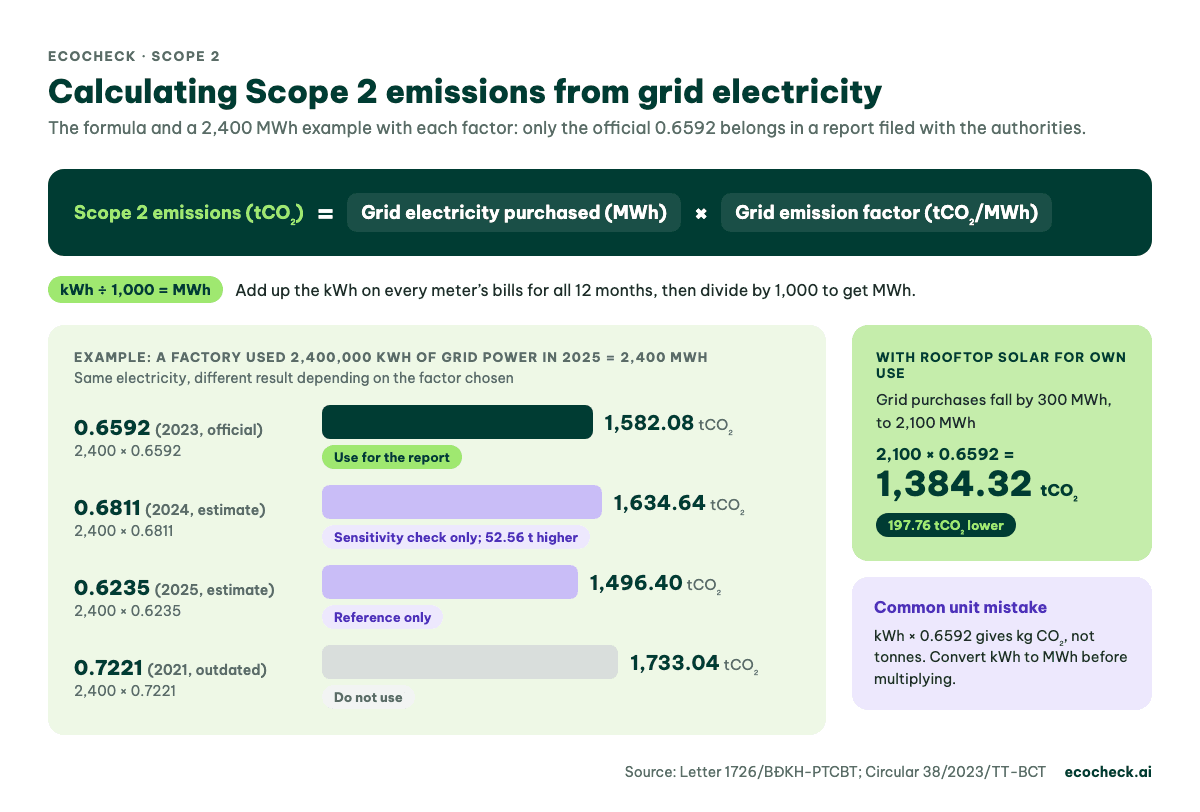
Figure 2: Scope 2 formula = grid MWh × factor; example 2,400 MWh × 0.6592 = 1,582.08 tCO₂ compared with estimated and outdated factors
How is the grid factor calculated, and what are OM, BM and CM?
You will see these three terms in carbon-credit documents. They come from the UNFCCC tool TOOL07, originally used for the CDM:
| Symbol | Name | Meaning | When it is used |
|---|---|---|---|
| OM | Operating Margin | Emissions of existing plants that would be displaced | Emission-reduction projects, carbon credits |
| BM | Build Margin | Emissions of recently built plants | Emission-reduction projects, carbon credits |
| CM | Combined Margin | Weighted average of OM and BM | Calculating reductions from renewable-energy projects |
When you inventory emissions from consuming electricity, use the single value published by the Department of Climate Change. You do not choose between OM, BM and CM. Letter 327 (data year 2022) and Letter 1726 (data year 2023) each state one value for the whole grid. Companies do not recalculate the grid factor themselves; they use the published value.
What is the difference between location-based and market-based Scope 2?
The GHG Protocol Scope 2 Guidance asks for two figures:
- Location-based: uses the average factor of the grid where the power is consumed. In Vietnam, that is the factor published by the Department of Climate Change.
- Market-based: uses a factor tied to your power contracts, such as a direct power purchase agreement (DPPA) or renewable energy certificates (I-RECs).
We have not found any official guidance that allows the market-based method in inventory reports under Decree 06/2022/ND-CP. Reports filed with the authorities should therefore use location-based. Market-based is better suited to voluntary reporting for international customers, CDP or SBTi. For a comparison of the two standards, see Scope 1, 2 and 3 under ISO 14064 and the GHG Protocol.
Why does the grid factor change from year to year?
The factor depends on the share of each power source in that year. From 2019 to 2023 it fell from 0.8458 to 0.6592, a drop of about 22%, mainly because solar and wind grew fast. The 2024 factor is estimated to have risen again because more coal power was needed to meet demand. Rainfall matters too: in wet years hydropower runs more and the factor falls; in dry years thermal plants fill the gap and the factor rises.
Companies cannot control the grid factor. When you compare Scope 2 across years, compare the MWh consumed as well as the tonnes of CO₂. Otherwise, swings in the factor can hide the savings you made by using less electricity. Ways to cut electricity use are covered in GHG emission reduction solutions for businesses in 2026.
What mistakes do companies make with the grid factor?
- Using an old factor (0.7221 or 0.8041) copied from earlier reports.
- Putting an estimate in the official report without labelling it as an estimate.
- Mixing up units: multiplying kWh by 0.6592 and recording the result as tonnes, when the correct result is in kg (or kWh must first be converted to MWh).
- Missing meters: leaving out the office, warehouse or wastewater plant inside the facility boundary.
- Subtracting solar twice: self-consumed solar is already absent from the purchased-power bill, so do not deduct it again.
- Not citing the factor's source: reviewers will ask for the letter number and the factor's data year.
How can you calculate quickly and correctly for the 2027 cycle?
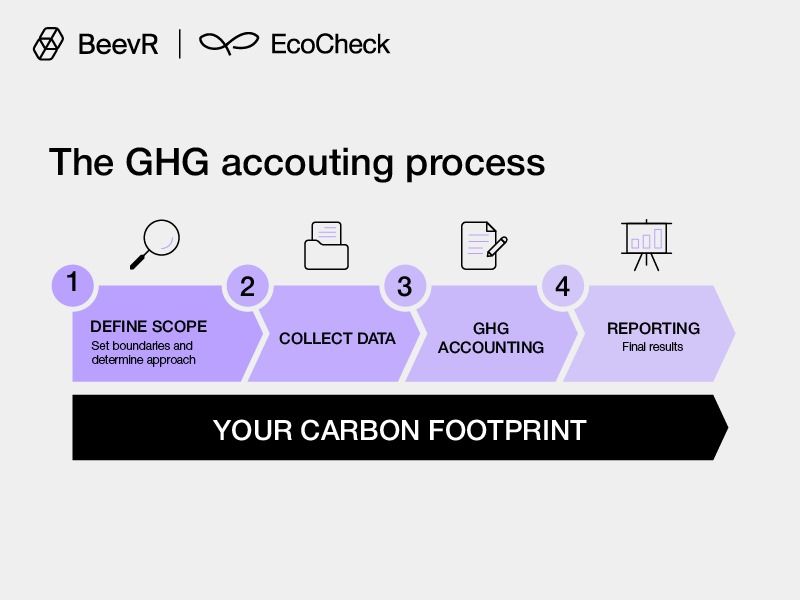
First, check whether your facility is on the list that must conduct an inventory, using the free GHG inventory obligation checker. Then follow the 8-step sequence in the GHG inventory process for 2026. The EcoCheck platform applies the latest official grid factor automatically and records the source of every factor. When a new value is published, you update it once instead of editing spreadsheets by hand. If you want specialists to handle the whole job, see the EcoCheck GHG inventory service.
Frequently asked questions
What is Vietnam's grid emission factor for 2024?
As of 7 October 2026 there is no official value. The figure 0.6811 tCO₂/MWh is an estimate by a research team from Hanoi University of Science and Technology with the Ministry of Agriculture and Environment, published in April 2025. The latest official value is 0.6592 tCO₂/MWh for 2023.
Which document published the 2023 grid emission factor?
Official Letter 1726/BĐKH-PTCBT dated 3 December 2024 from the Department of Climate Change, which gives 0.6592 tCO₂/MWh.
How many kg of CO₂ does 1 kWh of electricity emit in Vietnam?
Using the official 2023 factor, 1 kWh of grid electricity corresponds to 0.6592 kg CO₂. 1,000 kWh (1 MWh) corresponds to 0.6592 tonnes of CO₂.
Can I use the 2025 estimate in my inventory report?
You should not. Reports filed with the provincial People's Committee should use factors published by the competent authority and cite the source. Estimates are for internal analysis only.
Does self-consumed rooftop solar count toward Scope 2?
No. Power generated and used inside the facility boundary is not purchased from the grid, so it is not multiplied by the grid factor. Only grid purchases count toward Scope 2.










![Top 5 Công Cụ Tính Toán Phát Thải Khí Nhà Kính [Cập Nhật 2026]](https://cms.ecocheck.ai/uploads/Eco_Check_Top_5_cong_cu_va_phan_mem_ho_tro_kiem_ke_khi_nha_kinh_d9d03bf693.png)
![Phương pháp Kiểm kê Khí nhà kính: GHG Protocol & ISO 14064 [2026]](https://cms.ecocheck.ai/uploads/Cac_phuong_phap_va_tieu_chuan_kiem_ke_khi_nha_kinh_pho_bien_e645f7df80.png)