What is a carbon credit?
How do carbon credits work?
What is the difference between compliance and voluntary carbon markets?
Carbon credits vs carbon allowances vs carbon offsets: what is the difference?
What makes a high-quality carbon credit?
How do carbon credits work under Article 6 of the Paris Agreement?
Can carbon credits reduce CBAM costs?
What are the rules for carbon credits in Vietnam (2026)?
What should businesses do about carbon credits?
FAQ
What is a carbon credit in simple terms?
How much is one carbon credit?
Are carbon credits and carbon offsets the same thing?
Can a Vietnamese company sell carbon credits abroad?
Do carbon credits reduce the CBAM bill for exports to the EU?
Can carbon credits be deducted from a GHG inventory?
Sources
What Is a Carbon Credit? How They Work, Rules & Vietnam 2026
A carbon credit is a tradable certificate representing one tonne of carbon dioxide equivalent (tCO₂e) that a project has reduced, avoided or removed from the atmosphere. An independent body verifies the result, a registry issues the credit with a unique serial number, and the buyer "retires" it to claim the tonne. Once retired, it cannot be sold again.
Updated 18 November 2026: Paris Agreement Article 6 status (first Article 6.4 credits approved 26 February 2026), Vietnam's Decree 112/2026/ND-CP on international transfers, the 30% offset limit for Vietnamese facilities with allowances, and why carbon credits do not cut CBAM costs.
What is a carbon credit?
A carbon credit is a unit of measurement turned into a tradable asset. One credit equals one tonne of CO₂, or the same warming effect from another greenhouse gas such as methane or nitrous oxide, converted to CO₂ equivalent (CO₂e) using its global warming potential.
The credit is not the gas. It is a claim that a specific activity, such as a wind farm replacing coal power, a landfill capturing methane or a forest being restored, cut or removed one tonne compared with what would have happened without it. That "what would have happened" is the baseline, and most debates about credit quality are really debates about the baseline.
Vietnam's Law on Environmental Protection 2020 (Article 3, clause 35) defines a carbon credit as a commercially tradable certificate representing the right to emit one tonne of CO₂ or one tonne of CO₂ equivalent. The law treats it as a commodity that can be bought, sold and used for offsetting.
Credits are either avoidance or reduction credits (emissions that did not happen, such as renewable power or captured methane) or removal credits (CO₂ taken out of the air and stored, such as in forests, soils or geological storage).
How do carbon credits work?
Every credible credit goes through the same life cycle, whatever the standard:
- Project design. The developer chooses an approved methodology, sets the baseline and shows the project is additional, meaning it would not happen without carbon revenue.
- Validation and registration. An accredited third party checks the design. The project is registered with a crediting programme (for example Verra, Gold Standard or the UN's Article 6.4 mechanism).
- Monitoring and verification. The project measures actual performance. A verifier confirms how many tonnes were reduced or removed in that period.
- Issuance. The registry issues credits, one per verified tonne, each with a serial number, vintage year and project ID.
- Transfer. Credits move between registry accounts when sold, directly or through brokers and exchanges.
- Retirement. The final user retires the credit in the registry against a stated claim. Retirement is what prevents the same tonne being counted twice.
If a company claims to have "offset" emissions, the evidence is the retirement record, not the purchase invoice.
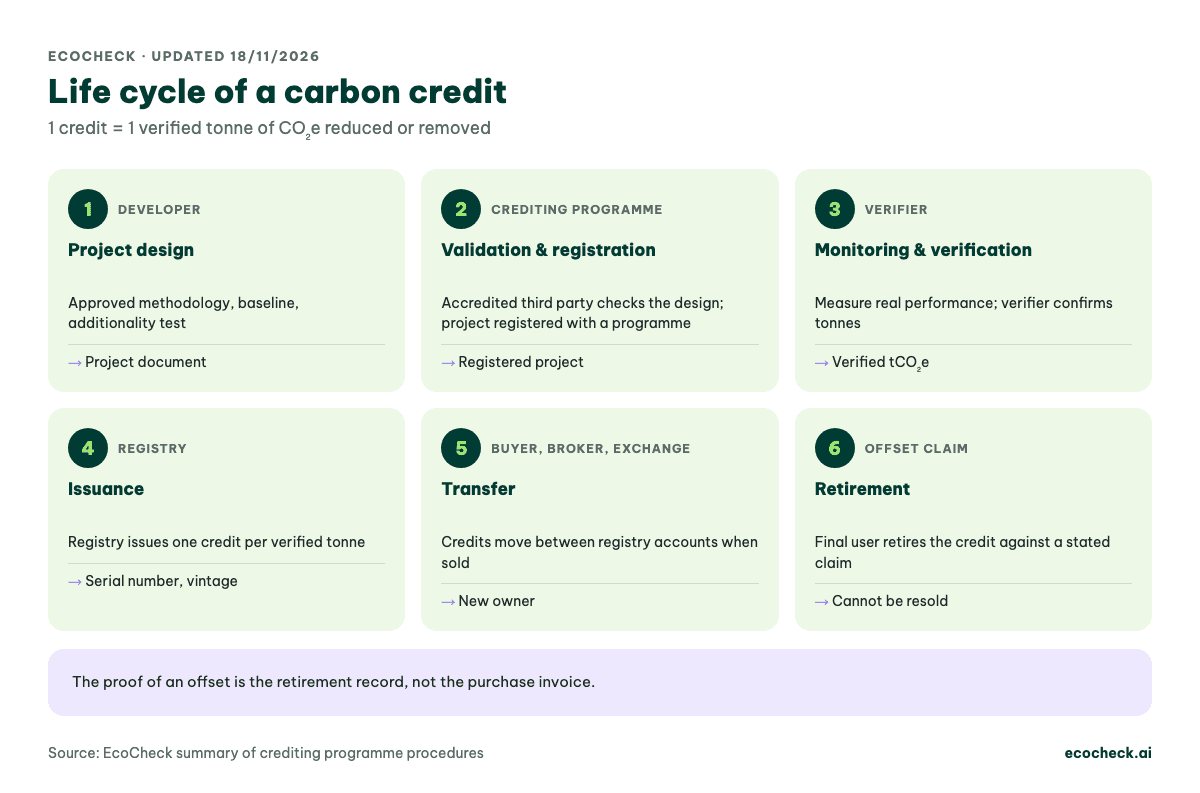
From project to retirement: six steps behind every credible carbon credit
What is the difference between compliance and voluntary carbon markets?
Compliance markets exist because a law requires them. A government caps emissions for covered companies, usually power, steel, cement and other heavy industry, and those companies must hand back enough allowances, and sometimes eligible credits, to cover their verified emissions. Vietnam's pilot emissions trading scheme is a compliance market.
Voluntary markets serve companies and individuals that buy credits for their own goals, such as a climate-neutral product claim or a net-zero pathway. Nobody forces the purchase, so quality depends on the buyer's diligence and on the standards and integrity initiatives described below.
The line is blurring: some compliance schemes accept eligible credits, as Vietnam does within a 30% limit.
Carbon credits vs carbon allowances vs carbon offsets: what is the difference?
- Carbon allowance: a permit to emit one tonne, created and allocated (or auctioned) by a government under a cap. It comes from the cap, not from a project. Vietnam's first allowance product, VN2025, covers the 2025–2026 period for thermal power, steel and cement facilities.
- Carbon credit: one verified tonne reduced or removed by a project, issued by a crediting programme.
- Carbon offset: not a separate instrument but a use. You "offset" when you retire a credit to compensate for a tonne you emitted.
The distinction matters in Vietnam because prices quoted for the domestic exchange are allowance prices, not credit prices. Our Vietnam carbon price tracker for VN2025 allowances explains the numbers.
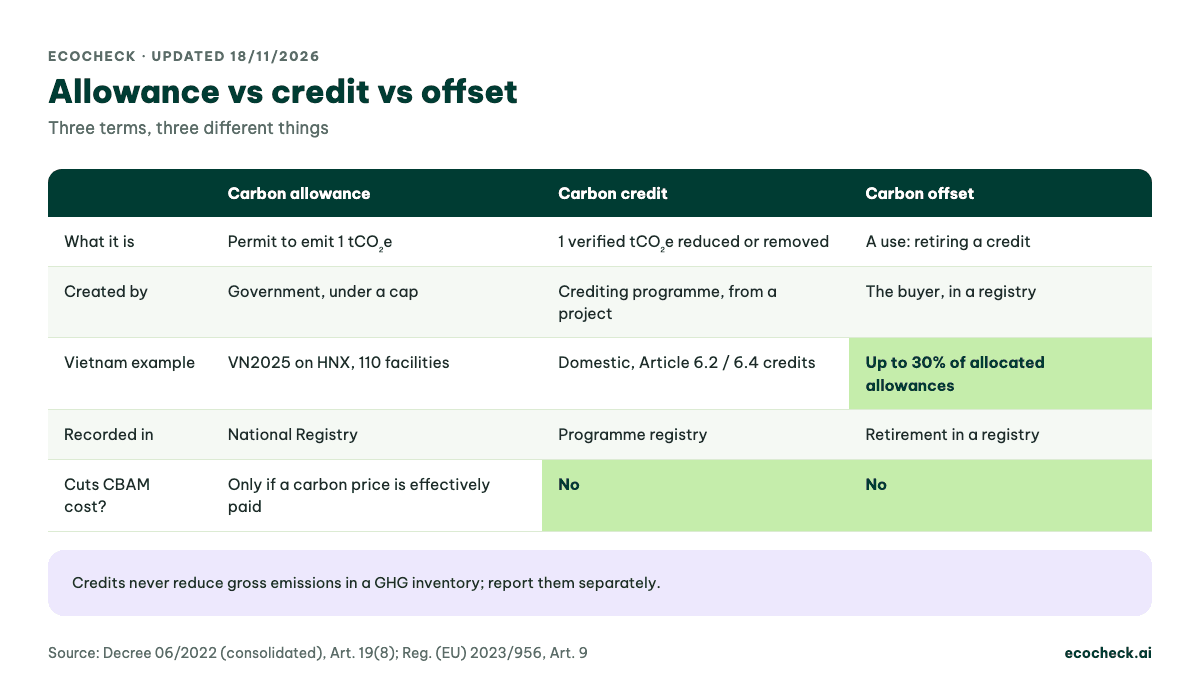
Allowances come from a cap, credits from projects, offsets are what you do with credits
What makes a high-quality carbon credit?
Not all tonnes are equal. The Integrity Council for the Voluntary Carbon Market (ICVCM) set out 10 Core Carbon Principles (CCPs) in three groups:
- Governance: effective programme governance, tracking in a registry, transparency, and robust independent validation and verification.
- Emissions impact: additionality, permanence, robust quantification of reductions and removals, and no double counting.
- Sustainable development: social and environmental safeguards, and a contribution to the net-zero transition.
Programmes and credit categories that pass the ICVCM assessment can carry the CCP label. In practice, buyers should check five risks:
- Additionality: would the project have happened anyway, for example because it was already profitable or legally required?
- Over-crediting: is the baseline inflated, so more credits are issued than real tonnes?
- Permanence: could stored carbon be released again by fire, logging or land-use change, and is there a buffer to cover reversals?
- Leakage: does protecting one area simply push deforestation or production somewhere else?
- Double counting: is the same tonne claimed by two parties, for example by the buyer and by the host country towards its national target?
How do carbon credits work under Article 6 of the Paris Agreement?
Article 6 lets countries cooperate on emission reductions and transfer the results across borders. It has two main channels:
- Article 6.2 (cooperative approaches). Two or more countries agree bilaterally to transfer mitigation outcomes, called ITMOs (internationally transferred mitigation outcomes).
- Article 6.4 (the Paris Agreement Crediting Mechanism, PACM). A UN-supervised crediting mechanism that succeeds the Kyoto-era Clean Development Mechanism (CDM). Its units are called A6.4ERs.
The key idea is the corresponding adjustment. When a host country authorises a credit for international transfer, it adds that tonne back to its own emissions balance, so only the buyer counts it. Without this step, both countries could claim the same reduction.
Under the rules adopted at COP26 (decision 3/CMA.3), 5% of A6.4ERs issued go to the Adaptation Fund as a share of proceeds, and at least 2% are cancelled to deliver an overall mitigation in global emissions, meaning nobody can use them.
According to the UN Supervisory Body's annual report to COP31 (FCCC/PA/CMA/2026/8), the Body approved the first issuance of credits under the Article 6.4 mechanism on 26 February 2026. By 30 June 2026, host countries had approved 418 CDM projects and programmes for transition to the new mechanism. The mechanism's registry is expected to be completed by the end of the first quarter of 2027.
Can carbon credits reduce CBAM costs?
No. The EU Carbon Border Adjustment Mechanism (CBAM) charges importers for the embedded emissions of covered goods such as steel, aluminium, cement, fertilisers, hydrogen and electricity. Under Article 9 of Regulation (EU) 2023/956, the declarant may reduce the number of CBAM certificates only to account for a carbon price effectively paid in the country of origin for those embedded emissions, net of any rebate or compensation.
Buying and retiring voluntary carbon credits is not a carbon price paid in the country of origin. It does not lower the embedded emissions reported for the product either, because those come from measured production data. A Vietnamese steel exporter that buys credits to call its product "carbon neutral" still faces the same CBAM certificate bill.
What does reduce CBAM costs is lower actual embedded emissions, backed by verified installation data instead of EU default values, and any domestic carbon price the exporter has genuinely paid. See What Is CBAM? for the timeline and certificate price.
What are the rules for carbon credits in Vietnam (2026)?
Vietnam's carbon market moved from paper to practice in 2026. The main rules businesses should know:
- Decree 06/2022/ND-CP, as amended by Decree 119/2025/ND-CP, sets the roadmap: a pilot phase until the end of 2028, including a pilot domestic carbon exchange, and full operation from 2029.
- The domestic carbon exchange opened on 29 June 2026 at the Hanoi Stock Exchange (HNX). Its first product is the VN2025 allowance for 110 thermal power, steel and cement facilities. See Vietnam's Carbon Exchange: How Can Businesses Trade?
- The 30% offset limit. Under Article 19(8) of the consolidated Decree 06, a facility with an allocated quota may use carbon credits from domestic mechanisms and from Article 6.2 and 6.4 mechanisms to offset no more than 30% of its allocated allowances. Credits are used through the National Registry during surrender.
- Decree 112/2026/ND-CP on international transfers was issued on 1 April 2026 and took effect on 19 May 2026. According to Vietnam's Department of Climate Change, with a corresponding adjustment, up to 90% of results may be transferred abroad for new, high-cost technology projects that are not yet or rarely deployed in Vietnam, and up to 50% for more common mitigation activities. Where no corresponding adjustment is applied, the maximum can be 90% for all projects. The remainder can be used in the domestic market. The Ministry of Agriculture and Environment issues approvals and records transfers in the national registry.
For key dates through 2030, see the Vietnam GHG, CBAM and carbon market compliance calendar.
What should businesses do about carbon credits?
Credits are the last step, not the first. A sensible order:
- Measure first. You cannot know how many credits you need, or whether you are long or short on allowances, without a reliable GHG inventory. Facilities on the Decision 42/2026/QD-TTg list must submit their inventory by 31 March 2027. Start with What Is a GHG Inventory?
- Reduce what you can. Energy efficiency, fuel switching and renewable electricity lower emissions for good. They also lower CBAM exposure, which credits cannot do.
- Know your obligations. If you hold allowances, credits can cover at most 30% of your allocation. If you export to the EU, credits do not reduce CBAM certificates.
- Buy credits with diligence. Check the standard, the methodology, the vintage, whether the credit carries the CCP label, whether it has a corresponding adjustment if you need one, and that it is retired in your name.
- Report credits separately. Under ISO 14064-1 and the GHG Protocol, your inventory shows gross emissions. Retired credits are disclosed separately and never subtracted from Scope 1, 2 or 3.
EcoCheck does not sell, broker or verify carbon credits. We help with the step that comes first: accurate emissions data. Our GHG inventory service prepares inventories under Decree 06 and ISO 14064-1. For EU exporters, the CBAM reporting service calculates embedded emissions from real plant data. Plans for the software are on our pricing page.
FAQ
What is a carbon credit in simple terms?
It is a certificate showing that one tonne of CO₂ equivalent was reduced, avoided or removed by a verified project. Companies buy and retire credits to compensate for emissions they cannot yet cut.
How much is one carbon credit?
There is no single price. Prices depend on project type, standard, vintage, quality label and whether the host country has authorised the credit. Vietnam's exchange price quotes so far are for VN2025 allowances, not credits.
Are carbon credits and carbon offsets the same thing?
Nearly. A carbon credit is the instrument. Offsetting is what you do with it when you retire it to compensate for your own emissions.
Can a Vietnamese company sell carbon credits abroad?
Yes, with approval. Under Decree 112/2026/ND-CP, international transfers need written approval from the Ministry of Agriculture and Environment and must be recorded in the national registry. Transfer shares are capped at 90% or 50% depending on the project type.
Do carbon credits reduce the CBAM bill for exports to the EU?
No. CBAM only allows a deduction for a carbon price effectively paid in the country of origin. Voluntary credits do not reduce embedded emissions or the number of CBAM certificates.
Can carbon credits be deducted from a GHG inventory?
No. ISO 14064-1 and the GHG Protocol require gross emissions in the inventory. Credits are reported separately as offsets.
Sources
- UNFCCC, FCCC/PA/CMA/2026/8: Annual report of the Supervisory Body for the Article 6.4 mechanism (22 Oct 2026)
- UNFCCC, decisions 2/CMA.3 and 3/CMA.3 (Article 6.2 and 6.4 rules)
- Paris Agreement (Article 6)
- ICVCM, The Core Carbon Principles
- Regulation (EU) 2023/956 establishing CBAM (Article 9)
- Consolidated Decree 06/2022/ND-CP (112/VBHN-BNNMT, 2026), Article 19(8)
- Department of Climate Change (Vietnam): Decree 112/2026/ND-CP on international carbon market integration
EcoCheck is a GHG inventory and emissions data platform aligned with ISO 14064-1, built by BeevR Technologies in Vietnam. We help businesses measure Scope 1, 2 and 3 emissions, prepare Decree 06 reports and CBAM data. We do not sell or verify carbon credits. Contact us
Is your business required to report GHG emissions?
EcoCheck automatically calculates Scope 1/2/3 and exports NĐ06/TT38-compliant reports in one click — saving 90% of the time vs. Excel.
Latest posts