What changed in Vietnam's GHG inventory rules in 2026?
What is a GHG inventory?
Why do businesses need a GHG inventory?
Which regulations govern GHG inventories in 2026?
Which companies must carry out a GHG inventory in Vietnam?
When is the GHG inventory report due?
Which emission scopes does a GHG inventory cover?
What are the steps of a GHG inventory?
How are emissions calculated?
What is the penalty for not submitting a GHG inventory report?
How does the GHG inventory relate to quotas, the carbon exchange and CBAM?
What problems did businesses face in the first reporting round?
How much does a GHG inventory cost, and should you do it in-house or outsource?
Further reading by topic
Frequently asked questions
What is a GHG inventory?
Which businesses must carry out a GHG inventory in Vietnam?
When is the 2027 GHG inventory report due?
How often must a GHG inventory be done?
Is Scope 3 mandatory in Vietnam's GHG inventory?
What is the penalty for not submitting a GHG inventory report?
What Is a GHG Inventory? Vietnam Rules, Who Must Report, 2027 Deadline
A greenhouse gas (GHG) inventory is the process of collecting data on emission sources and calculating how much greenhouse gas a facility emits in a year, using methods set by the Vietnamese authorities. From 25 September 2026, the 2,441 facilities listed in Decision 42/2026/QD-TTg must carry out an inventory. The next facility-level inventory report is due before 31 March 2027, goes to the provincial People's Committee, and covers data for 2025 and 2026. Thermal power plants, steel mills and cement plants that receive emission quotas follow a separate schedule: they send a verified report to the Ministry of Agriculture and Environment before 1 December each reporting year, starting in 2027.
This is EcoCheck's hub page on GHG inventories in Vietnam. Each section summarises one topic and links to a detailed guide.
What changed in Vietnam's GHG inventory rules in 2026?
- New list of 2,441 facilities: Decision 42/2026/QD-TTg, signed 10 August 2026 and effective 25 September 2026, replaces Decision 13/2024/QD-TTg (2,166 facilities).
- Second reporting round: the report due before 31 March 2027 covers inventory results for 2025 and 2026, under Decree 06/2022/ND-CP as amended by Decree 119/2025/ND-CP.
- New annual mitigation report: by the same date, 31 March 2027, facilities submit their first facility-level mitigation report (for 2026).
- Online reporting: according to the Agriculture and Environment newspaper (Báo Nông nghiệp và Môi trường), the March 2027 round runs through a facility-level online inventory reporting system.
- Quotas and the carbon exchange: 110 thermal power, steel and cement facilities received quotas for 2025–2026 and have their own reporting obligations.
- Facilities dropped from the list: facilities listed in Decision 13/2024 but not in Decision 42/2026 are exempt from submitting a facility-level inventory report from 2027.
What is a GHG inventory?
A GHG inventory collects information and data on emission sources and calculates greenhouse gas emissions and removals within a defined boundary and a specific year, following methods and procedures issued by the competent authority. Results are converted to tonnes of CO₂ equivalent (tCO₂e) so that different gases can be added together.
Vietnam runs inventories at three levels: national, sector and facility. A company's obligation is the facility-level inventory.
See also the main greenhouse gases and their GWP values and the GHG inventory glossary.
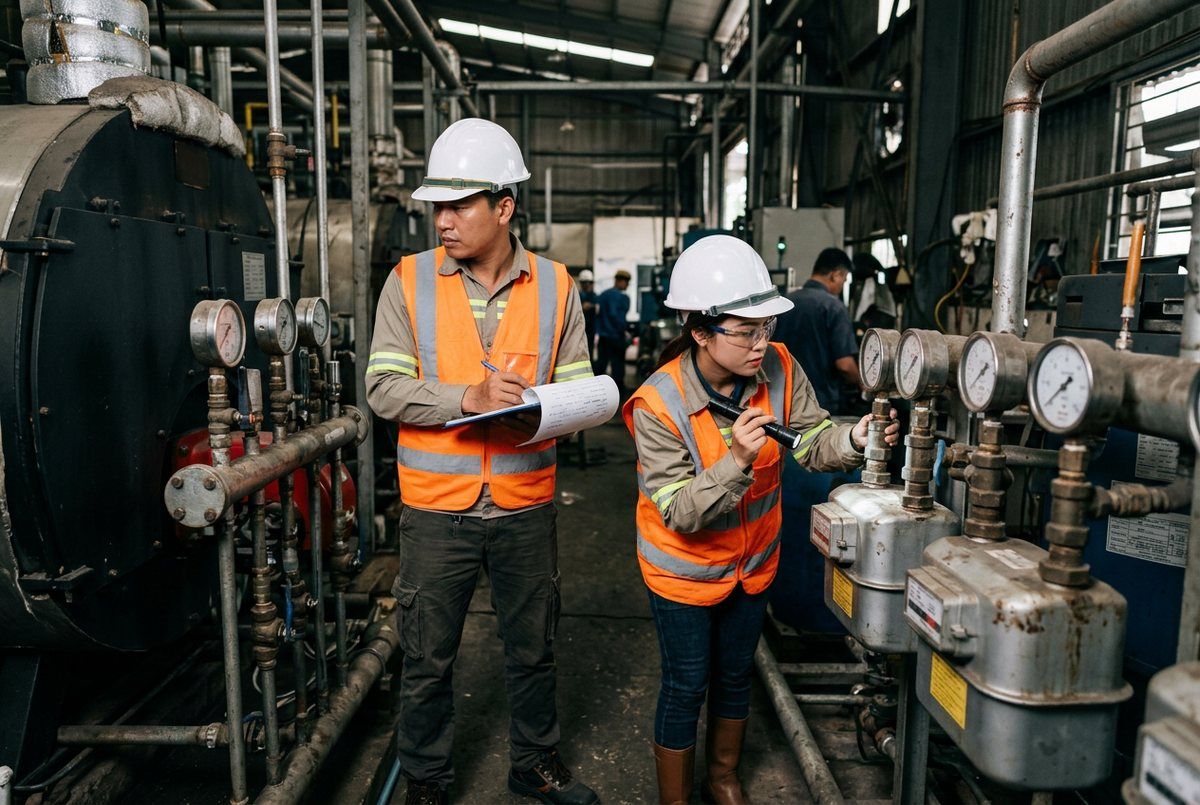
Engineers checking meters at a plant while collecting inventory data
Why do businesses need a GHG inventory?
Beyond the legal obligation, inventory results are the basis for allocating and surrendering emission quotas, they are the data EU importers need for CBAM, and they show which sources use the most energy, which is the starting point for an emission reduction plan.
Which regulations govern GHG inventories in 2026?
| Document | Main content |
|---|---|
| Decree 06/2022/ND-CP | Criteria for facilities that must report, reporting cycle, recipient, verification, quotas |
| Decree 119/2025/ND-CP (effective 1 August 2025) | Amends Decree 06: biennial report to the provincial People's Committee before 31 March; annual mitigation report from 2027; separate schedule for quota facilities |
| Decree 83/2026/ND-CP (23 March 2026) | Further amends Decree 06/2022 (Decision 42/2026 cites it together with the two decrees above) |
| Decision 42/2026/QD-TTg | List of sectors and 2,441 facilities required to report, effective 25 September 2026 |
| Decision 263/QD-TTg (9 February 2026) | Total pilot quota for 2025–2026 for 34 thermal power plants, 25 steel facilities and 51 cement facilities |
| Sector technical circulars | Circular 38/2023/TT-BCT (Industry and Trade), Circular 13/2024/TT-BXD (Construction), Circular 63/2024/TT-BGTVT (Transport) |
| Decree 45/2022/ND-CP | Administrative penalties, including GHG inventory violations (Article 45) |
How these documents evolved year by year is covered in the Vietnam GHG inventory roadmap under Decree 06/2022 and 119/2025.
Which companies must carry out a GHG inventory in Vietnam?
Under Article 6(1) of Decree 06/2022/ND-CP, a facility must carry out an inventory if its annual GHG emissions are 3,000 tonnes CO₂e or more, or if it falls into one of these groups:
- Thermal power plants and industrial facilities with total annual energy consumption of 1,000 tonnes of oil equivalent (TOE) or more;
- Freight transport companies with total annual fuel consumption of 1,000 TOE or more;
- Commercial buildings with total annual energy consumption of 1,000 TOE or more;
- Solid waste treatment facilities with an annual operating capacity of 65,000 tonnes or more.
These criteria are used to build the list. The obligation applies once a facility is named on the list issued by the Prime Minister. The current list is Decision 42/2026/QD-TTg:
| Managing sector | Facilities | Notes |
|---|---|---|
| Industry and Trade | 1,916 | Largest groups: plastics, rubber, textiles, machinery, steel |
| Construction (construction sector) | 411 | — |
| Transport (under the Ministry of Construction) | 53 | Transport sector |
| Agriculture and Environment | 61 | Agriculture, forestry, waste treatment |
| Total | 2,441 | 275 more than the 2024 list |
The obligation applies to each facility, not to the company as a whole. A company with three plants may have only one plant on the list. Search by the name and address of each plant using the free GHG inventory obligation lookup tool, or read the analysis in Decision 42/2026/QD-TTg: 2,441 facilities must conduct a GHG inventory.
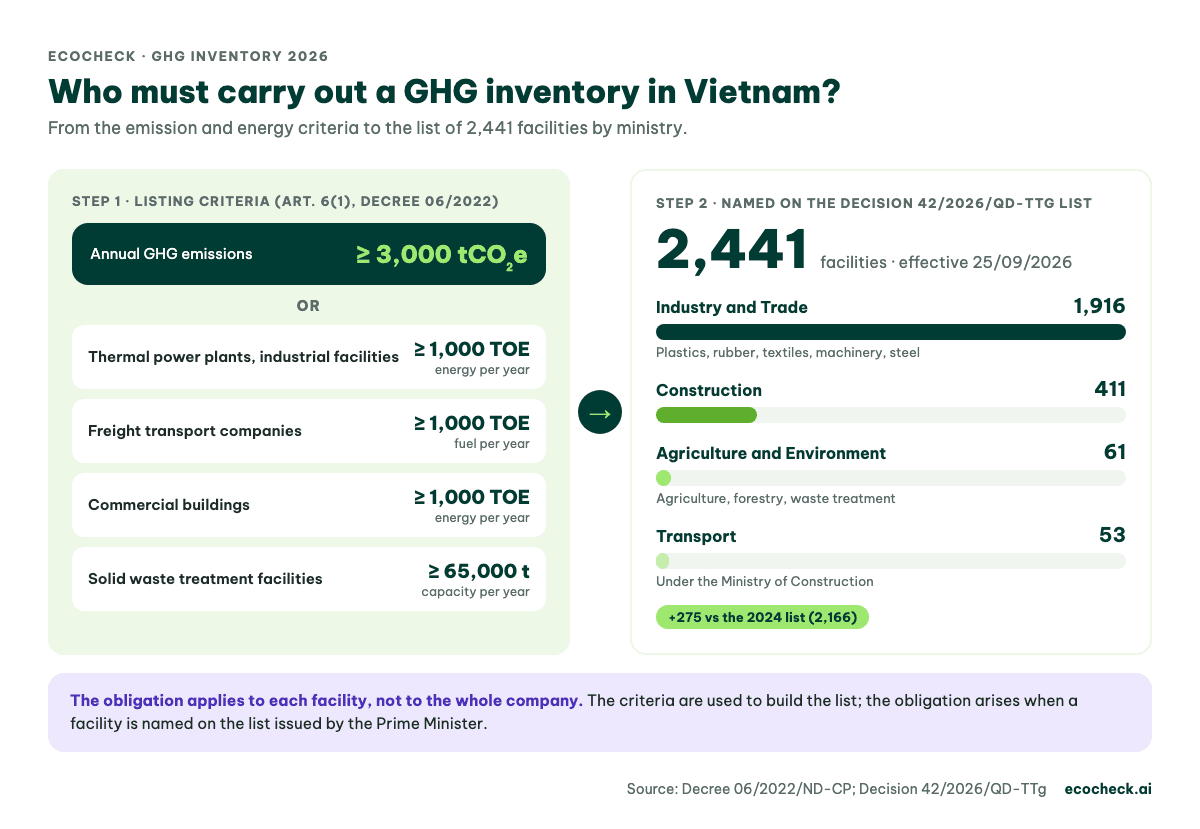
Figure 1: GHG inventory criteria (3,000 tCO₂e/year, 1,000 TOE or 65,000 t solid waste/year) and the 2,441 listed facilities by ministry
When is the GHG inventory report due?
| Deadline | What to do | Who | Legal basis |
|---|---|---|---|
| Before 31 March 2027 | Submit the facility-level GHG inventory report (2025 and 2026 data) using Form 06, Appendix II | Listed facilities, to the provincial People's Committee | Art. 11(4)(b) Decree 06/2022 (amended by Decree 119/2025) |
| Before 31 March 2027 | Submit the facility-level mitigation report for 2026 using Form 02, Appendix III | Listed facilities, to the provincial People's Committee | Art. 10(3) Decree 06/2022 (amended by Decree 119/2025) |
| Before 30 June 2027 | Compile inventory and mitigation results of facilities in the province | Provincial People's Committee, to the Ministry of Agriculture and Environment | Art. 11(6), Art. 10(3) |
| Before 1 December, from 2027 | Submit the verified inventory report | Quota facilities, to the Ministry of Agriculture and Environment | Art. 11(6a) |
| Before 31 March 2029 | Next inventory report (every two years) | Listed facilities | Two-year cycle under Art. 11(4)(b) |
Listed thermal power plants, steel mills and cement plants prepare a biennial inventory report from 2026 and do not follow the 31 March schedule to the province. Instead, their reports are verified by a designated verification body and sent to the Ministry of Agriculture and Environment before 1 December. A month-by-month schedule up to 31 March 2027 is in the GHG inventory process in Vietnam 2026.
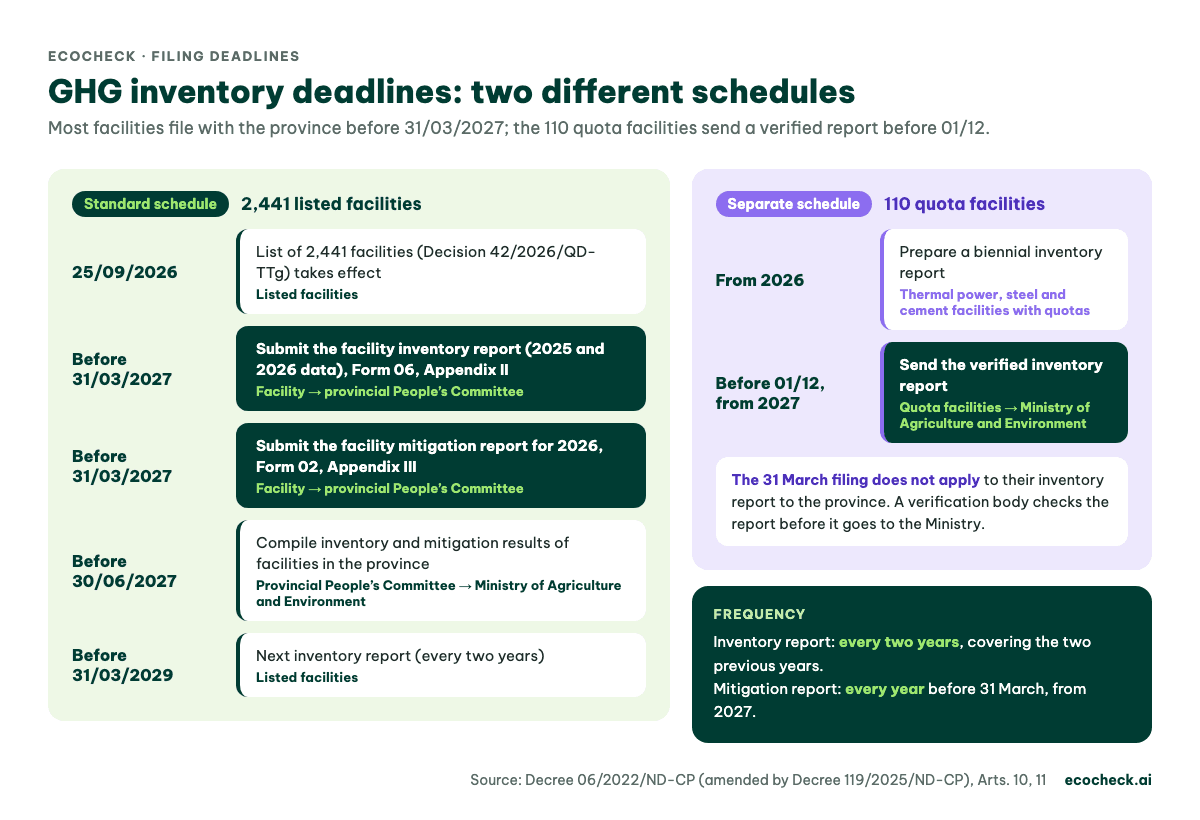
Figure 2: Two inventory filing schedules: listed facilities file with the province before 31/03/2027; the 110 quota facilities send a verified report to the Ministry before 01/12 from 2027
Which emission scopes does a GHG inventory cover?
Under the GHG Protocol and ISO 14064-1, emissions fall into three scopes:
| Scope | Emission sources | Examples in a factory | In the government report |
|---|---|---|---|
| Scope 1 (direct) | Sources the facility owns or controls | Boilers, diesel generators, forklifts, process emissions, refrigerant leaks | Yes |
| Scope 2 (energy indirect) | Purchased electricity, steam, heat | Grid electricity bought from EVN | Yes |
| Scope 3 (other indirect) | Value chain | Purchased materials, outsourced transport, business travel | Encouraged, not mandatory |
The specific sources a report must include are set by the technical circular of the managing ministry. According to a JICA expert quoted by the Agriculture and Environment newspaper, the online reporting system separates direct emissions (Scope 1) from indirect emissions from electricity (Scope 2), while Scope 3 is only encouraged. For quota facilities, the quota to be surrendered is based on emissions from direct sources. For a detailed comparison of the three scopes, see what are emissions: Scope 1, 2, 3 and Scope 1, 2, 3 under ISO 14064 and the GHG Protocol.
What are the steps of a GHG inventory?
The process has 8 steps: (1) check the list facility by facility; (2) define boundaries and emission sources; (3) collect 2025–2026 activity data with source documents; (4) choose methods and emission factors under the sector circular; (5) calculate and run quality control; (6) prepare the report using Form 06, Appendix II; (7) submit to the provincial People's Committee before 31 March 2027; (8) respond to verification, correct and archive the records.
Step-by-step guidance is in the GHG inventory process: 8 steps. The technical calculation is covered in 9 steps to conduct a GHG inventory, and the report structure in GHG inventory report templates.
How are emissions calculated?
The basic formula (IPCC Tier 1) is:
Emissions (tCO₂e) = Activity data × Emission factor × GWP
Scope 2 example: a factory uses 1,000 MWh of grid electricity in a year. Vietnam's 2023 grid emission factor, published by the Department of Climate Change in Official Letter 1726/BDKH-PTCBT (3 December 2024), is 0.6592 tCO₂/MWh. Emissions from electricity = 1,000 × 0.6592 = 659.2 tCO₂.
For fuels (Scope 1), litres of oil or kilograms of coal are converted using the net calorific value and then multiplied by the factor for each gas. See also GHG Protocol vs ISO 14064 and common GHG inventory methods.
What is the penalty for not submitting a GHG inventory report?
Article 45 of Decree 45/2022/ND-CP sets fines for individuals. Under Article 6(2) of the same decree, organisations are fined twice as much:
| Violation | Individual | Organisation |
|---|---|---|
| Not submitting the inventory report to the state authority | Warning | Warning |
| Providing incorrect or incomplete information in the inventory report | VND 5–10 million | VND 10–20 million |
| Not preparing the GHG inventory report as required | VND 30–50 million | VND 60–100 million |
On top of the fine, the facility must still prepare the reports for the late or missing years and bear any costs incurred. A draft decree amending Decree 45/2022 may change these amounts, so check the latest text before relying on them.
How does the GHG inventory relate to quotas, the carbon exchange and CBAM?
- Emission quotas: Decision 263/QD-TTg allocates a pilot 243.08 million tCO₂e for 2025 and 268.39 million tCO₂e for 2026 to 110 facilities. The verified inventory result determines how many allowances must be surrendered. See 2025–2026 emission quotas allocated.
- Carbon exchange: facilities with surplus or shortfall allowances trade on the exchange; see Vietnam's carbon exchange and what is a carbon credit.
- EU CBAM: exporters of steel, aluminium, cement and fertilisers need emissions per tonne of product. The facility inventory and CBAM data share the same activity data. See what is CBAM and CBAM 2027: what Vietnamese exporters need to do.
What problems did businesses face in the first reporting round?
At a workshop reported by Tuoi Tre on 25 June 2026, Mr Luong Quang Huy (Department of Climate Change, Ministry of Agriculture and Environment) said some businesses had submitted three times with three different datasets. The issues raised were:
- Inconsistent data caused by fragmented internal data management.
- Reliance on default factors instead of facility-measured data, which reduces accuracy.
- Staff shortages: few people understand both plant operations and inventory methods.
A full list of common verification errors is in challenges in GHG inventory activities.
How much does a GHG inventory cost, and should you do it in-house or outsource?
Market prices usually range from a few tens of millions to over one hundred million VND per facility per reporting round, depending on the number of emission sources, production lines and how complete the data are. Sector pricing is in GHG inventory cost 2026.
- In-house suits facilities with few sources, complete data and staff who understand the method.
- Outsourcing suits a first reporting round, process emissions, multiple facilities, the need to reconstruct 2025 data, or the need to reuse data for CBAM.
A detailed comparison is in in-house inventory or outsourced service. Selection criteria are in 7 criteria for choosing a GHG inventory consultant. For facilities with fuel and electricity data ready, EcoCheck can complete the report in 5 days.
Further reading by topic
| You need to | Detailed guide |
|---|---|
| Check whether your facility is listed | Decision 42/2026: 2,441 facilities |
| Follow the steps to 31 March 2027 | 8-step inventory process |
| See the long-term legal roadmap | GHG inventory roadmap |
| Use the report template | Inventory report templates |
| Estimate the cost | GHG inventory cost 2026 |
| Read sector guidance | Industry, transport and construction, iron and steel |
| Apply international standards | Inventory under ISO 14064-1 |
| Find answers to other questions | GHG inventory FAQ |
Next step: check each plant's obligation with the free lookup tool, then talk to EcoCheck about our GHG inventory service to meet the 31 March 2027 deadline. If you export to the EU, see our CBAM reporting service to use one dataset for both.
Frequently asked questions
What is a GHG inventory?
It is the collection of data on emission sources and the calculation of greenhouse gas emissions and removals within a defined boundary and year, using methods issued by the competent authority. Results are expressed in tonnes of CO₂ equivalent.
Which businesses must carry out a GHG inventory in Vietnam?
The 2,441 facilities named in Decision 42/2026/QD-TTg (effective 25 September 2026). The list is built on criteria of emissions of 3,000 tCO₂e/year or more, energy use of 1,000 TOE/year or more, or solid waste treatment of 65,000 tonnes/year or more.
When is the 2027 GHG inventory report due?
Before 31 March 2027, to the provincial People's Committee, covering 2025 and 2026 data. Thermal power, steel and cement facilities with quotas send a verified report to the Ministry of Agriculture and Environment before 1 December, from 2027.
How often must a GHG inventory be done?
The facility-level inventory report is prepared every two years and includes results for the two preceding years. The facility-level mitigation report is submitted every year before 31 March, starting in 2027.
Is Scope 3 mandatory in Vietnam's GHG inventory?
No. The government report focuses on direct emissions and indirect emissions from electricity; Scope 3 is encouraged. International customers may still ask for Scope 3 under the GHG Protocol.
What is the penalty for not submitting a GHG inventory report?
Under Article 45 of Decree 45/2022/ND-CP, not submitting the report draws a warning; not preparing the report draws a fine of VND 30–50 million for individuals and VND 60–100 million for organisations, plus an order to prepare the missing reports.
Is your business required to report GHG emissions?
EcoCheck automatically calculates Scope 1/2/3 and exports NĐ06/TT38-compliant reports in one click — saving 90% of the time vs. Excel.
Latest posts

![Vietnam Carbon Price: VN2025 Allowances on HNX [Oct 2026]](https://cms.ecocheck.ai/uploads/ecocheck_vietnam_carbon_price_vn2025_allowances_hnx_8e7c642d53.jpg)