What is Vietnam's grid emission factor for each year?
Has an official grid emission factor been published for 2024 or 2025?
Which factor should the inventory report due 31 March 2027 use?
How do you calculate emissions from electricity (Scope 2)?
How is the grid factor calculated, and what are OM, BM and CM?
What is the difference between location-based and market-based Scope 2?
Why does the grid factor change from year to year?
What mistakes do companies make with the grid factor?
How can you calculate quickly and correctly for the 2027 cycle?
Frequently asked questions
What is Vietnam's grid emission factor for 2024?
Which document published the 2023 grid emission factor?
How many kg of CO₂ does 1 kWh of electricity emit in Vietnam?
Can I use the 2025 estimate in my inventory report?
Does self-consumed rooftop solar count toward Scope 2?
Vietnam Grid Emission Factor 2024: Official 0.6187 tCO₂/MWh
Vietnam's latest official grid emission factor is 0.6187 tCO₂/MWh, for data year 2024. The Ministry of Agriculture and Environment announced it in Official Letter 1232/BNNMT-BĐKH dated 30 September 2026. For the first time, the Ministry of Industry and Trade led the calculation. The value is 6.1% lower than the 2023 factor of 0.6592. There is no official value for 2025 yet; the 0.6235 tCO₂/MWh figure in circulation is a researchers' estimate. This page gives the year-by-year lookup table, marks which values are official and which are estimates, and shows how to use the factor for Scope 2 in the inventory report due by 31 March 2027.
Last updated: 19 October 2026, adding the official 2024 factor from Official Letter 1232/BNNMT-BĐKH. We will update this table when an official 2025 value is published.
What is Vietnam's grid emission factor for each year?
The table below lists the national grid emission factor (EF) by data year. The unit is tonnes of CO₂ per MWh, which is the same as kg CO₂ per kWh.
| Data year | Factor (tCO₂/MWh) | Change vs previous year | Status | Document / source |
|---|---|---|---|---|
| 2019 | 0.8458 | — | Official | Announced by the Department of Climate Change in 2020 (letter number not verified) |
| 2020 | 0.8041 | −4.9% | Official | Official Letter 1316/BĐKH-TTBVTOD, 31 December 2021 |
| 2021 | 0.7221 | −10.2% | Official | Official Letter 1278/BĐKH-TTBVTOD, 31 December 2022 |
| 2022 | 0.6766 | −6.3% | Official | Official Letter 327/BĐKH-PTCBT, 19 March 2024 |
| 2023 | 0.6592 | −2.6% | Official | Official Letter 1726/BĐKH-PTCBT, 3 December 2024 |
| 2024 | 0.6187 | −6.1% | Official, latest | Official Letter 1232/BNNMT-BĐKH, 30 September 2026 (calculated under the lead of the Ministry of Industry and Trade) |
| 2025 | 0.6235 | +0.8% | Estimate (range 0.3757–0.7863) | Same author group, published in Doanh nghiệp & Kinh tế xanh on 22 January 2026 |
Every official letter was signed by the Department of Climate Change; Letter 1232 was signed by the Director General of the Department on behalf of the Minister. The Department used to sit under the former Ministry of Natural Resources and Environment and now sits under the Ministry of Agriculture and Environment. Unlike earlier years, the 2024 factor was researched and built in 2025 by the Ministry of Industry and Trade, working with the relevant agencies, and it was announced under Article 11 of Decree 06/2022/ND-CP. Letter 1232 states its purpose: to be referred to and applied consistently in GHG mitigation activities; carbon-credit exchange and offset programmes and projects; business-as-usual emission scenarios for updating the NDC; and sector and provincial emission reduction plans. Each letter gives a single value for the whole grid. There is no split by region or by hour.
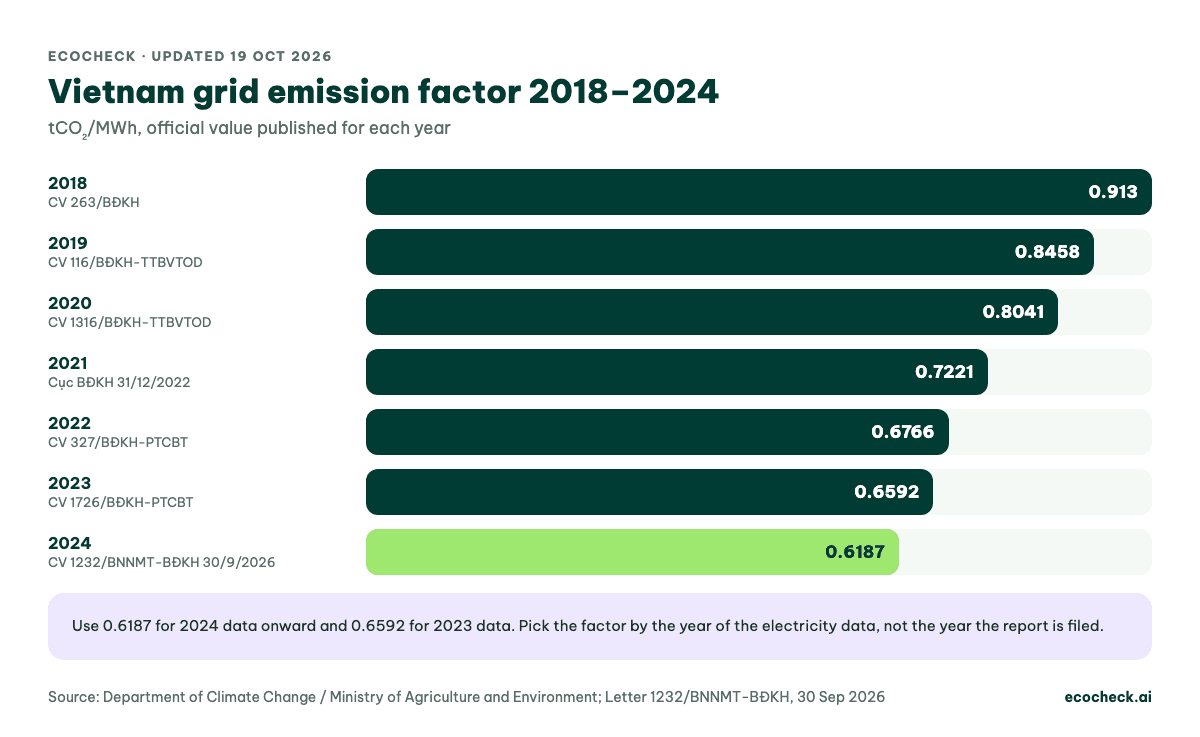
Vietnam's official grid emission factor, 2018–2024
Has an official grid emission factor been published for 2024 or 2025?
2024 has one now: 0.6187 tCO₂/MWh under Official Letter 1232/BNNMT-BĐKH dated 30 September 2026. 2025 does not yet have an official value. The article of 22 January 2026 in which the authors estimate the 2025 factor says that, as of January 2026, the competent authority had not announced factors for 2024 or 2025; the 2024 gap has now been filled.
Before Letter 1232, two estimates were widely quoted:
- 2024: 0.6811 tCO₂/MWh (estimate, now superseded). The authors estimated it at about 3.3% higher than 2023, because coal-fired output rose 17.7% and made up about 49.5% of total generation. The official value is now 0.6187, which is 0.0624 tCO₂/MWh below the estimate.
- 2025: 0.6235 tCO₂/MWh. This is the average of the medium scenario (0.4607) and the high scenario (0.7863). The low scenario is 0.3757. The authors attribute the fall mainly to less coal power and more hydropower. The scenarios are far apart, so treat this number as an indication of the trend only.
On the government side, the Institute of Energy (Ministry of Industry and Trade) held a technical workshop on building the 2024 grid emission factor and the coal-power factor for 2020–2024 using TOOL07. According to Letter 1232, in 2025 the Ministry of Industry and Trade led the research and construction of the 2024 factor with the relevant agencies, and the result, 0.6187 tCO₂/MWh, was announced on 30 September 2026.

Power transmission lines next to an industrial plant
Which factor should the inventory report due 31 March 2027 use?
The 2027 facility-level inventory report covers data years 2025 and 2026. It applies to the 2,441 facilities listed in Decision 42/2026/QD-TTg. We have found no document that says which year's factor must be used for this cycle. Circular 38/2023/TT-BCT (industry and trade sector) requires factors published by the competent authority, and allows IPCC guidance only when no published factor exists. On that basis, a reasonable approach is:
- Use the factor for the same data year; if that year has no factor yet, use the most recently published one. For 2025 and 2026 data, that is currently 0.6187 tCO₂/MWh (data year 2024). State the letter number (1232/BNNMT-BĐKH, 30 September 2026) and the factor's data year in the report. 2023 data still uses 0.6592 from Letter 1726.
- Do not put estimates (0.6235 for 2025, or the 0.6811 once quoted for 2024) in a report filed with the authorities. Use them only for internal analysis, for example to see how much your result would change if the factor rose.
- Check for new announcements before you file. If the 2025 factor is published before 31 March 2027, ask the provincial department which value to apply, and keep the method consistent across both data years.
- Do not use outdated values. Some documents still use 0.7221 (2021) or 0.8041 (2020). These make Scope 2 emissions about 17–30% higher than 0.6187 does. Even 0.6592 (2023) gives a result about 6.5% higher if applied to data from 2024 onward.
This is our reading of the documents available today, not official guidance. The reviewing authority may have its own requirements, so confirm with the provincial department before you finalise your data.
How do you calculate emissions from electricity (Scope 2)?
Formula:
Scope 2 emissions (tCO₂) = Grid electricity purchased (MWh) × Grid emission factor (tCO₂/MWh)
Circular 38/2023/TT-BCT uses the same structure for indirect emissions from electricity use: activity data multiplied by the emission factor. Take the kWh for each meter from the electricity bills, add up all 12 months, and divide by 1,000 to convert to MWh.
Example: a factory used 2,400,000 kWh of grid electricity in 2025, which is 2,400 MWh.
| Factor applied | Calculation | Scope 2 emissions | Note |
|---|---|---|---|
| 0.6187 (2024, official, Letter 1232) | 2,400 × 0.6187 | 1,484.88 tCO₂ | Use for the report |
| 0.6592 (2023, official) | 2,400 × 0.6592 | 1,582.08 tCO₂ | 2023 factor, not for 2025 data; 97.20 t higher |
| 0.6235 (2025, estimate) | 2,400 × 0.6235 | 1,496.40 tCO₂ | Reference only |
| 0.7221 (2021, outdated) | 2,400 × 0.7221 | 1,733.04 tCO₂ | Do not use |
Suppose the factory installs rooftop solar for its own use and cuts grid purchases by 300 MWh, to 2,100 MWh. Scope 2 is then 2,100 × 0.6187 = 1,299.27 tCO₂, a reduction of 185.61 tCO₂. Solar power generated and used inside the facility boundary has no Scope 2 emissions, but keep the generation records so you can explain the numbers. To add fuel combustion (Scope 1), see what emissions are and how to calculate Scope 1, 2 and 3.
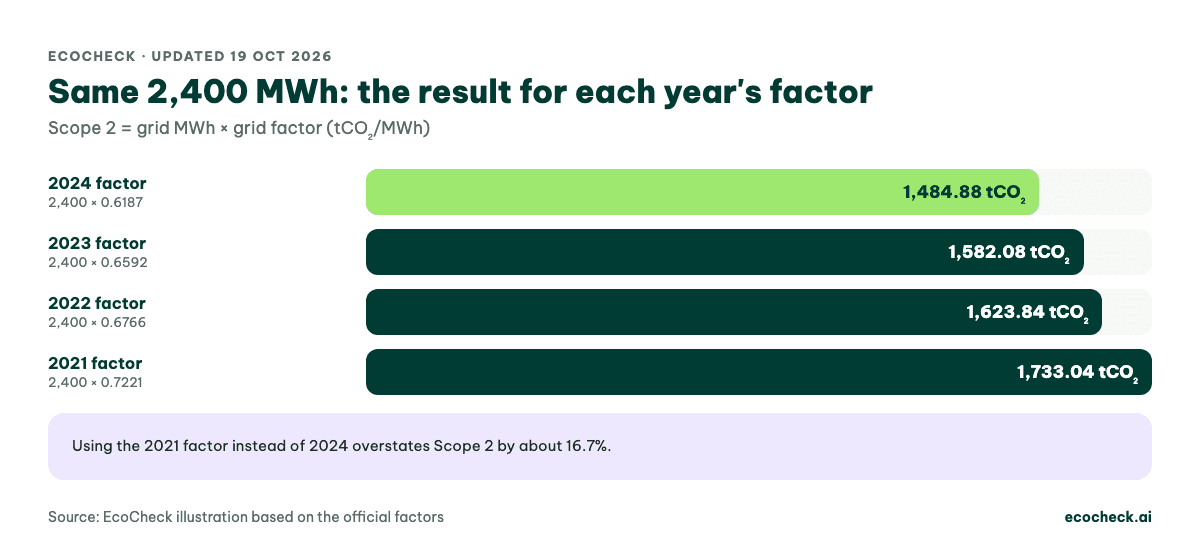
Same electricity, Scope 2 result by each year's factor
How is the grid factor calculated, and what are OM, BM and CM?
You will see these three terms in carbon-credit documents. They come from the UNFCCC tool TOOL07, originally used for the CDM:
| Symbol | Name | Meaning | When it is used |
|---|---|---|---|
| OM | Operating Margin | Emissions of existing plants that would be displaced | Emission-reduction projects, carbon credits |
| BM | Build Margin | Emissions of recently built plants | Emission-reduction projects, carbon credits |
| CM | Combined Margin | Weighted average of OM and BM | Calculating reductions from renewable-energy projects |
When you inventory emissions from consuming electricity, use the single value published by the Department of Climate Change. You do not choose between OM, BM and CM. Letter 327 (data year 2022), Letter 1726 (data year 2023) and Letter 1232 (data year 2024) each state one value for the whole grid. Companies do not recalculate the grid factor themselves; they use the published value.
What is the difference between location-based and market-based Scope 2?
The GHG Protocol Scope 2 Guidance asks for two figures:
- Location-based: uses the average factor of the grid where the power is consumed. In Vietnam, that is the factor published by the Department of Climate Change.
- Market-based: uses a factor tied to your power contracts, such as a direct power purchase agreement (DPPA) or renewable energy certificates (I-RECs).
We have not found any official guidance that allows the market-based method in inventory reports under Decree 06/2022/ND-CP. Reports filed with the authorities should therefore use location-based. Market-based is better suited to voluntary reporting for international customers, CDP or SBTi. For a comparison of the two standards, see Scope 1, 2 and 3 under ISO 14064 and the GHG Protocol.
Why does the grid factor change from year to year?
The factor depends on the share of each power source in that year. From 2019 to 2023 it fell from 0.8458 to 0.6592, a drop of about 22%, mainly because solar and wind grew fast. In 2024 the official factor kept falling, to 0.6187, although researchers had earlier estimated a rise because more coal power was needed to meet demand. Rainfall matters too: in wet years hydropower runs more and the factor falls; in dry years thermal plants fill the gap and the factor rises.
Companies cannot control the grid factor. When you compare Scope 2 across years, compare the MWh consumed as well as the tonnes of CO₂. Otherwise, swings in the factor can hide the savings you made by using less electricity. Ways to cut electricity use are covered in GHG emission reduction solutions for businesses in 2026.
What mistakes do companies make with the grid factor?
- Using an old factor (0.7221 or 0.8041) copied from earlier reports, or keeping 0.6592 (2023) for data from 2024 onward.
- Putting an estimate in the official report without labelling it as an estimate.
- Mixing up units: multiplying kWh by 0.6187 and recording the result as tonnes, when the correct result is in kg (or kWh must first be converted to MWh).
- Missing meters: leaving out the office, warehouse or wastewater plant inside the facility boundary.
- Subtracting solar twice: self-consumed solar is already absent from the purchased-power bill, so do not deduct it again.
- Not citing the factor's source: reviewers will ask for the letter number and the factor's data year.
How can you calculate quickly and correctly for the 2027 cycle?
First, check whether your facility is on the list that must conduct an inventory, using the free GHG inventory obligation checker. Then follow the 8-step sequence in the GHG inventory process for 2026. The EcoCheck platform applies the latest official grid factor automatically and records the source of every factor. When a new value is published, you update it once instead of editing spreadsheets by hand. If you want specialists to handle the whole job, see the EcoCheck GHG inventory service.
Frequently asked questions
What is Vietnam's grid emission factor for 2024?
0.6187 tCO₂/MWh, under Official Letter 1232/BNNMT-BĐKH dated 30 September 2026 from the Ministry of Agriculture and Environment. The Ministry of Industry and Trade led its calculation in 2025. The 0.6811 tCO₂/MWh figure quoted earlier was only an estimate by a research team from Hanoi University of Science and Technology with the Ministry of Agriculture and Environment, not an official value.
Which document published the 2023 grid emission factor?
Official Letter 1726/BĐKH-PTCBT dated 3 December 2024 from the Department of Climate Change, which gives 0.6592 tCO₂/MWh. That value applies to 2023 data.
How many kg of CO₂ does 1 kWh of electricity emit in Vietnam?
Using the official 2024 factor, 1 kWh of grid electricity corresponds to 0.6187 kg CO₂. 1,000 kWh (1 MWh) corresponds to 0.6187 tonnes of CO₂.
Can I use the 2025 estimate in my inventory report?
You should not. Reports filed with the provincial People's Committee should use factors published by the competent authority and cite the source. Until a 2025 factor is published, use the most recent one, 0.6187 (2024). Estimates are for internal analysis only.
Does self-consumed rooftop solar count toward Scope 2?
No. Power generated and used inside the facility boundary is not purchased from the grid, so it is not multiplied by the grid factor. Only grid purchases count toward Scope 2.
Is your business required to report GHG emissions?
EcoCheck automatically calculates Scope 1/2/3 and exports NĐ06/TT38-compliant reports in one click — saving 90% of the time vs. Excel.
Latest posts