Is the GHG inventory annual or every two years?
What does the 2026 amended Law on Environmental Protection propose?
What has changed and what has not?
Why did the Government keep the two-year frequency?
National Assembly timeline: when will we know?
If the inventory becomes annual later, how will businesses be affected?
What should businesses do now?
Frequently asked questions
How often must a GHG inventory be done in Vietnam?
Has the amended Law on Environmental Protection been passed?
Will the inventory become annual from 2027?
Will the 31/03/2027 deadline move?
Which report is already annual?
What is the penalty for not submitting a GHG inventory report?
Vietnam's Amended Environmental Protection Law 2026: Annual GHG Inventory?
As of 07/10/2026, Vietnam's GHG inventory is still required every two years. The amended Law on Environmental Protection is still a draft and has not been passed by the National Assembly. The draft prepared by the Ministry of Agriculture and Environment (MAE) proposed moving to an annual inventory. At a meeting on 30/09/2026, however, Deputy Prime Minister Hồ Quốc Dũng asked to "keep the current rule of two years". He said the frequency would be reconsidered only if international requirements change. Facilities should therefore work to the current deadline: file the inventory report covering 2025–2026 with the provincial People's Committee before 31/03/2027. This article covers what has changed and what has not, the National Assembly timeline, and what to do now.
Legal status checked on 07/10/2026. We will update this article after the National Assembly debates or passes the law.
Is the GHG inventory annual or every two years?
It is currently every two years. This rule is in force and does not depend on the outcome of the 2026 law amendment. The legal basis is Article 11(4)(b) of Decree 06/2022/ND-CP, as amended by Decree 119/2025/ND-CP (in force since 01/08/2025):
- Facilities on the mandatory list prepare a facility-level inventory report every two years and submit it to the provincial People's Committee before 31 March. The next filing is due before 31/03/2027 and covers 2025 and 2026.
- Thermal power, steel and cement facilities that receive allowances (110 facilities for 2025–2026) follow separate rules under Article 11(4)(c) and 11(6a). They still run an inventory every two years from 2026. However, they do not file with the province by 31 March. Instead they send a verified report to MAE before 1 December, starting in 2027.
- The facility-level emission reduction report is already annual: due before 31 March each year, starting in 2027 (Article 10(3)(a)).
So the "annual or every two years" question concerns only the inventory report. The list of covered facilities is in Decision 42/2026/QD-TTg (2,441 facilities). Every deadline to 2030 is in the GHG, CBAM and carbon market compliance calendar 2026–2030.
What does the 2026 amended Law on Environmental Protection propose?
According to Báo Xây dựng (18/09/2026), the draft amends 78 of the 171 articles of the 2020 Law on Environmental Protection and adds two new articles (72a and 139a). The changes fall into five groups:
- Administrative reform: fewer projects needing an environmental impact assessment or environmental permit, and simpler dossiers.
- Risk-based management built on data and monitoring technology.
- Circular economy, recycling and extended producer responsibility (EPR).
- Air and water quality management, low-emission zones and emissions inventories.
- Climate change response.
In the climate group, the draft shifts the approach from "mitigation" to "greenhouse gas emissions management" and proposes an annual inventory. Báo Chính phủ (22/09/2026) reported the same when the National Assembly Standing Committee reviewed the bill. The Standing Committee also asked the drafters to study a minimum share of emission reduction results and carbon credits that must be retained when credits are transferred abroad.
Earlier, VnExpress (05/06/2026) quoted the Department of Climate Change on an early version of the draft. It contained three proposals that matter to businesses:
- Provincial People's Committees would run local GHG inventories and build the facility lists.
- Allowance allocation would move from MAE to the line ministries, which would also set emission norms per unit of product.
- GHG reporting and verification would be fully digitised.
We could not confirm whether these three proposals are still in the bill going to the National Assembly. Treat them as a direction of travel, not as rules.
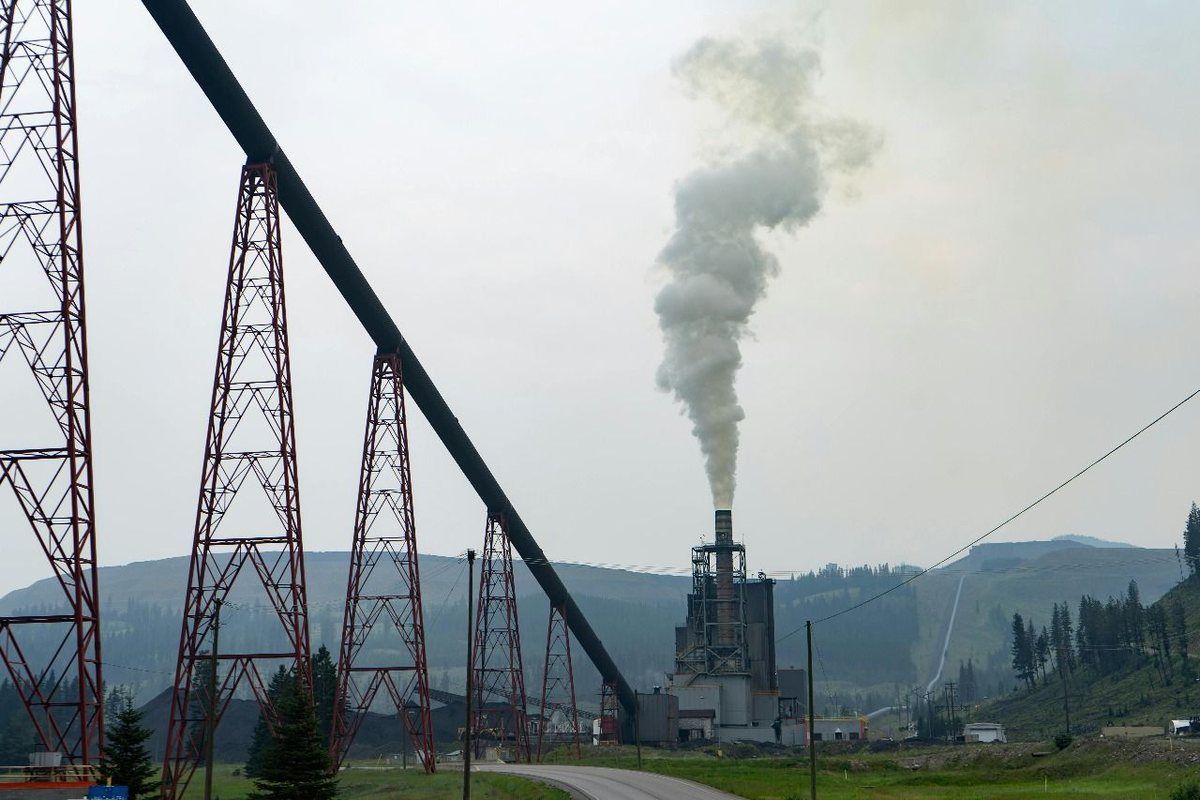
Power lines next to an industrial plant
What has changed and what has not?
| Item | Current rule (in force) | Draft amended law | Status on 07/10/2026 |
|---|---|---|---|
| Facility inventory frequency | Every 2 years, filed before 31/03 (amended Decree 06/2022) | Draft proposed annual | Government asked to keep 2 years (30/09). Not passed |
| Facility emission reduction report | Annual, before 31/03, from 2027 | No reported change | In force |
| 110 facilities with allowances | Verified report to MAE before 01/12, from 2027 | No reported change | In force |
| Approach | "GHG emission mitigation" | "GHG emissions management" | Draft |
| Provincial People's Committee role | Receives and reviews facility reports; aggregates to MAE before 30/06 | June 2026 version: also runs local inventories and builds lists | Draft, not confirmed in the bill |
| Allowance allocation | MAE allocates | June 2026 version: line ministries allocate | Draft, not confirmed in the bill |
| Transfer of credits abroad | Under the carbon market decrees | Standing Committee asked for a minimum retained share | Under study |
| Inventory penalties | Decree 45/2022: warning for not submitting; VND 60–100 million for an organisation that does not prepare the report | Outside the law; a new penalty decree is being drafted | Decree 45/2022 still in force |
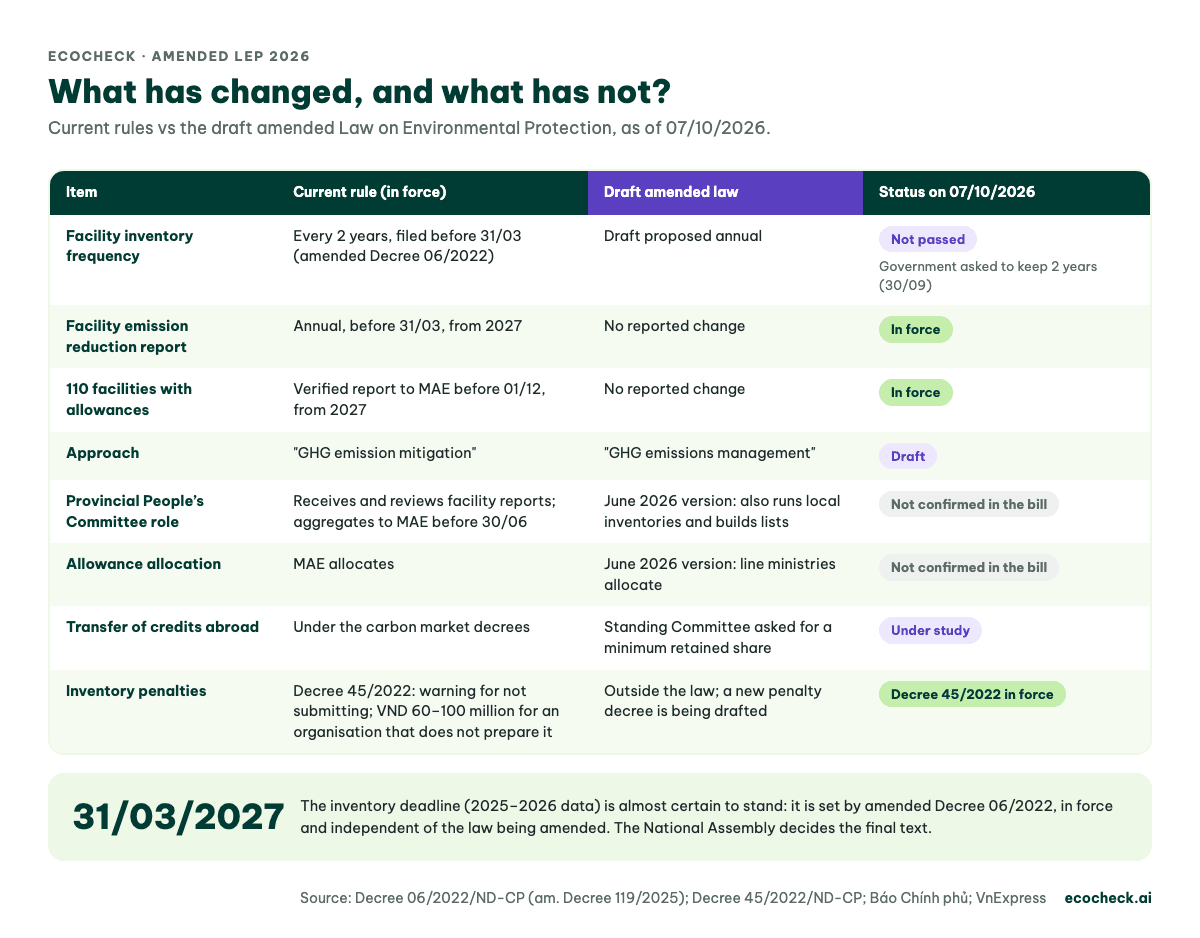
Figure 2: Comparison of current rules and the draft amended Law on Environmental Protection: inventory frequency, reduction report, 110 facilities with allowances, allowance allocation, penalties, status on 07/10/2026
Why did the Government keep the two-year frequency?
At the 30/09/2026 meeting, Deputy Prime Minister Hồ Quốc Dũng gave three reasons:
- Compliance cost: an annual inventory would add cost and difficulty for businesses when it is not yet necessary.
- Policy context: the Government is refining policy to make things easier for businesses and to support its high-growth targets.
- Open condition: if international requirements change, the frequency will be studied and adjusted.
MAE had proposed an annual inventory so that data would be timely for the domestic carbon market and for international commitments. According to VnEconomy (01/10/2026), the drafting agency also noted the need to weigh each sector's technology, compliance costs and the capacity of verification bodies.
Note: the Government's position shapes the bill it submits. The National Assembly decides the final text of the law.
National Assembly timeline: when will we know?
| Date | Event | Source |
|---|---|---|
| 05/06/2026 | MAE outlines the draft: annual inventory, provincial inventories, allocation by line ministries | VnExpress |
| 18/09/2026 | Preliminary review by the National Assembly Committee on Science, Technology and Environment | Báo Xây dựng, VnEconomy |
| 22/09/2026 | National Assembly Standing Committee comments at its 6th session | Báo Chính phủ |
| 30/09/2026 | Deputy PM Hồ Quốc Dũng chairs a meeting and keeps the two-year frequency | Báo Chính phủ, Nhân Dân, VOV |
| 17/10–20/11/2026 | 2nd session of the 16th National Assembly (phase 1: 17/10–13/11; phase 2: 19–20/11), with 43 laws and resolutions planned. According to Báo Chính phủ, the amended law is due to be submitted to this session | Tuổi Trẻ, HTV, Báo Chính phủ |
| Not announced | Date of passage and effective date | – |
| Before 31/03/2027 | Current inventory filing deadline (2025–2026 data) | Amended Decree 06/2022 |
| Before 01/12/2027 | 110 facilities with allowances send their verified inventory | Amended Decree 06/2022 |
We could not confirm whether the National Assembly will pass the law at this session or only hold a first debate. Even if it passes in November 2026, a law usually takes effect several months later, and implementing decrees must follow. The 31/03/2027 deadline is therefore almost certain to stand.
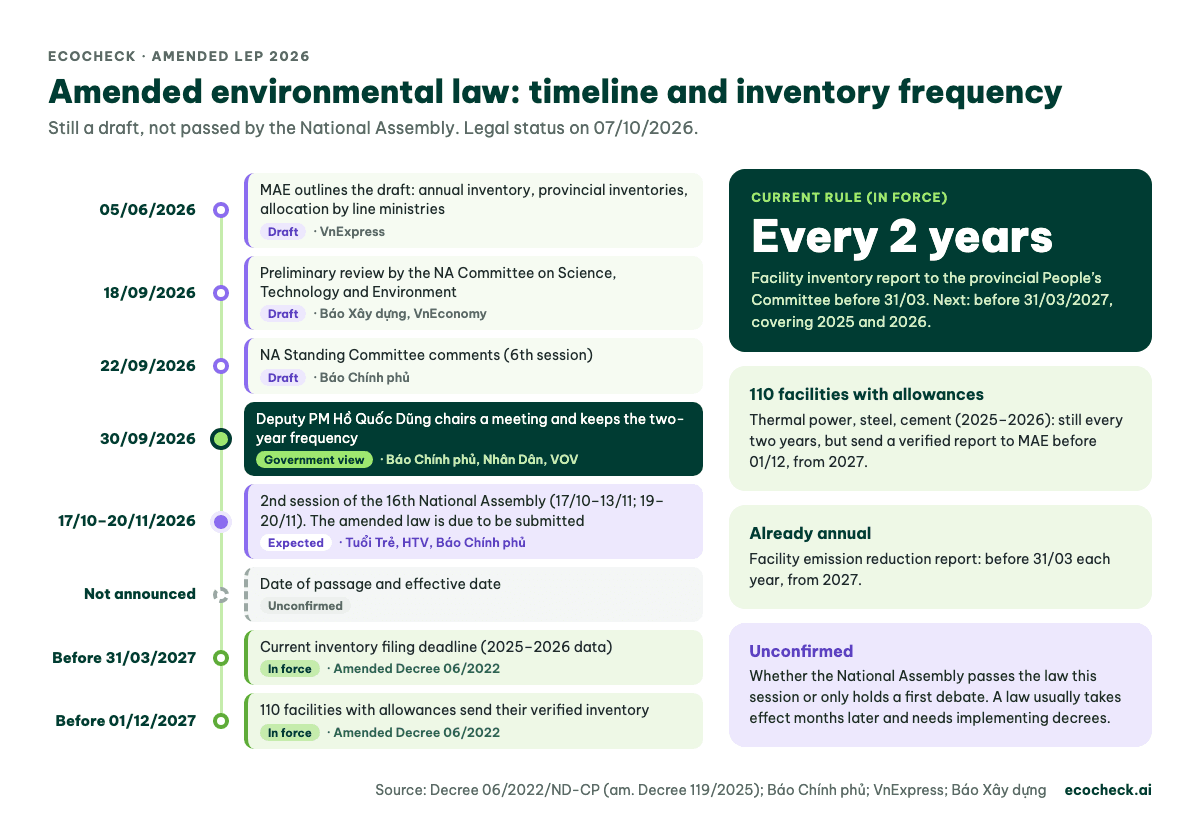
Figure 1: Timeline of the amended Law on Environmental Protection from 05/06/2026 to the National Assembly session of 17/10–20/11/2026, the Government keeping the two-year inventory, and current deadlines of 31/03/2027 and 01/12/2027 for 110 facilities with allowances
If the inventory becomes annual later, how will businesses be affected?
The two-year frequency stays for now, but the Government has left the door open to change if international requirements shift, and the lead ministry has already proposed annual reporting. It is worth preparing for both scenarios:
| Item | Every two years (current) | If it becomes annual |
|---|---|---|
| Inventory reports to 2030 | 2027 and 2029 cycles (2029 inferred) | One every year |
| Data collection | Gathered every two years; first-year records often go missing | Data must be closed out every year |
| Project-based consulting cost | One project every two years | Could roughly double if still bought project by project |
| How to save | Track energy and fuel data monthly | Digitise and use software so data is reused |
Cost ranges by industry are in GHG inventory cost 2026. A business working by hand in spreadsheets would feel an annual cycle most. One that already enters monthly data into software would see little change.
What should businesses do now?
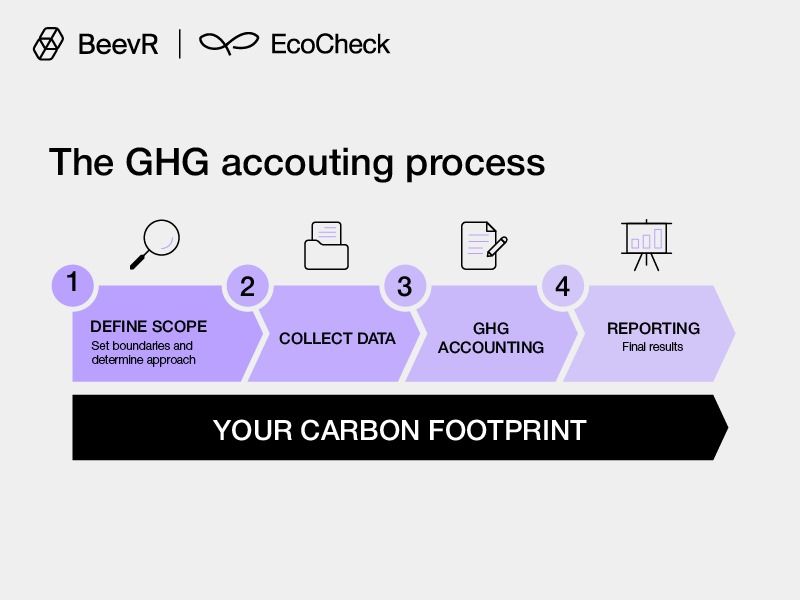
- Do not wait for the new law. Plan to file before 31/03/2027 under the current process. The steps are in GHG inventory process in Vietnam 2026.
- Check whether you are on the list. Use the free lookup tool. If you are a thermal power, steel or cement facility with allowances, your deadline is 01/12/2027 for a verified report.
- Collect 2025 records in Q4 2026. Electricity bills, fuel records and 2025 production data are usually the hardest to find when the deadline arrives.
- Track data every year even if the law does not require it. The emission reduction report is already annual. EU buyers, CBAM and green-loan lenders also ask for yearly data. Run a baseline with the free Scope 1 and 2 calculator.
- Follow the 17/10–20/11/2026 session. Two things to watch: the inventory frequency in the final text, and who allocates allowances.
If you want one provider to handle the 2027 filing and set up your data for an annual scenario, see the EcoCheck GHG inventory service. For an overview of inventory, roadmap and cost, read EcoCheck Greenhouse Gas Inventory Service. For earlier legal background, see Law on Environmental Protection and Effective Emission Management.
Frequently asked questions
How often must a GHG inventory be done in Vietnam?
Every two years, under Decree 06/2022/ND-CP as amended by Decree 119/2025/ND-CP. The next report goes to the provincial People's Committee before 31/03/2027 and covers 2025 and 2026. As of 07/10/2026, no legal text has made it annual.
Has the amended Law on Environmental Protection been passed?
No. As of 07/10/2026 it is still a draft, due to be submitted to the 2nd session of the 16th National Assembly (17/10–20/11/2026). The dates of passage and entry into force have not been announced.
Will the inventory become annual from 2027?
There is no basis for that. The annual proposal is in the draft law, but on 30/09/2026 the Deputy Prime Minister asked to keep two years. Even if the National Assembly decides otherwise, a new law needs time to take effect and implementing decrees.
Will the 31/03/2027 deadline move?
No. It is set by amended Decree 06/2022, which is in force and does not depend on the law now being amended. The 110 facilities with allowances send a verified report to MAE before 01/12/2027.
Which report is already annual?
The facility-level GHG emission reduction report, filed with the provincial People's Committee before 31 March each year from 2027.
What is the penalty for not submitting a GHG inventory report?
Under Decree 45/2022/ND-CP (still in force on 07/10/2026): not submitting draws a warning. An organisation that does not prepare the report is fined VND 60–100 million and must still prepare it. Inaccurate or incomplete data costs VND 10–20 million.





![Top 5 Công Cụ Tính Toán Phát Thải Khí Nhà Kính [Cập Nhật 2026]](https://cms.ecocheck.ai/uploads/Eco_Check_Top_5_cong_cu_va_phan_mem_ho_tro_kiem_ke_khi_nha_kinh_d9d03bf693.png)
![Phương pháp Kiểm kê Khí nhà kính: GHG Protocol & ISO 14064 [2026]](https://cms.ecocheck.ai/uploads/Cac_phuong_phap_va_tieu_chuan_kiem_ke_khi_nha_kinh_pho_bien_e645f7df80.png)