What are greenhouse gas emissions?
What are Scope 1, 2 and 3? A quick comparison
How to calculate emissions: formula and worked examples
What is the difference between direct and indirect emissions?
Does your business have to report its emissions?
What Are Emissions? Scope 1, 2, 3 Explained & How to Calculate [With Examples]
Emissions are the release of substances — most commonly greenhouse gases such as CO₂, CH₄ and N₂O — from human activities into the atmosphere. In business management, "emissions" usually means greenhouse gas (GHG) emissions, measured in tonnes of CO₂ equivalent (CO₂e) and classified into 3 scopes: Scope 1 (direct), Scope 2 (from purchased energy) and Scope 3 (value chain). This article explains each type with examples and how to calculate them.
Is your business required to conduct a greenhouse gas inventory?
Check for free in about 20 seconds based on your industry and energy consumption — no sign-up required.
Check now →What are greenhouse gas emissions?
Greenhouse gas emissions are the quantity of heat-trapping gases released into the atmosphere by an activity, a facility or an organization over a given period. Under the Law on Environmental Protection 2020, the main greenhouse gases are CO₂, CH₄ and N₂O; there are also industrial gases with high warming potential such as HFCs, PFCs, SF6 and NF3 — see details in our article greenhouse gases that cause the greenhouse effect. Because each gas traps heat differently, all measurements are converted into a common unit: tonnes of CO₂ equivalent, based on GWP (global warming potential) values.
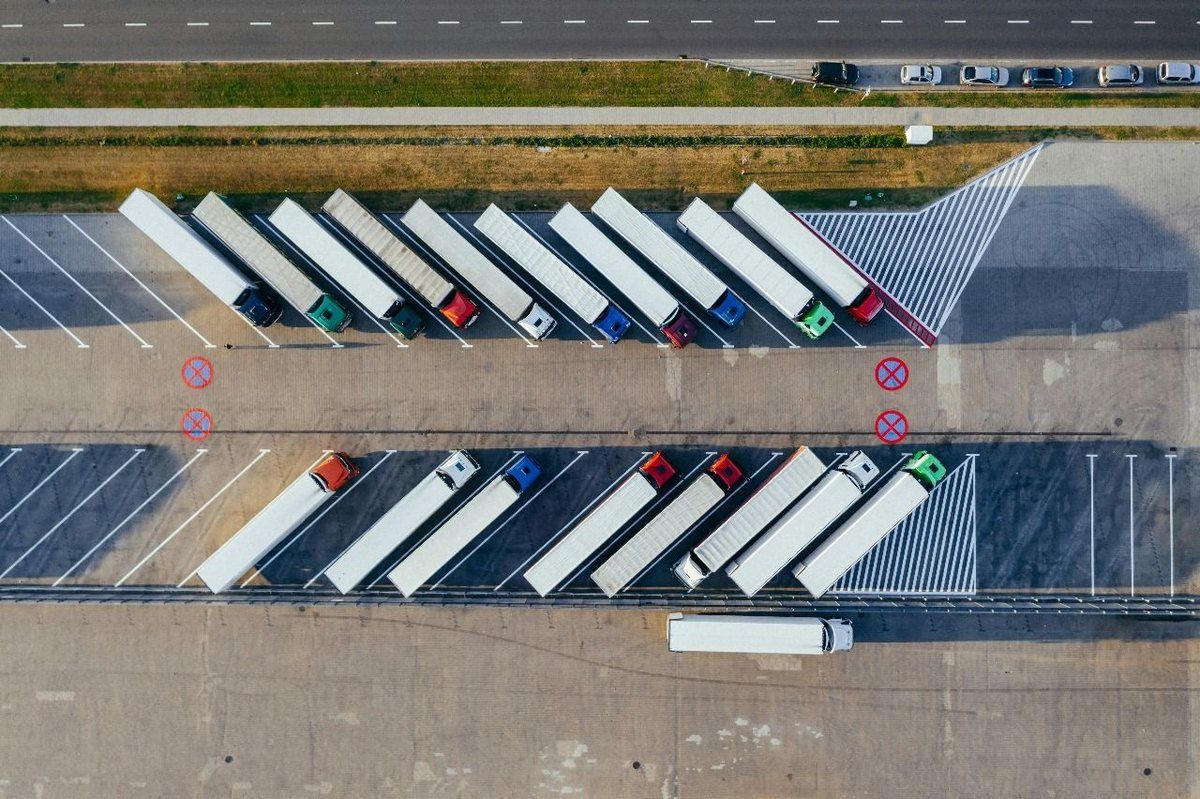
Aerial view of a truck fleet yard, a Scope 1 fuel emission source
What are Scope 1, 2 and 3? A quick comparison
| Scope | Definition | Example at a factory |
|---|---|---|
| Scope 1 — direct | Emissions from sources owned or controlled by the business | Burning coal/oil in boilers, company trucks, refrigerant leaks |
| Scope 2 — indirect from energy | Emissions generated elsewhere to produce the electricity, steam, heat or cooling the business purchases | Grid electricity used for production lines, lighting, air conditioning |
| Scope 3 — value chain | Other indirect emissions upstream and downstream | Purchased raw materials, outsourced transport, business travel, use of sold products |
Under Decree 06/2022/ND-CP, facility-level inventories in Vietnam currently focus on Scope 1 and Scope 2; Scope 3 is not yet mandatory but is increasingly required by export customers and ESG standards. Read more: Scope 1, 2 and 3 emissions under the GHG Protocol and ISO 14064 and what are Scope 3 emissions.
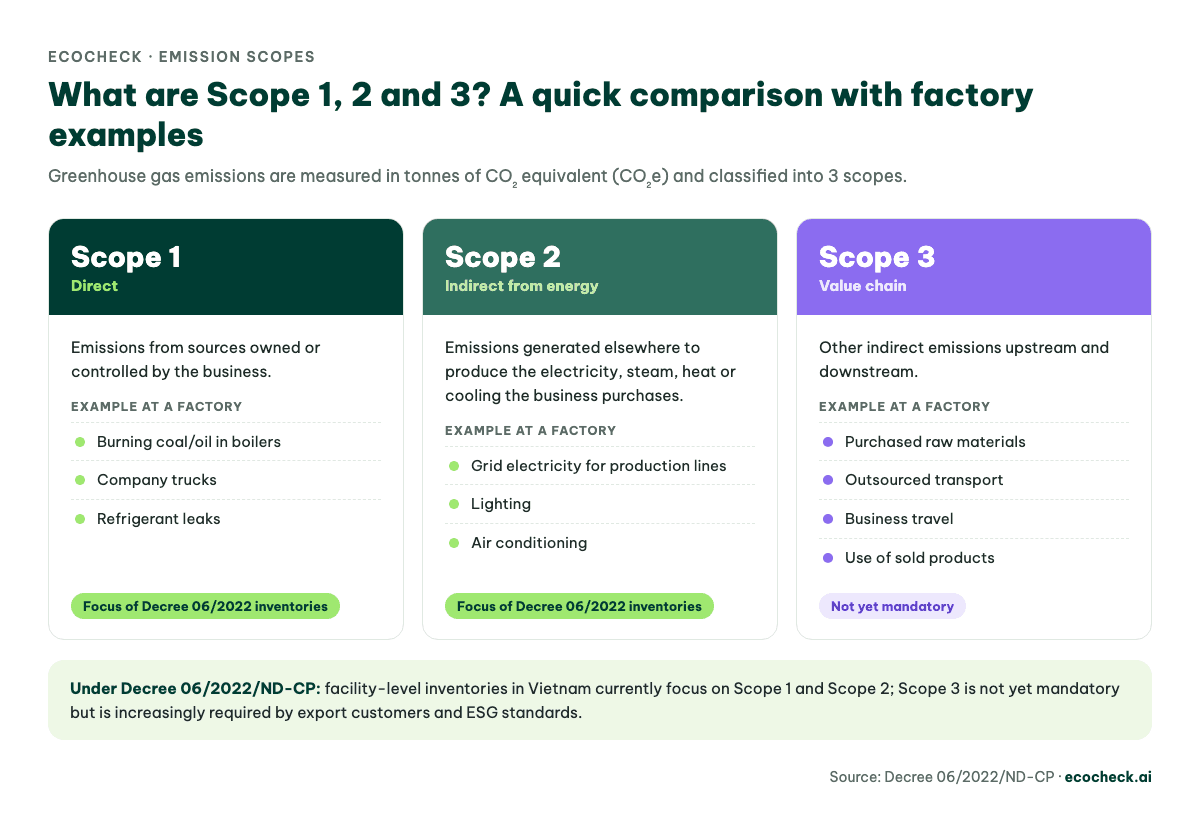
Figure 1: Comparison of Scope 1 (direct), Scope 2 (indirect from energy) and Scope 3 (value chain) emissions with factory examples
How to calculate emissions: formula and worked examples
The basic formula behind every inventory:
Emissions (tCO₂e) = Activity data × Emission factor × GWP
Example 1 — Scope 1: a factory burns 10,000 litres of diesel oil (DO) in a month. The activity data is 10,000 litres; multiplying by the emission factor for DO (kg CO₂/litre from the national factor list or IPCC) gives the direct CO₂ emissions.
Example 2 — Scope 2: a business consumes 500,000 kWh of grid electricity in a year. Multiplying by Vietnam's grid emission factor (kg CO₂/kWh, published annually by the Ministry) gives the indirect emissions from purchased electricity.
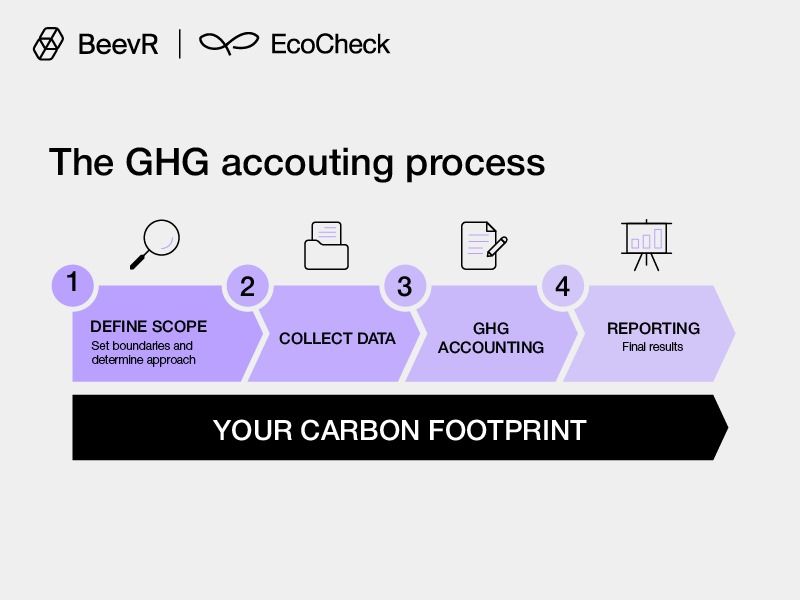
The entire process — from setting boundaries and collecting data to preparing the report in the prescribed template — is explained in our article 9 steps to conduct your own GHG inventory.
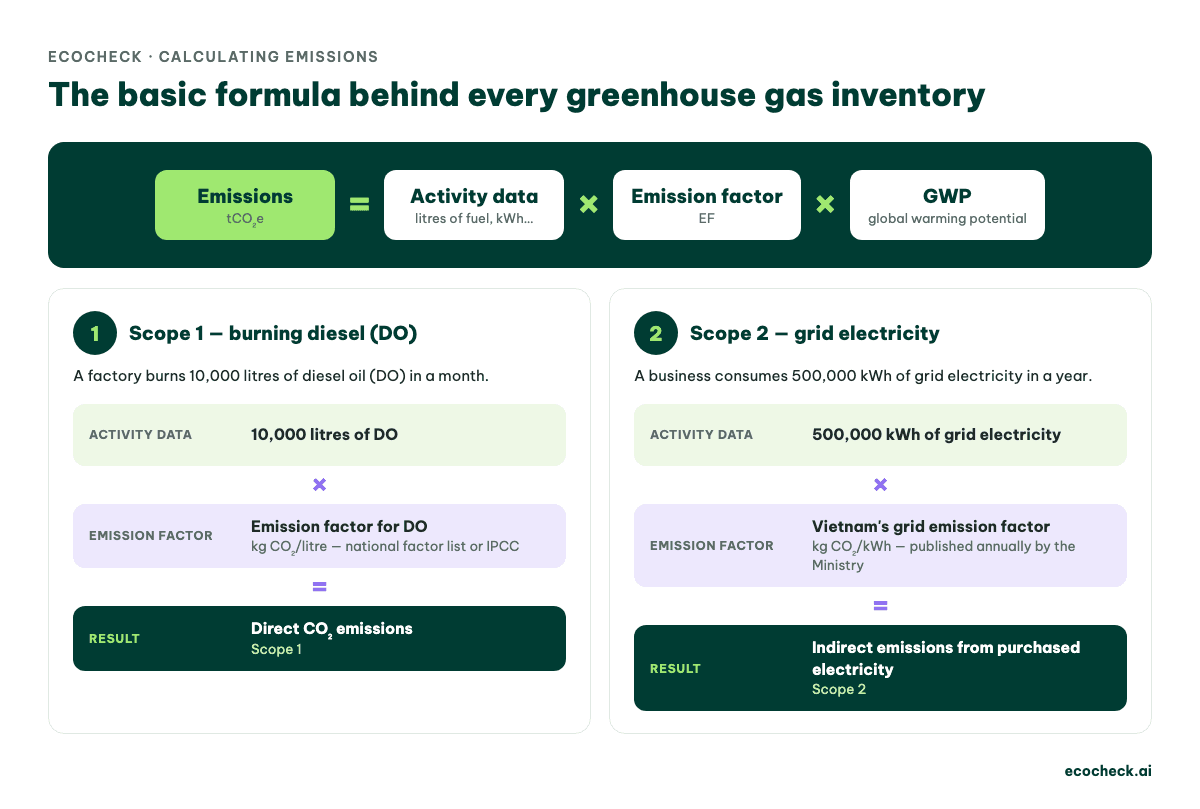
Figure 2: Emissions formula: Emissions (tCO₂e) = Activity data × Emission factor × GWP, with examples for Scope 1 burning 10,000 litres of diesel and Scope 2 using 500,000 kWh of grid electricity
What is the difference between direct and indirect emissions?
The difference lies in whether the emission source is under the business's control. Burning fuel on site is direct (Scope 1) — the business can act on it immediately by switching fuels or improving efficiency. Purchased electricity is indirect (Scope 2) — reduced through energy savings or switching to renewable energy. Classifying these two correctly determines whether an inventory report is accepted; see the full analysis in our article direct vs. indirect emissions explained.
Does your business have to report its emissions?
If a facility emits 3,000 tCO₂e/year or more, or consumes 1,000 TOE/year or more of energy (factories, commercial buildings, transport), or processes more than 65,000 tonnes of waste per year, it is required to conduct an inventory and submit a report every 2 years under Decree 06/2022/ND-CP (as amended by Decree 119/2025/ND-CP). See the list of facilities required to conduct an inventory and the full set of deadlines in our GHG inventory roadmap article.
EcoCheck helps businesses measure and manage emissions automatically using national and international standard emission factors (IPCC, GHG Protocol), producing reports ready for independent verification. Learn about the EcoCheck GHG inventory service.
Read more: What does GHG mean? A glossary of basic greenhouse gas inventory terms.
Once you can distinguish the emission scopes, the next step is a greenhouse gas inventory for your facility in line with the regulations and the mandatory roadmap.
Is your business on the mandatory list and in need of an end-to-end provider? See our GHG inventory service under ISO 14064, supporting you until your report passes verification.






![Top 5 Công Cụ Tính Toán Phát Thải Khí Nhà Kính [Cập Nhật 2026]](https://cms.ecocheck.ai/uploads/Eco_Check_Top_5_cong_cu_va_phan_mem_ho_tro_kiem_ke_khi_nha_kinh_d9d03bf693.png)
![Phương pháp Kiểm kê Khí nhà kính: GHG Protocol & ISO 14064 [2026]](https://cms.ecocheck.ai/uploads/Cac_phuong_phap_va_tieu_chuan_kiem_ke_khi_nha_kinh_pho_bien_e645f7df80.png)