What is VSME?
What does the VSME standard contain?
Which suppliers does the value chain cap apply to?
What data can EU buyers ask suppliers for?
What will textile, furniture and electronics suppliers be asked first?
What data should suppliers prepare for 2027?
Can you reuse your Vietnamese GHG inventory data?
How is VSME different from CBAM?
What should suppliers do before the end of 2026?
Frequently asked questions
Is VSME mandatory for Vietnamese companies?
Which regulation established VSME?
Can EU buyers require Scope 3 data?
What about factories with more than 1,000 employees?
Does the value chain cap apply to CBAM requests?
EU VSME Standard (2026/1560): What Vietnamese Suppliers Must Provide
VSME is the EU's voluntary sustainability reporting standard. It was set out in Commission Delegated Regulation (EU) 2026/1560 of 3 July 2026, published in the Official Journal on 21 September 2026, and in force since 24 September 2026. For financial years starting on or after 1 January 2027 it also works as a "value chain cap": when EU companies under mandatory reporting (CSRD) gather information for their sustainability report, they may not ask suppliers with an average of 1,000 employees or fewer for more than the datapoints listed in Annex II. For a Vietnamese supplier with more than 10 employees, that list covers total energy consumption (MWh), Scope 1 and location-based Scope 2 greenhouse gas emissions, water, waste, workforce and occupational safety. Scope 3 is not in the cap.
The good news is that European buyers will have to ask for less, and in a common format. The less good news is that whatever sits inside the cap will become the baseline every buyer asks for. This article explains what VSME is, who the value chain cap protects, what textile, furniture and electronics factories will be asked, and gives a checklist of the data to prepare for 2027.
What is VSME?
VSME (Voluntary Sustainability Reporting Standard) is a sustainability reporting standard for companies that are not required to report under the EU Accounting Directive (Directive 2013/34/EU). It builds on the VSME standard the European Commission recommended in 2025 (Recommendation (EU) 2025/1710 of 30 July 2025). Once Regulation 2026/1560 entered into force, that Recommendation stopped having legal effect.
Background: the Omnibus I package (Directive (EU) 2026/470 of 24 February 2026) narrowed CSRD to companies with net turnover above EUR 450 million and an average of more than 1,000 employees. Those companies must still report on their value chain. The value chain cap is there so that smaller suppliers are not buried in questionnaires.
What does the VSME standard contain?
The standard has two modules. A company chooses Option A (Basic Module only) or Option B (Basic and Comprehensive), and must comply with the chosen module in full.
The Basic Module covers B1–B2 (basis for preparation, practices and policies) and nine metric groups, B3–B11: energy and GHG emissions, pollution, biodiversity, water, waste, workforce, health and safety, pay and training, and corruption. The Comprehensive Module adds C1–C9, including GHG reduction targets (C3) and climate risks (C4).
B3 is the climate section. The company discloses total energy consumption in MWh and, where it can, splits it into electricity (as billed) and fuels, renewable and non-renewable. It also discloses GHG emissions in tCO₂e with reference to the GHG Protocol, covering Scope 1 and location-based Scope 2. If the three scopes are new to you, see what emissions are and how Scope 1, 2 and 3 differ.
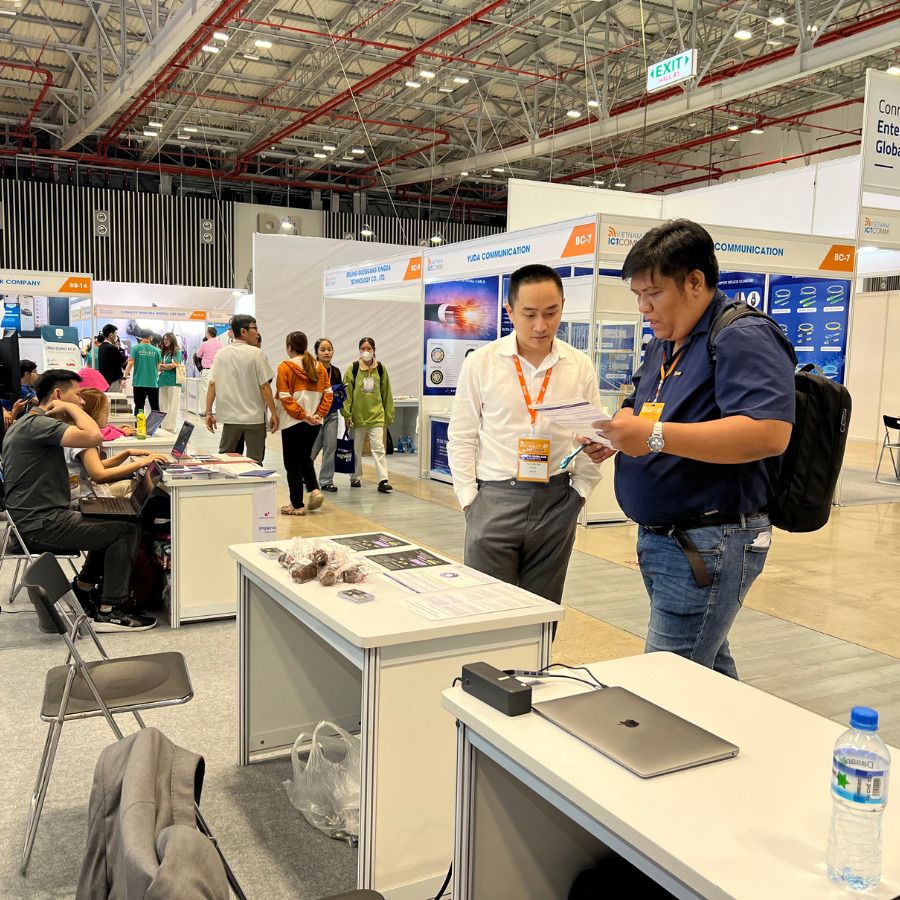
A meeting to discuss data with a customer
Which suppliers does the value chain cap apply to?
Under Article 1, the cap is the upper limit of information that CSRD reporters may require from undertakings in their value chain that had an average of no more than 1,000 employees during the preceding financial year, measured at the balance sheet date. The text sets no geographic limit, so Vietnamese suppliers are part of that value chain too. Under the Omnibus I Directive, buyers may rely on the supplier's self-declared size without further checks.
Three common misunderstandings:
- Factories with more than 1,000 employees are not protected. Many garment, footwear and electronics plants in Vietnam employ several thousand workers. Buyers can ask them for more than the VSME list.
- The cap only covers CSRD reporting. The Omnibus I Directive states that the cap does not affect information required under other EU law (CBAM, for example), due diligence obligations, or information a buyer gathers for its own risk management.
- The cap does not stop voluntary sharing. Suppliers can still send more, such as Scope 3 data or a product carbon footprint, if it helps win the order.
What data can EU buyers ask suppliers for?
Annex II sets two levels of cap: suppliers with 10 employees or fewer, and those with more than 10. Most export factories fall into the second group.
| Ref. | Datapoint in the cap | ≤ 10 employees | > 10 employees |
|---|---|---|---|
| B1 | Module option; individual or consolidated reporting; general information (legal form, NACE code, total assets, turnover, employees, country of operations, geolocation of sites) | Yes | Yes |
| B3 | Total energy consumption (MWh) | No | Yes |
| B3 | Estimated gross GHG emissions (Scope 1, location-based Scope 2) | No | Yes |
| B6 | Total water withdrawal | No | Yes |
| B7 | Whether circular economy principles are applied; total waste (hazardous, non-hazardous); share recycled or reused | No | Yes |
| B8 | Employees by contract type and by gender | Yes | Yes |
| B9 | Number and rate of recordable work-related accidents | Yes | Yes |
| B10 | Pay at or above minimum wage; share of employees under collective bargaining agreements; average training hours | Yes | Yes |
| C1 | Main product groups, main markets, main business relationships | No | Yes |
| C5–C7 | Employee turnover rate; code of conduct or human rights policy; complaints-handling mechanism; confirmed human rights incidents | No | Yes |
What is not in the cap: Scope 3, GHG reduction targets (C3), climate risks (C4), pollutant emissions (B4) and biodiversity (B5). The standard gives voluntary guidance on Scope 3 and notes that manufacturing, agrifood, construction and packaging companies are likely to have significant Scope 3 categories. The cap is a ceiling, not a requirement: the Regulation's recitals say buyers should only ask for what they actually need.
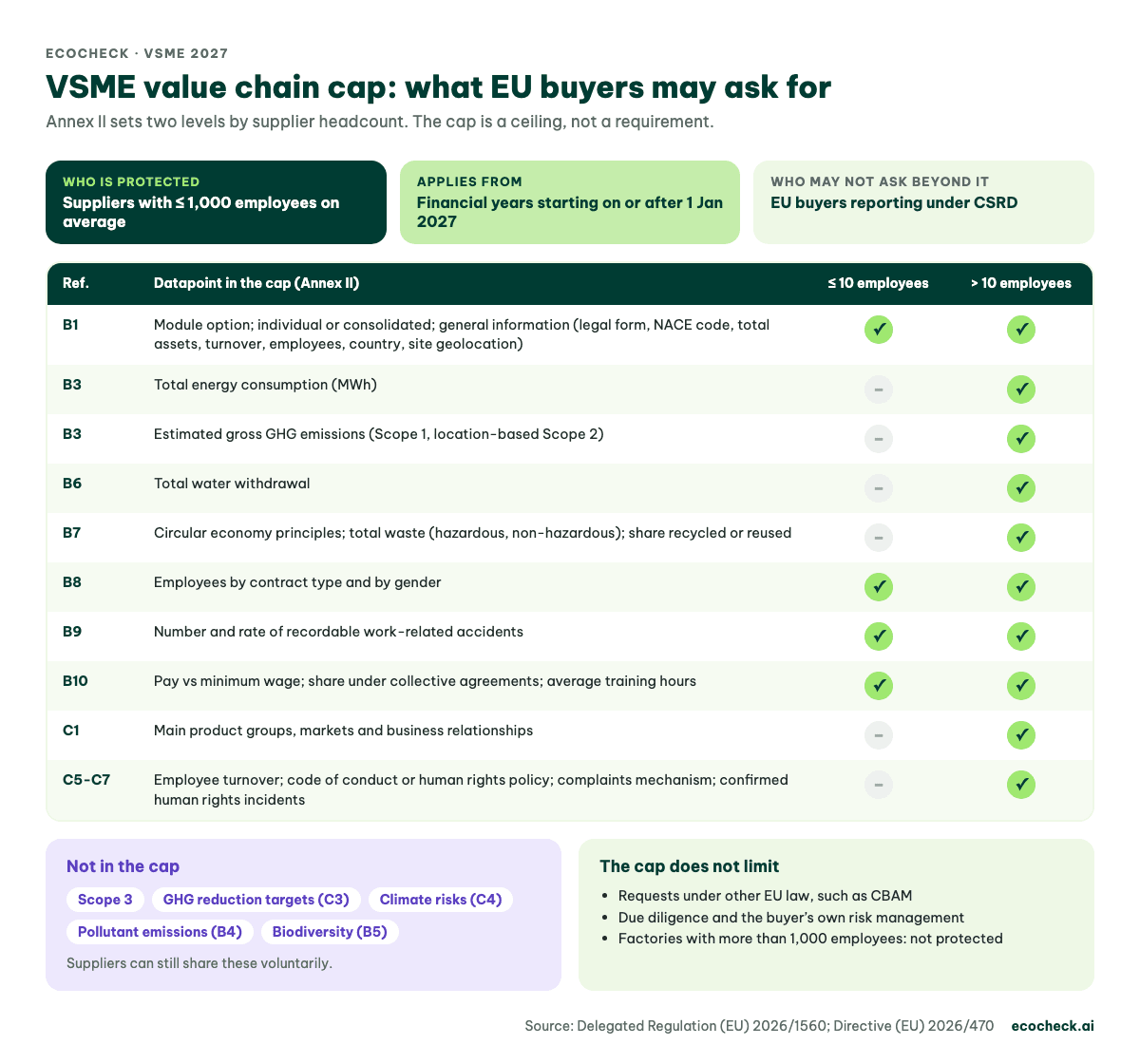
Figure 1: VSME value chain cap table under Annex II: datapoints EU buyers may request from suppliers with 10 or fewer and more than 10 employees, plus items outside the cap such as Scope 3
What will textile, furniture and electronics suppliers be asked first?
The climate section (B3) is almost certain to be requested, because a supplier's Scope 1 and 2 feed into the buyer's Scope 3. Each sector also has its own hotspots:
| Sector | Main energy and emission sources | Hardest data to produce |
|---|---|---|
| Textiles, dyeing, footwear | Electricity; steam from coal or biomass boilers, or bought from the industrial park | Boiler fuel and purchased steam; water and wastewater; work accidents; collective agreements |
| Wood furniture | Electricity; kilns fired with wood waste or biomass; diesel or LPG forklifts | Mass of wood waste burned; hazardous waste (paint, solvents); recycling rate |
| Electronics, components | Mostly electricity; backup generators; possibly fluorinated gases in production | Splitting electricity by line when serving several customers; refrigerant and fluorinated gas leaks |
For electricity, location-based Scope 2 means multiplying consumption by the national grid emission factor. The latest official factor and how to apply it are covered in Vietnam's grid emission factor.
What data should suppliers prepare for 2027?
The checklist follows the cap for companies with more than 10 employees. Every line needs source documents.
- General information (B1): legal form, sector code, total assets, turnover, headcount, address and coordinates of each factory and warehouse. Decide whether to report per legal entity or consolidated for the group.
- Energy (B3): monthly electricity from bills (kWh); fuels by type (diesel, petrol, LPG, gas, coal, biomass) from stock records; purchased steam; self-consumed rooftop solar. Convert everything to MWh.
- Emissions (B3): Scope 1 from fuel combustion, company vehicles and refrigerant leaks; location-based Scope 2 from purchased electricity and steam. Record each factor and its source.
- Water (B6): total water withdrawn or bought, from meters and bills.
- Waste (B7): hazardous and non-hazardous waste from handover records with collectors; the share recycled or reused.
- Workforce and policies (B8–B10, C5–C7): employees by contract and gender; work accidents; pay versus the regional minimum wage; collective agreements; training hours; turnover; code of conduct and complaints channel.
From the second reporting year VSME requires comparative figures for the previous year, so lock down your 2026 baseline now.
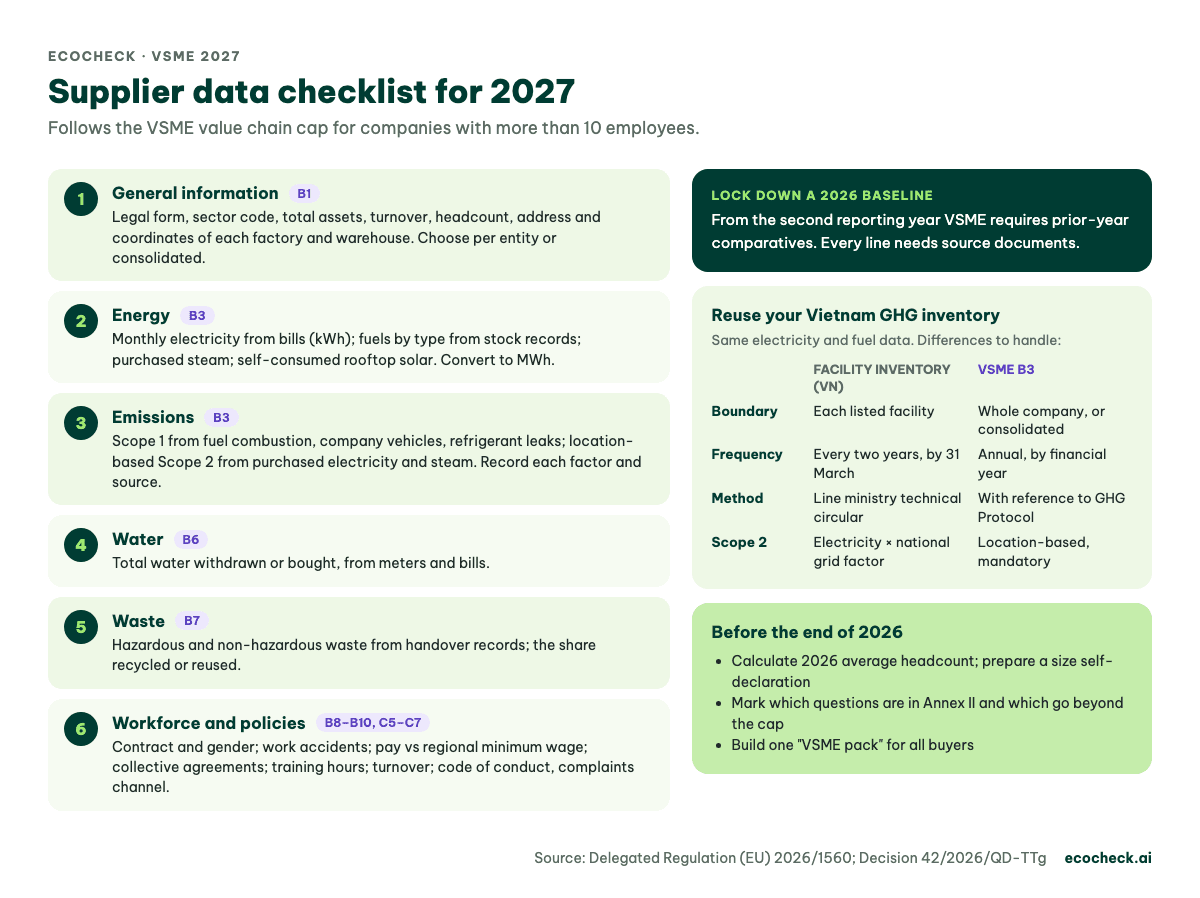
Figure 2: Checklist of six data groups suppliers with more than 10 employees should prepare for 2027 under VSME (B1, B3, B6, B7, B8–B10, C5–C7) and how a facility GHG inventory differs from VSME B3
Can you reuse your Vietnamese GHG inventory data?
Mostly, yes. If your plant is among the 2,441 facilities listed under Decision 42/2026/QD-TTg, you must file a facility-level inventory report with the provincial People's Committee by 31 March 2027, covering 2025 and 2026. The activity data (electricity, fuels) is the same set. The differences to handle:
| Criterion | Facility inventory (Vietnam) | VSME B3 (EU buyer) |
|---|---|---|
| Boundary | Each listed facility | Whole company, or consolidated if chosen |
| Frequency | Every two years, filed by 31 March | Annual, by financial year |
| Method | Technical circular of the line ministry | With reference to the GHG Protocol Corporate Standard |
| Scope 2 | Electricity × national grid factor | Location-based, mandatory |
If your plant is not on the list, you still need Scope 1 and 2 to answer buyers. Start with the Scope 1 and 2 emissions calculator, or check your domestic obligations with the GHG inventory lookup tool.
How is VSME different from CBAM?
CBAM is a separate legal obligation for iron and steel, aluminium, cement, fertilisers, hydrogen and electricity, and it calculates emissions per tonne of product. VSME covers the whole company and serves sustainability reporting only. The value chain cap does not limit CBAM requests. See CBAM 2027: what Vietnamese exporters need to do.
What should suppliers do before the end of 2026?
- Calculate your 2026 average headcount to see whether the cap protects you, and prepare a size self-declaration.
- Review the questionnaires you receive: mark which questions are in Annex II and which go beyond the cap. For those beyond it, ask the buyer what the data is for (CSRD, CBAM, due diligence or risk management).
- Lock down 2026 energy and emissions data by month, with documents. This is also the data for the inventory report filed in 2027.
- Build one "VSME pack" for all buyers instead of filling in each questionnaire separately.
- Consider voluntary Scope 3 if a major buyer is setting climate targets for suppliers. See what Scope 3 emissions are.
Next step: EcoCheck calculates Scope 1, Scope 2 and total energy in the VSME B3 format, using the same data set as your inventory report to the province. See the GHG inventory service, or the ESG reporting service if buyers also ask for workforce and governance data. For a starting point, read ESG consulting for SMEs in Vietnam.
Frequently asked questions
Is VSME mandatory for Vietnamese companies?
No. VSME is voluntary. But from financial year 2027 it caps what CSRD-reporting EU buyers may require from suppliers with 1,000 employees or fewer, so many questionnaires will follow it.
Which regulation established VSME?
Commission Delegated Regulation (EU) 2026/1560, adopted on 3 July 2026, published in the Official Journal on 21 September 2026 and in force from 24 September 2026. The value chain cap applies to financial years starting on or after 1 January 2027.
Can EU buyers require Scope 3 data?
Not for CSRD reporting purposes, if the supplier has 1,000 employees or fewer. Scope 3 is not in Annex II. Suppliers can still provide it voluntarily.
What about factories with more than 1,000 employees?
The cap does not protect them. Buyers can ask for more than the VSME list.
Does the value chain cap apply to CBAM requests?
No. The cap only covers information gathered for sustainability reporting under the EU Accounting Directive. It does not affect obligations under other EU law such as CBAM.




![Top 5 Công Cụ Tính Toán Phát Thải Khí Nhà Kính [Cập Nhật 2026]](https://cms.ecocheck.ai/uploads/Eco_Check_Top_5_cong_cu_va_phan_mem_ho_tro_kiem_ke_khi_nha_kinh_d9d03bf693.png)
![Phương pháp Kiểm kê Khí nhà kính: GHG Protocol & ISO 14064 [2026]](https://cms.ecocheck.ai/uploads/Cac_phuong_phap_va_tieu_chuan_kiem_ke_khi_nha_kinh_pho_bien_e645f7df80.png)