What does the draft replacing Circular 96/2020 say about ESG?
Who must disclose ESG information?
When will it apply? Timeline so far
What does Circular 96/2020 require today, and what changes?
What does "disclose or explain" mean in practice?
How should you prepare Scope 1 and 2 emissions data?
Public companies already doing a GHG inventory: how to reuse the data?
What should companies do now?
Frequently asked questions
Is ESG disclosure mandatory for public companies in Vietnam?
When will the circular replacing Circular 96/2020 take effect?
Does the draft require Scope 1 and 2 emissions?
What does "disclose or explain" mean?
Must the ESG report be separate from the annual report?
Will the annual report deadline change?
Vietnam ESG Disclosure for Public Companies: Draft to Replace Circular 96/2020
Vietnam's Ministry of Finance is consulting on a draft circular on information disclosure in the securities market, which will replace Circular 96/2020/TT-BTC. The draft proposes that public companies prepare and publish sustainability information on environmental, social and governance (ESG) matters at the same time as their annual report. It uses a "disclose or explain" mechanism. Where a company cannot disclose an indicator, it must give the reason and a plan to disclose it in the next period. As of 07/10/2026 the text is still a draft with no effective date. The ESG indicator template (Appendix V) has not been released with the draft. For most companies, the first climate metric to prepare is Scope 1 and Scope 2 greenhouse gas emissions.
Legal status checked on 07/10/2026. This article will be updated when the circular is signed.
What does the draft replacing Circular 96/2020 say about ESG?
The State Securities Commission (SSC) drafted the circular for the Ministry of Finance. According to Vietstock (28/09/2026), the draft has 10 chapters, 47 articles and 22 annexes. The main ESG points reported so far:
- New obligation: public companies "must prepare and disclose sustainability information covering environmental, social and governance (ESG) factors" (Báo Đầu tư and Tinnhanhchungkhoan, 29/09/2026).
- Timing: published together with the annual report. A company may prepare a standalone sustainability report or include it in the annual report. A standalone report must still follow the prescribed template (Báo Xây dựng, 01/10/2026).
- Template: Appendix V. This appendix was not attached to the consultation draft (Báo Xây dựng).
- Reference standards: according to Vietstock, the ESG obligation draws on international standards such as ISSB and IFC and covers four areas: Governance, Strategy, Risk Management, and Metrics and Targets. Báo Chính phủ only says the rules "gradually approach international practice".
- Disclose or explain: "Where a company has not disclosed one or more indicators, it must state the reasons, causes, and a plan and roadmap for implementation" (Báo Chính phủ, 05/10/2026).
Who must disclose ESG information?
According to reports on the draft, the duty to prepare and publish ESG information applies to public companies. The circular's overall scope is wider. According to Báo Chính phủ, it covers public companies, issuers, securities companies, fund management companies, public funds, insiders, major shareholders, the Vietnam Securities Clearing Corporation (VSC) and intermediaries involved in clearing and settlement. We could not confirm whether the ESG duty extends beyond public companies, or whether it is tiered by company size.
Public companies include listed companies, companies registered for trading on UPCoM and unlisted public companies. Many mid-sized manufacturers, not only large groups, would therefore be covered if the draft is adopted as written.

A team reviewing reports and data
When will it apply? Timeline so far
| Date | Event | Status |
|---|---|---|
| 01/01/2021 | Circular 96/2020/TT-BTC takes effect; still in force | In force |
| 28–29/09/2026 | Press reports on the replacement draft, with a separate ESG annex | Draft |
| Before 07/10/2026 | Comment deadline, comments to the SSC (per Báo Xây dựng) | Draft |
| 05/10/2026 | Báo Chính phủ publishes the main points of the draft | Draft |
| Not announced | Signing date, effective date, first reporting year for ESG | – |
| 01/01/2027 (proposed) | Periodic disclosure in English for the expanded group (securities companies, fund managers, public funds, VSC, payment members) (per Vietstock) | Draft |
| 01/01/2028 (proposed) | By this date at the latest, all covered entities must fully meet English-language disclosure duties, including extraordinary disclosures (Báo Chính phủ) | Draft |
If the circular is signed in 2026 or early 2027, the annual report for financial year 2026 or 2027 could be the first to use the new ESG template. This is our inference, not a date in the text.
What does Circular 96/2020 require today, and what changes?
Circular 96/2020 is not silent on the environment. Its annual report template (Appendix IV) already has a section on environmental and social impact, including "total direct and indirect greenhouse gas (GHG) emissions", direct and indirect energy use, and water use and recycling. Even so, according to Tinnhanhchungkhoan, Circular 96 has no standalone ESG disclosure duty, so many companies have not reported this content.
| Item | Circular 96/2020 (current) | Replacement draft |
|---|---|---|
| Where ESG information sits | One section of the annual report template | A separate duty and template (Appendix V); standalone report or within the annual report |
| Greenhouse gases | A line for "total direct and indirect GHG emissions", no method specified | Specific indicators not yet published (Appendix V not attached) |
| Reference framework | None stated | Per Vietstock: ISSB and IFC, four pillars of Governance, Strategy, Risk Management, and Metrics and Targets |
| Missing indicators | No clear mechanism | State reasons, causes, a plan and a roadmap for the next period |
| Annual report deadline | 20 days after the audited annual financial statements are published, no later than 110 days after year-end | 120 days after financial year-end |
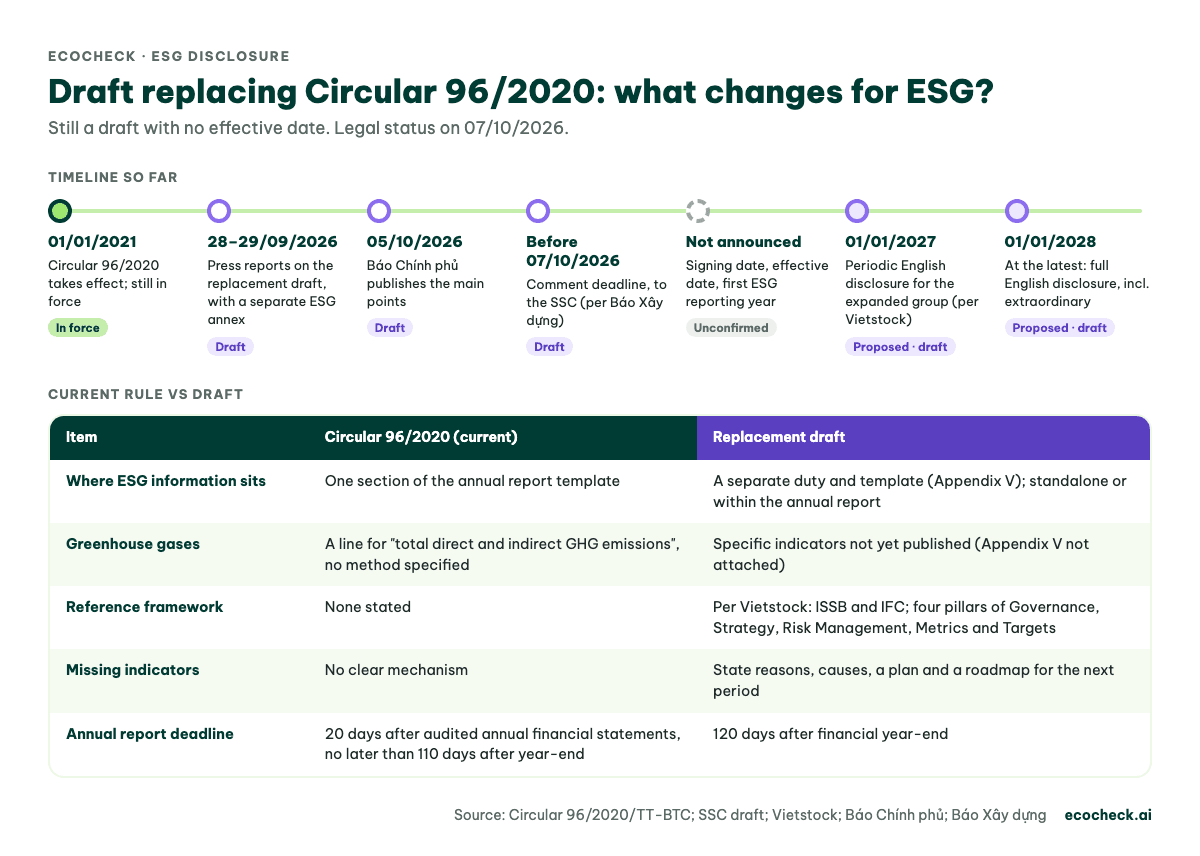
Figure 1: Timeline of the draft circular replacing Circular 96/2020 and a comparison of current and draft ESG disclosure rules: Appendix V, greenhouse gases, ISSB and IFC framework, disclose or explain, 120-day annual report deadline
What does "disclose or explain" mean in practice?
"Disclose or explain" is not permission to skip. Under the draft, a company that does not disclose an indicator must do three things: give the reason, give the cause, and set out a plan and roadmap to disclose in the next period. The first explanation therefore commits the company for the following year. Investors and banks will compare companies in the same sector, and explaining year after year is likely to count against a company's governance rating.
On the other hand, an emissions figure with no method or records behind it can be seen as greenwashing. See greenwashing risks in emissions reporting. The safe approach is to disclose fewer indicators with solid evidence, plus a clear roadmap for the rest.
How should you prepare Scope 1 and 2 emissions data?
If Appendix V follows ISSB, as Vietstock describes, its "Metrics and Targets" section will be close to IFRS S2 on climate. IFRS S2 requires gross Scope 1, 2 and 3 emissions measured under the GHG Protocol, with relief for Scope 3 in the first year of application. Scope 1 and 2 are therefore what companies should prepare first. The scopes are explained in Scope 1, 2, 3 GHG emissions.
A minimum climate dataset for financial year 2026:
| Metric | Input data | Evidence |
|---|---|---|
| Scope 1 emissions (tCO₂e) | Diesel, petrol, LPG, coal, gas; refrigerant top-ups; process emissions (if any) | Fuel invoices, stock issue slips, air-conditioning maintenance logs |
| Scope 2 emissions (tCO₂e) | Grid electricity (kWh), purchased steam or heat | 12 months of electricity bills; the Vietnam grid emission factor for the year |
| Energy use | Total energy (GJ or MWh), share of renewables | Invoices, rooftop solar meters, power purchase contracts |
| Emissions intensity | tCO₂e per unit of revenue or per unit of product | Financial statements, production data |
| Method | Standard used (GHG Protocol, ISO 14064-1, national guidance), organisational boundary, factor sources | Internal methodology file |
| Targets | Base year, reduction target, action plan | Board resolution or decision |
You can run a first estimate of Scope 1 and 2 with the free GHG emissions calculator to get a baseline before commissioning independent assurance.
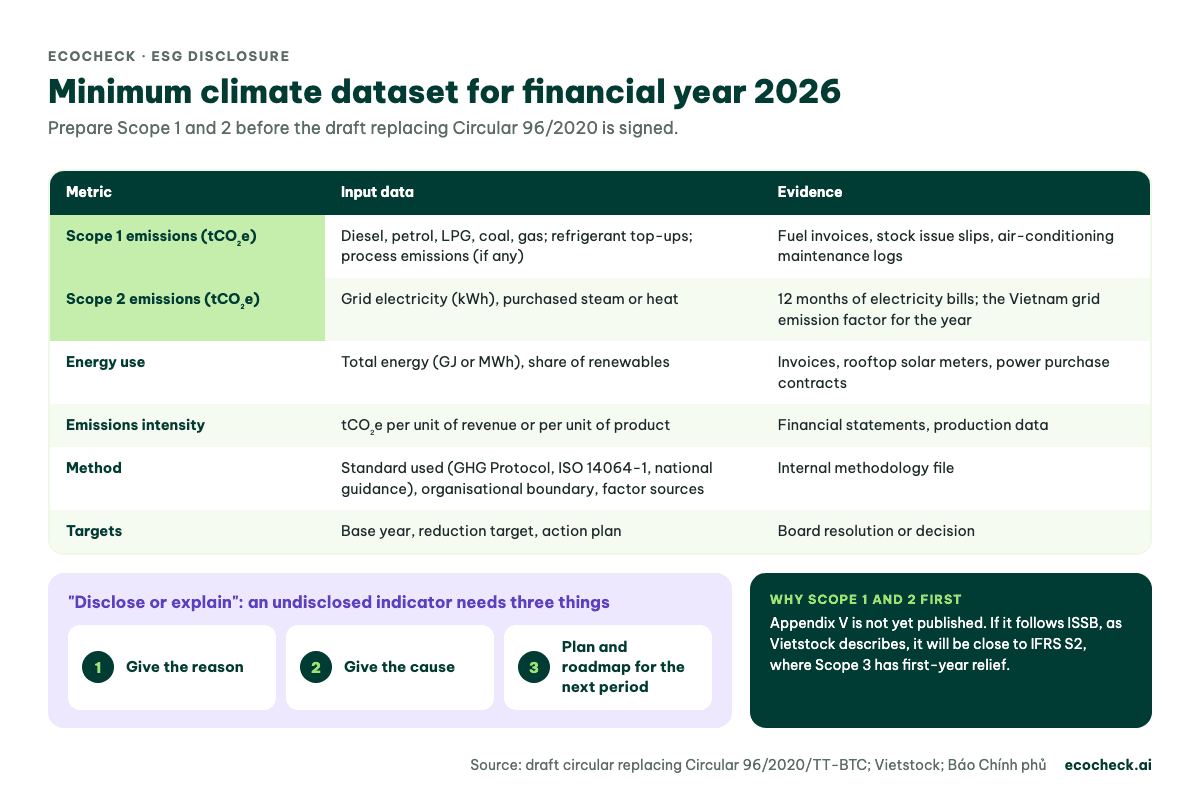
Figure 2: Minimum climate dataset for financial year 2026: Scope 1 and Scope 2 emissions, energy use, emissions intensity, method and targets, with the input data and evidence needed
Public companies already doing a GHG inventory: how to reuse the data?
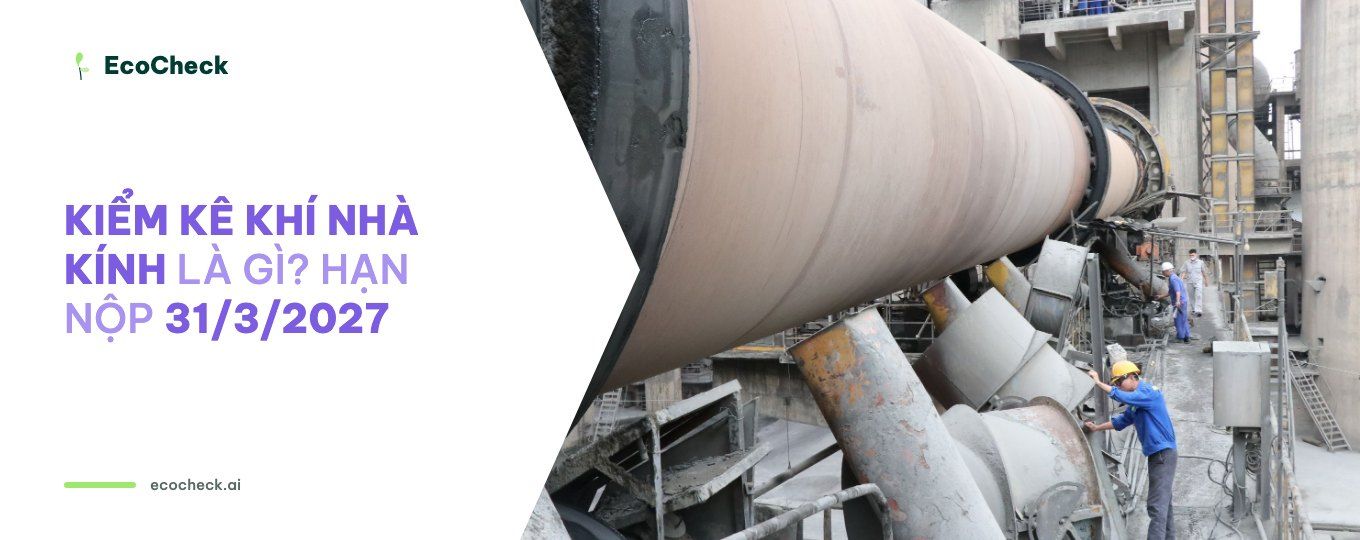
Many public companies in steel, cement, thermal power, textiles and food have plants on the Decision 42/2026/QD-TTg list. These plants must file a facility-level inventory report with the provincial People's Committee before 31/03/2027. The 110 facilities with allowances instead send a verified report to the Ministry of Agriculture and Environment before 01/12/2027. The fuel and electricity data behind the inventory are the same inputs as the ESG indicators. The two reports still differ:
- Boundary: the Decree 06/2022 inventory is per facility. An ESG report covers the whole company or group, including offices, warehouses, branches and subsidiaries.
- Period: the facility inventory is every two years. An ESG report needs data for every financial year. The debate on frequency is covered in the 2026–2030 compliance calendar.
- Factors and method: use one set of factors for both reports so the figures match when compared.
What should companies do now?
- Assign an owner. ESG under the securities rules is a disclosure duty, so finance, investor relations and EHS all need to be involved.
- Keep complete 2026 energy and fuel records before the books close at year-end.
- Calculate Scope 1 and 2 for 2025 and 2026 to establish a base year and a trend.
- Draft the explanations for indicators you do not yet have, such as Scope 3 and climate scenario analysis, with a concrete roadmap.
- Watch for the signed circular and Appendix V and recheck your indicator list.
For budgeting, see ESG report cost in Vietnam 2026. Smaller companies can start with ESG consulting for SMEs. If you need one provider for the ESG report and well-evidenced emissions data, see EcoCheck's ESG reporting service and GHG inventory service. For an overview of GHG inventories, read EcoCheck Greenhouse Gas Inventory Service.
Frequently asked questions
Is ESG disclosure mandatory for public companies in Vietnam?
Under the draft circular replacing Circular 96/2020, yes. Public companies would prepare and publish sustainability (ESG) information together with the annual report, on a disclose-or-explain basis. As of 07/10/2026 this is still a draft and not in force.
When will the circular replacing Circular 96/2020 take effect?
Not yet announced. Comments on the draft were due before 07/10/2026 (per Báo Xây dựng). The signing and effective dates will be added when the Ministry of Finance issues it.
Does the draft require Scope 1 and 2 emissions?
Not yet clear. The indicator template (Appendix V) was not attached to the consultation draft. Circular 96 already has a line for total direct and indirect GHG emissions. If the new template follows ISSB, Scope 1 and 2 are almost certain to be among the climate indicators.
What does "disclose or explain" mean?
For any indicator it cannot disclose, a company must state the reasons, causes, and a plan and roadmap to disclose it in the next reporting period.
Must the ESG report be separate from the annual report?
No. Under the draft, a company may prepare a standalone sustainability report or include it in the annual report, but the content must follow the prescribed template.
Will the annual report deadline change?
The draft proposes 120 days after financial year-end. The current rule is 20 days after the audited annual financial statements are published, and no later than 110 days after year-end.



![Top 5 Công Cụ Tính Toán Phát Thải Khí Nhà Kính [Cập Nhật 2026]](https://cms.ecocheck.ai/uploads/Eco_Check_Top_5_cong_cu_va_phan_mem_ho_tro_kiem_ke_khi_nha_kinh_d9d03bf693.png)
![Phương pháp Kiểm kê Khí nhà kính: GHG Protocol & ISO 14064 [2026]](https://cms.ecocheck.ai/uploads/Cac_phuong_phap_va_tieu_chuan_kiem_ke_khi_nha_kinh_pho_bien_e645f7df80.png)